
Juno (spacecraft)
NASA solar-powered probe orbiting Jupiter since 2016.

NASA/JPL-Caltech · Public domain
Juno is a NASA space probe orbiting the planet Jupiter, built by Lockheed Martin and operated by NASA's Jet Propulsion Laboratory. Launched on August 5, 2011, as part of the New Frontiers program, it entered a polar orbit of Jupiter on July 5, 2016, to study the planet's composition, gravitational field, magnetic field, and polar magnetosphere. Juno is the second spacecraft to orbit Jupiter, after the Galileo orbiter, and is notable for being the first outer Solar System probe powered by solar panels rather than radioisotope thermoelectric generators.
Quick Facts
- Names List
- New Frontiers 2
- Mission Type
- Jupiter orbiter
- Operator
- NASAJet Propulsion Laboratory
- Cospar Id
- 2011-040A
- Satcat
- 37773
- Manufacturer
- Lockheed Martin Space
- Launch Mass
- 3625 kg
- Dry Mass
- 1593 kg
- Dimensions
- 20.1 xx
- Power
- 14 kW at Earth, 435 W at Jupiter / 2 × 60-ampere hour, 28 Volt lithium-ion batteries
- Launch Date
- August 5, 2011, 16:25:00 UTC
- Launch Rocket
- Atlas V 551 (AV-029)
Facts from the source article.
Lore & Background
Juno's name comes from Greek and Roman mythology: the god Jupiter drew a veil of clouds to hide his mischief, and his wife Juno could peer through them to reveal his true nature. A NASA compilation referred to the mission by the backronym Jupiter Near-polar Orbiter, but the project itself consistently describes it as a name with mythological associations, not an acronym. Juno is sometimes called New Frontiers 2, but is not to be confused with New Horizons 2, a proposed but unselected New Frontiers mission.
Reader's Guide
Juno's significance lies in its unprecedented study of Jupiter's deep atmosphere, gravitational and magnetic fields, and polar magnetosphere, providing clues about the planet's formation, including whether it has a rocky core and the amount of water present. Its measurements of deep winds, which can reach 620 km/h, and thermal radiation from within the atmosphere complement earlier observations. Juno is also notable for being the first outer Solar System probe powered by solar panels, requiring the three largest solar panel wings ever deployed on a planetary probe at launch. The spacecraft's extended mission, approved until contact is lost, allows exploration of Jovian rings and inner moons, areas not well explored. Juno's legacy includes demonstrating the viability of solar power far from the Sun and providing data that will inform understanding of giant planet formation and evolution.
Did You Know?
- Juno's solar panels are the three largest ever deployed on a planetary probe at the time of launching.
- The spacecraft's name comes from Roman mythology, where the goddess Juno could see through clouds hiding her husband Jupiter.
- Juno's deep winds can reach speeds up to 620 km/h (390 mph).
Scientific Mandate and Deep-Atmosphere Probing
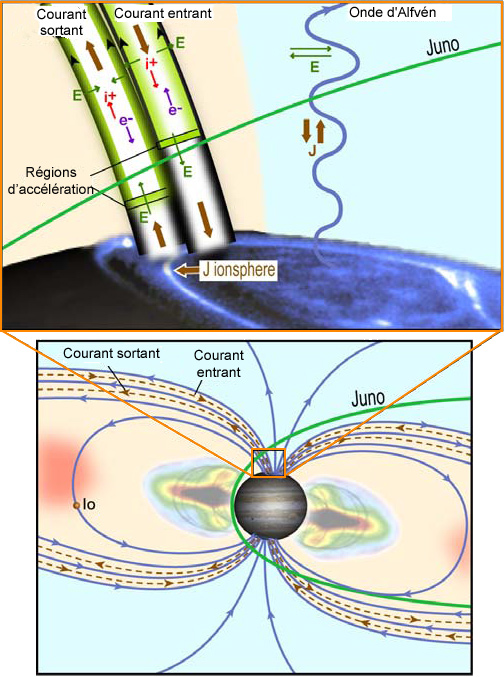
Juno's primary scientific mandate centers on unraveling Jupiter's hidden interior and atmospheric dynamics. The spacecraft carries infrared and microwave instruments designed to detect thermal radiation rising from deep within the planet's atmosphere, allowing scientists to assess the abundance and spatial distribution of water—and by extension oxygen—thereby shedding light on Jupiter's formative history. A key question the mission tackles is whether the gas giant harbors a rocky core at all, alongside measuring the planet's mass distribution and the ferocious deep winds that can top 620 kilometers per hour. Beyond composition, Juno maps the gravitational field, the magnetic field, and the polar magnetosphere, while also investigating the convection processes that drive Jupiter's natural atmospheric circulation patterns. In its extended phase, the probe's focus shifts toward the poorly explored region of the Jovian rings and inner moons, with planned close flybys of Thebe, Amalthea, Adrastea, and Metis, broadening the mission's reach well beyond the planet itself.
A Five-Year Odyssey and an Extended Life
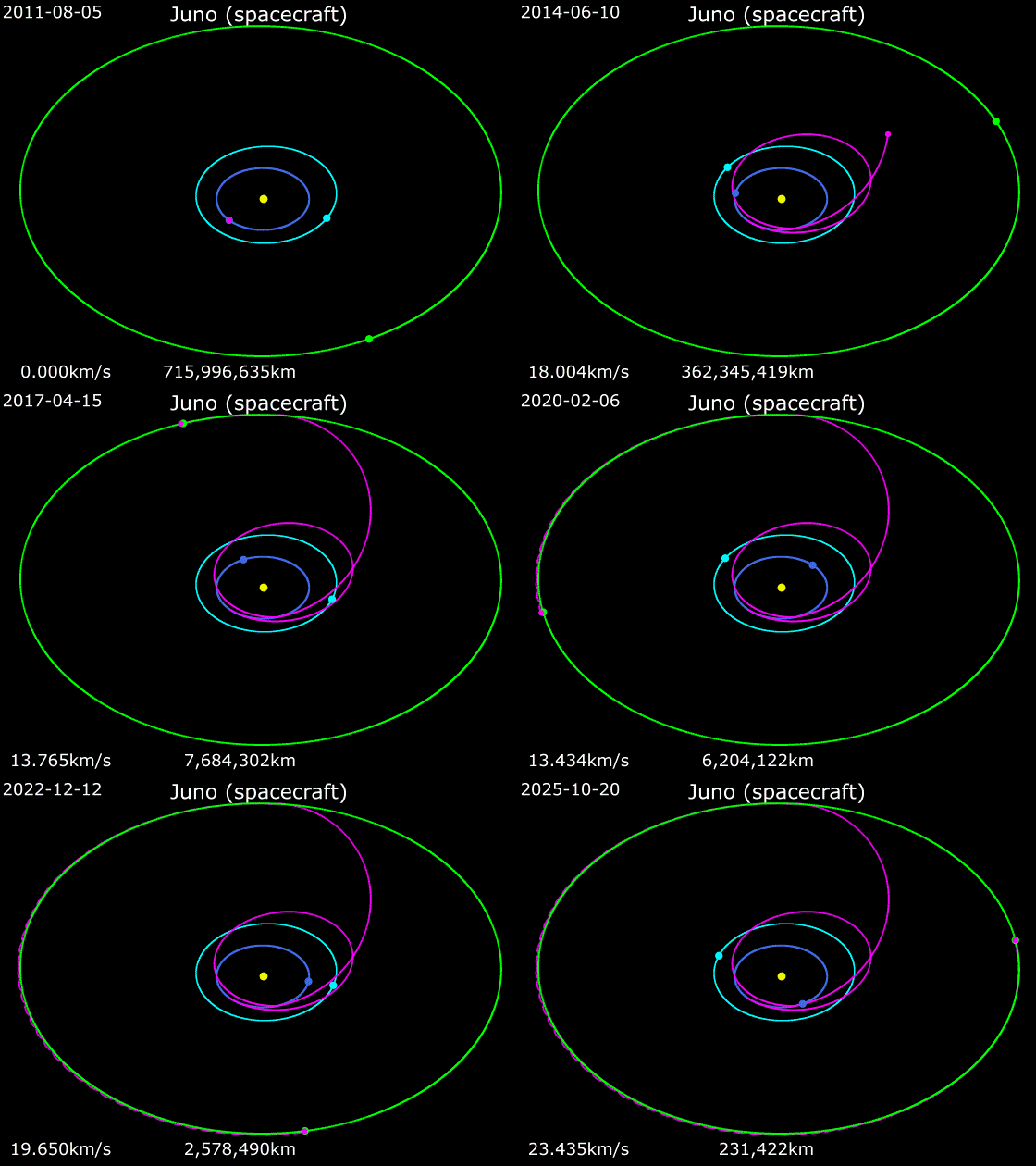
Juno's path from Earth to Jupiter spanned roughly five years and nearly 2.8 billion kilometers. After its August 2011 launch, the spacecraft executed a gravity-assist flyby of Earth in October 2013 to gain additional velocity before arriving at the gas giant on July 5, 2016, when it fired its main engine to be captured into a 53-day polar orbit. The original plan called for 37 orbits over twenty months, followed by a second burn to shorten the period to fourteen days. However, a suspected issue with the main engine led to the cancellation of that December 2016 maneuver, leaving Juno in its longer orbit. The extended mission, inaugurated by a Ganymede flyby in June 2021, subsequently used close encounters with Europa and Io to gradually reduce the orbital period to thirty-three days by early 2024. Rather than the originally intended deorbit into Jupiter's atmosphere, the spacecraft has been approved to keep orbiting until radio contact is lost. As of August 2026, Juno remains fully operational and in communication with Earth via the Deep Space Network.
Solar Power in the Outer Dark
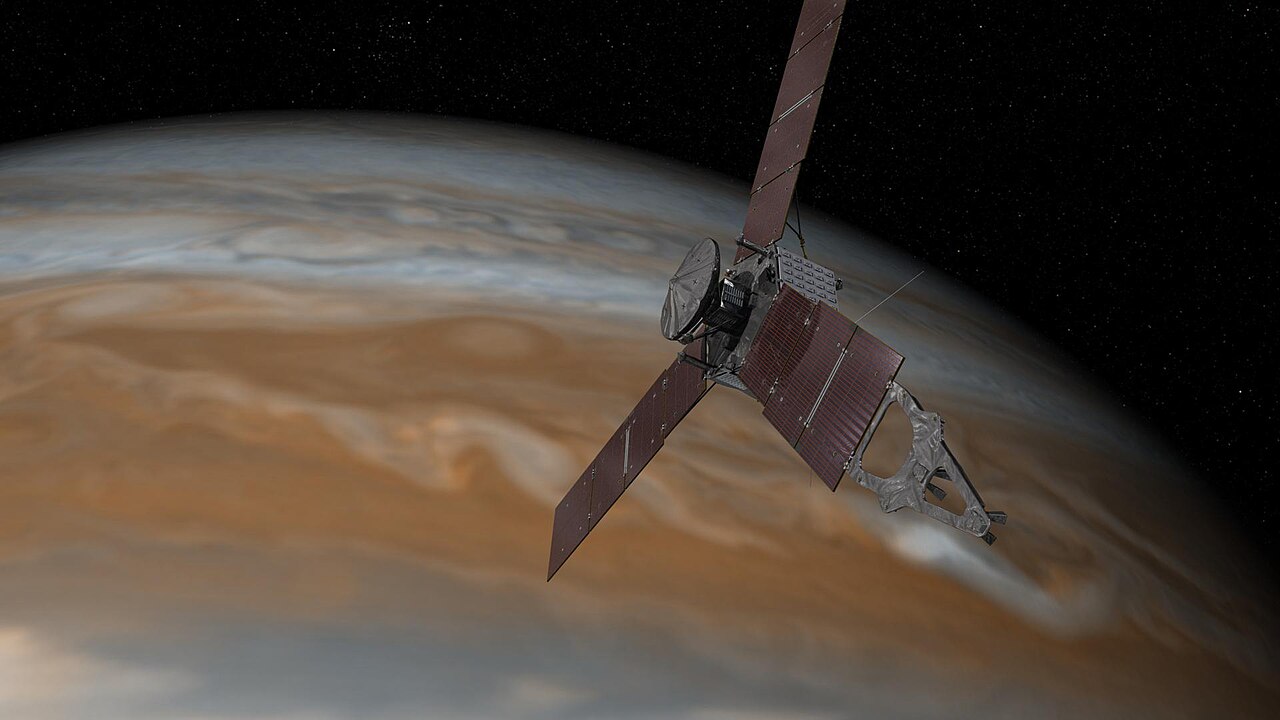
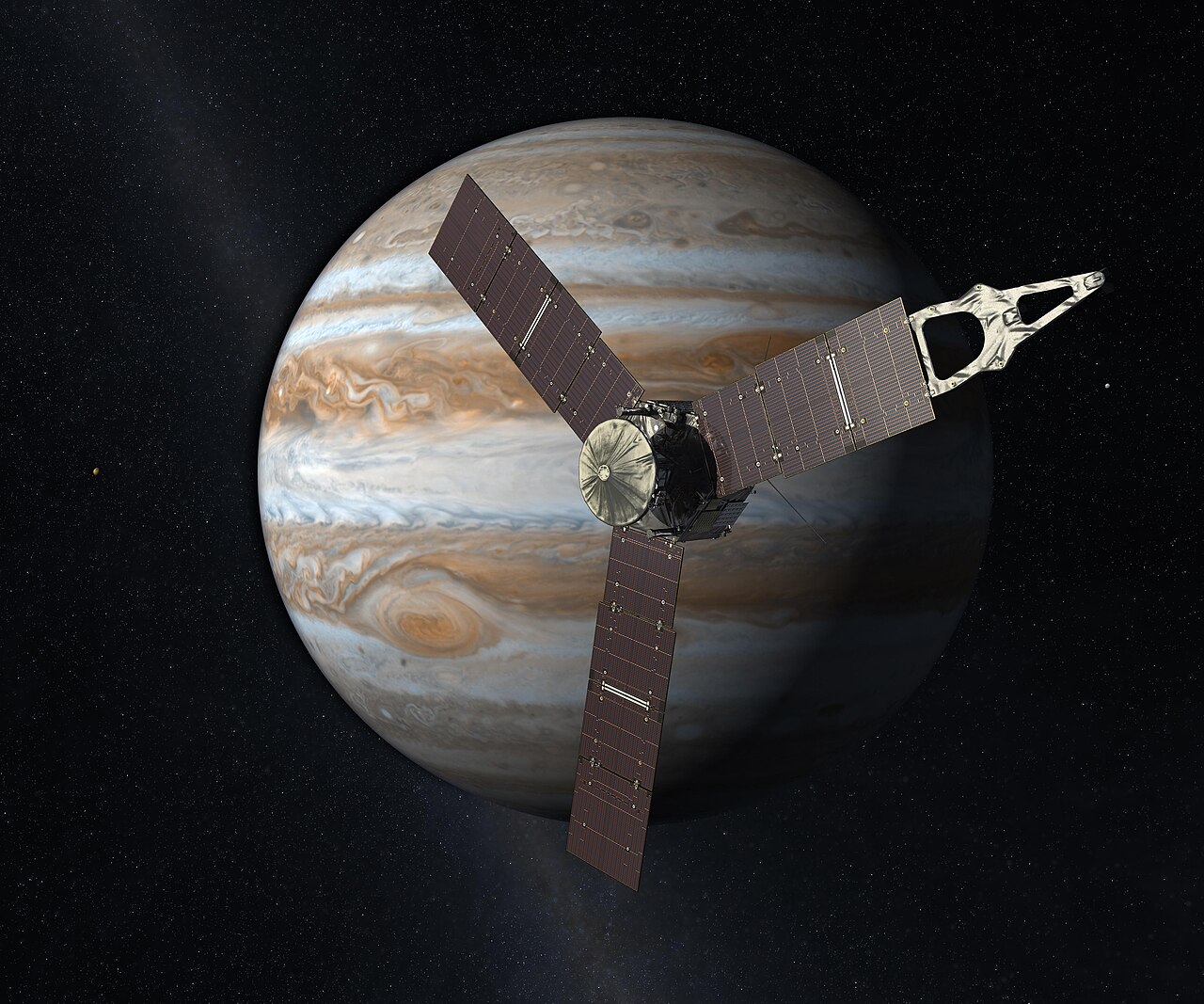
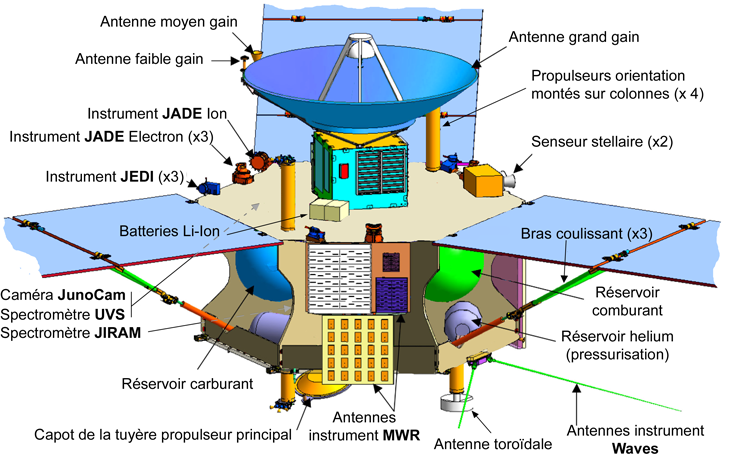
A defining engineering choice that sets Juno apart from every predecessor sent to the outer Solar System is its reliance on solar power. Where earlier deep-space probes depended on radioisotope thermoelectric generators, this spacecraft instead harvests sunlight through three enormous panel wings—the largest ever deployed on a planetary probe at the time of its 2011 launch. These wings serve a dual purpose: generating the electricity needed to run the onboard instruments and providing critical rotational stability for the spacecraft in orbit. The decision to go solar also made Juno the second orbiter of Jupiter in history, following the RTG-powered Galileo probe that circled the planet from 1995 to 2003. Built by Lockheed Martin and managed by NASA's Jet Propulsion Laboratory under the New Frontiers program, the spacecraft represents a bold departure from the power architecture that had governed outer-planet exploration for decades, proving that a solar-powered design could sustain a full scientific campaign at Jupiter's distance.
Mythology, Program Context, and a Crowded Jupiter Pipeline
The name Juno draws directly from Roman mythology: the goddess Juno, wife of Jupiter, was said to peer through the veil of clouds the god draped over himself to conceal his mischief, revealing his true nature. NASA's project team has consistently emphasized this mythological origin over the backronym Jupiter Near-polar Orbiter that circulated in some mission-name compilations. Juno was selected as the second mission under the New Frontiers program on June 1, 2005, following New Horizons, though it should not be confused with the unselected New Horizons 2 proposal. The road to a Jupiter orbiter was anything but straightforward. Earlier in the 2000s, the Discovery Program passed over the INSIDE Jupiter proposal, the Europa Orbiter was canceled in 2002, and the ambitious Europa Jupiter System Mission was scaled back into ESA's Jupiter Icy Moons Explorer due to funding constraints. Juno's approval finally filled a long-standing gap in approved planetary missions to the solar system's largest world.
Gallery
Frequently Asked Questions
What is Juno (spacecraft)?
Juno is a NASA probe that has been circling Jupiter in a polar orbit since mid-2016. It was launched in August 2011 from Cape Canaveral under the New Frontiers program and is managed by the Jet Propulsion Laboratory.
Who built and operates Juno (spacecraft)?
Lockheed Martin constructed the spacecraft, while NASA's Jet Propulsion Laboratory handles its day-to-day operations. It holds the distinction of being the second human-made vehicle ever to enter a stable orbit around Jupiter, following the Galileo mission.
How does Juno (spacecraft) generate power?
Juno relies on large solar panels to generate electricity, making it the first probe sent to the outer Solar System to use solar power instead of radioisotope thermoelectric generators. This design choice was possible thanks to advances in panel technology capable of functioning at Jupiter's greater distance from the Sun.
When did Juno (spacecraft) begin its Jupiter orbit?
After a five-year cruise through the inner Solar System, Juno fired its engines on July 5, 2016, to brake into a polar orbit around Jupiter. The spacecraft had originally lifted off on August 5, 2011, from Cape Canaveral Air Force Station.
What is Juno (spacecraft) studying?
The mission focuses on Jupiter's internal composition, gravitational field, magnetic environment, and the structure of its polar magnetosphere. These observations help scientists understand how gas giants form and evolve over time.
More in Extraterrestrial orbiters 1-21
Spotted an error? Know more?
Reader corrections go straight into our review queue. Suggest an edit · How this site is sourced