
Dawn (spacecraft)
First spacecraft to orbit two celestial bodies and a dwarf planet.

Wikimedia Commons · Public domain
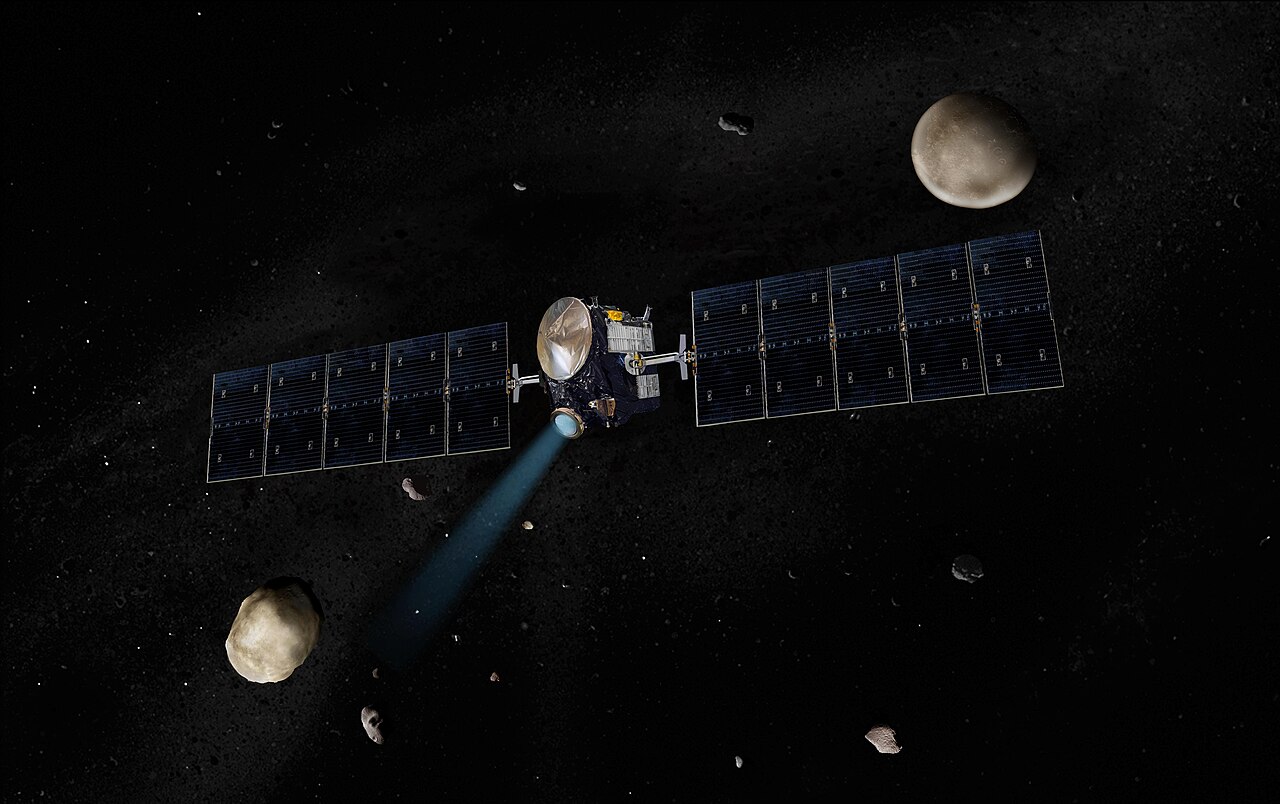
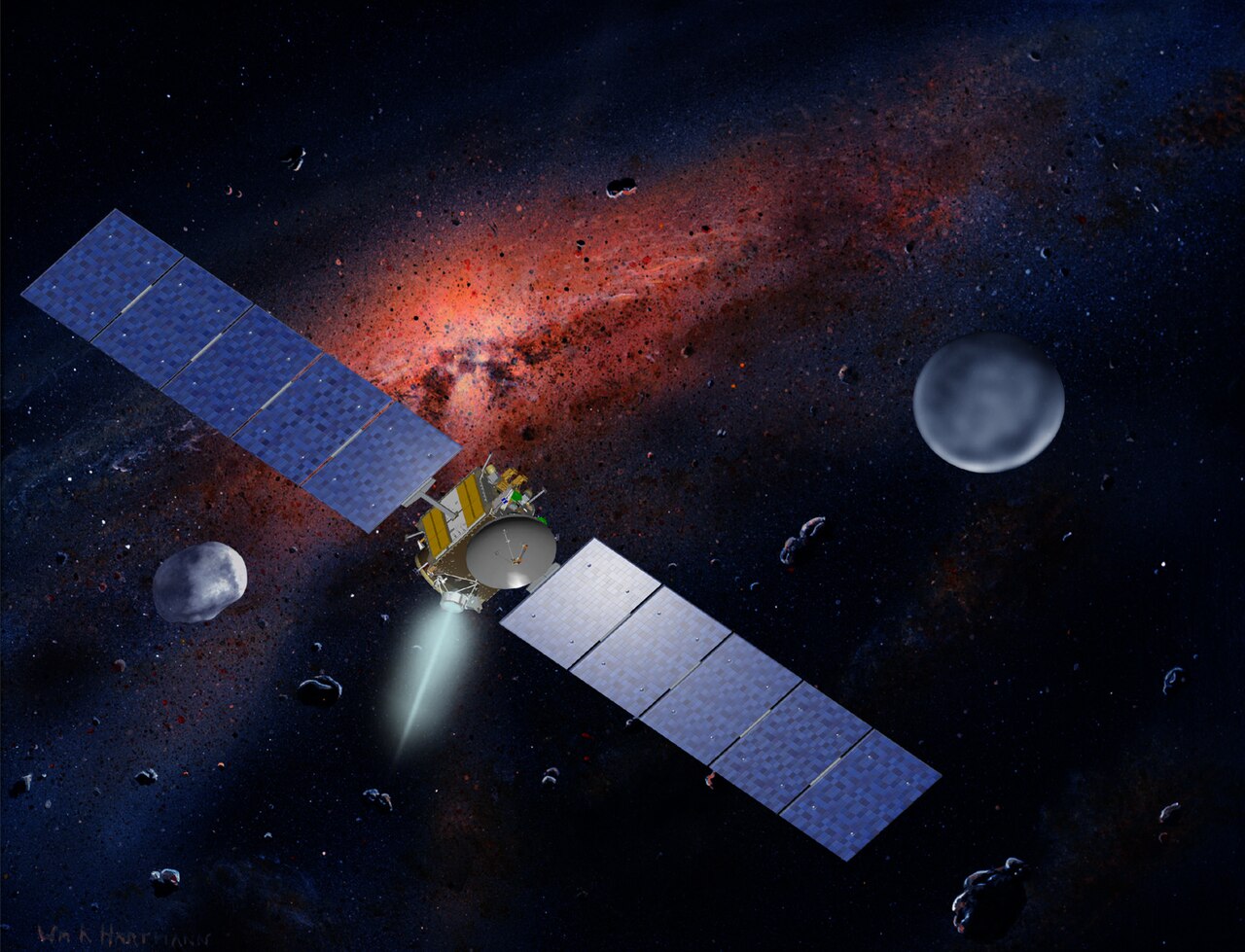
Dawn is a retired space probe launched by NASA in September 2007 as part of the Discovery Program. It was the first spacecraft to orbit two extraterrestrial bodies, the first to visit either Vesta or Ceres, and the first to orbit a dwarf planet. Its mission was to study two protoplanets of the asteroid belt—Vesta and Ceres—to answer questions about the formation of the Solar System.
Quick Facts
- Auto
- all
- Mission Type
- Vesta/Ceres orbiter
- Operator
- NASAJPL
- Cospar Id
- 2007-043A
- Satcat
- 32249
- Mission Duration
- 27 Sept 2007 · 1 Nov 2018
- Manufacturer
- Orbital Sciences / JPL / UCLA
- Launch Mass
- 2684.6 lb
- Dry Mass
- 1647.1 lb
- Dimensions
- 1.64 xx
- Power
- 10 kW at 1 AU / 1.3 kW at 3 AU
- Launch Date
- September 27, 2007, 11:34 UTC
Facts from the source article.
Lore & Background
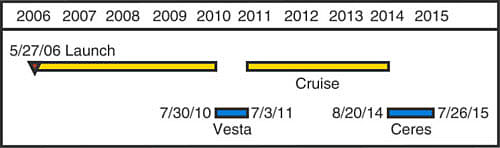
Dawn was launched by NASA in September 2007 with the mission of studying two protoplanets: Vesta and Ceres. It entered orbit around Vesta on July 16, 2011, completing a 14-month survey before departing for Ceres in late 2012. It entered orbit around Ceres on March 6, 2015. In 2017, NASA extended the mission until the probe's hydrazine fuel was depleted; on November 1, 2018, NASA announced the mission had ended, and the derelict probe remains in a stable orbit around Ceres.
The mission was managed by NASA's Jet Propulsion Laboratory, with European partners from Italy, Germany, France, and the Netherlands. It was the first NASA exploratory mission to use ion propulsion, enabling it to enter and leave the orbit of two celestial bodies. The spacecraft was built by Orbital Sciences Corporation, its first interplanetary mission. The project faced multiple cancellations and reinstatements between 2003 and 2006 before finally proceeding.
Reader's Guide
Dawn's significance lies in its pioneering use of ion propulsion for a multi-target mission, allowing it to orbit two different bodies—a feat impossible with chemical rockets, which are restricted to flybys. By studying Vesta and Ceres, two contrasting protoplanets—one dry and rocky, the other icy and wet—Dawn provided insights into the early Solar System's formation and the role of size and water in planetary evolution. It was the first mission to orbit a dwarf planet, arriving at Ceres months before New Horizons reached Pluto. The data collected continues to be analyzed, addressing questions about the building blocks of terrestrial planets and the conditions that shaped them. Dawn's legacy includes validating ion thruster technology for deep-space missions and demonstrating international collaboration in space exploration.
Did You Know?
- Dawn is the first spacecraft to have orbited two extraterrestrial bodies.
- The mission was cancelled three times between 2003 and 2006 before being reinstated.
- Ceres comprises a third of the total mass of the asteroid belt.
An Accidental Pioneer
Luna 1 stands as a remarkable testament to how unintended outcomes can reshape the history of space exploration. Originally conceived with a singular, dramatic purpose—deliberately striking the lunar surface—the Soviet spacecraft never reached its intended target. When it missed the Moon in 1959, the mission that was supposed to end in a controlled impact instead opened an entirely new chapter. Rather than terminating in a crash, the craft found itself in a trajectory that carried it beyond Earth's gravitational domain. This unplanned escape made Luna 1 the very first object of human manufacture to break free of our planet's orbit and enter a path around the Sun. What was meant to be a one-way mission to a dead world became, by sheer misfortune of aim, a permanent solar expedition. The spacecraft has continued its silent circuit of the Sun ever since, a quiet monument to the serendipity that can define an era.
Cataloging the Solar System's Orbital Pioneers
The comprehensive listing of extraterrestrial orbiters serves as a structured record of every spacecraft that has successfully entered orbit around a body beyond Earth. The catalog is organized by destination, with dedicated sections for the Sun, the Moon, Mars, Venus, Jupiter, Saturn, Mercury, and a combined category for minor planets and comets. This taxonomy reflects the breadth of humanity's reach across the solar system, from the inner rocky worlds to the gas giants and the smaller, more distant objects. The inclusion of the Sun as a separate category acknowledges that orbital achievement is not limited to planetary bodies. Each entry represents a milestone in engineering and navigation, a proof that a machine built by human hands can be captured by the gravity of a distant world. The list functions as both a historical archive and a benchmark, tracking the progressive expansion of robotic exploration over decades.
The Broader Web of Interplanetary Exploration
The list of extraterrestrial orbiters does not exist in isolation; it connects to a wider network of related achievements in spaceflight. Cross-references point to the history of lunar orbit, the mechanics of circumlunar trajectories, records of spacecraft visits to minor planets and comets, and the separate milestone of landings on extraterrestrial surfaces. There is also a dedicated listing of interplanetary voyages, which tracks the broader journeys even when they did not culminate in orbit. Additionally, the concept of a satellite system in astronomy provides the theoretical framework within which these orbital achievements are understood. Together, these interconnected records paint a fuller picture of humanity's growing presence beyond Earth, showing how orbital insertion is one critical step among many in the ongoing story of robotic exploration of the solar system.
Preserving the Record of Space Artifacts
Beyond the official Wikipedia listing, the documentation of extraterrestrial orbiters extends into dedicated archival projects. One notable external resource is the comprehensive catalog maintained by Philippe Pinczon du Sel at spaceartefacts.com, which provides a more detailed inventory of space artifacts across the solar system. This kind of dedicated preservation effort ensures that the technical and historical details of each mission are not lost to time. The existence of multiple documentation channels—encyclopedic lists, specialized databases, and academic references—reflects the community's commitment to maintaining an accurate record of human achievement in space. For researchers, historians, and enthusiasts alike, these resources collectively form a living archive that grows with each new mission, capturing the evolving story of how humanity has sent machines to circle worlds and objects scattered throughout the solar system.
Gallery
Frequently Asked Questions
What is Dawn (spacecraft)?
Dawn is a NASA space probe that launched in September 2007 under the Discovery Program to explore two protoplanets in the asteroid belt. It spent years studying Vesta and then Ceres, gathering data about how our Solar System formed.
What are Dawn (spacecraft)'s key achievements?
Dawn holds the distinction of being the first spacecraft ever to orbit two separate extraterrestrial bodies, and the first to orbit a dwarf planet (Ceres). It was also the first NASA exploratory mission to rely on ion propulsion for its primary thrusters.
Why is Dawn (spacecraft) important to space exploration?
Dawn proved that ion propulsion could successfully move a spacecraft between two very different targets, opening the door for more efficient deep-space missions. Its detailed surveys of Vesta and Ceres gave scientists crucial clues about the early building blocks of planets.
What did Dawn (spacecraft) actually study?
The probe mapped the geology, composition, and magnetic environment of both Vesta and Ceres to understand how protoplanets evolved in the asteroid belt. This helped researchers piece together the processes that shaped planetary formation in our Solar System.
More in Extraterrestrial orbiters 1-21
Spotted an error? Know more?
Reader corrections go straight into our review queue. Suggest an edit · How this site is sourced