
Europa Orbiter
Cancelled NASA orbiter mission to Jupiter's moon Europa.

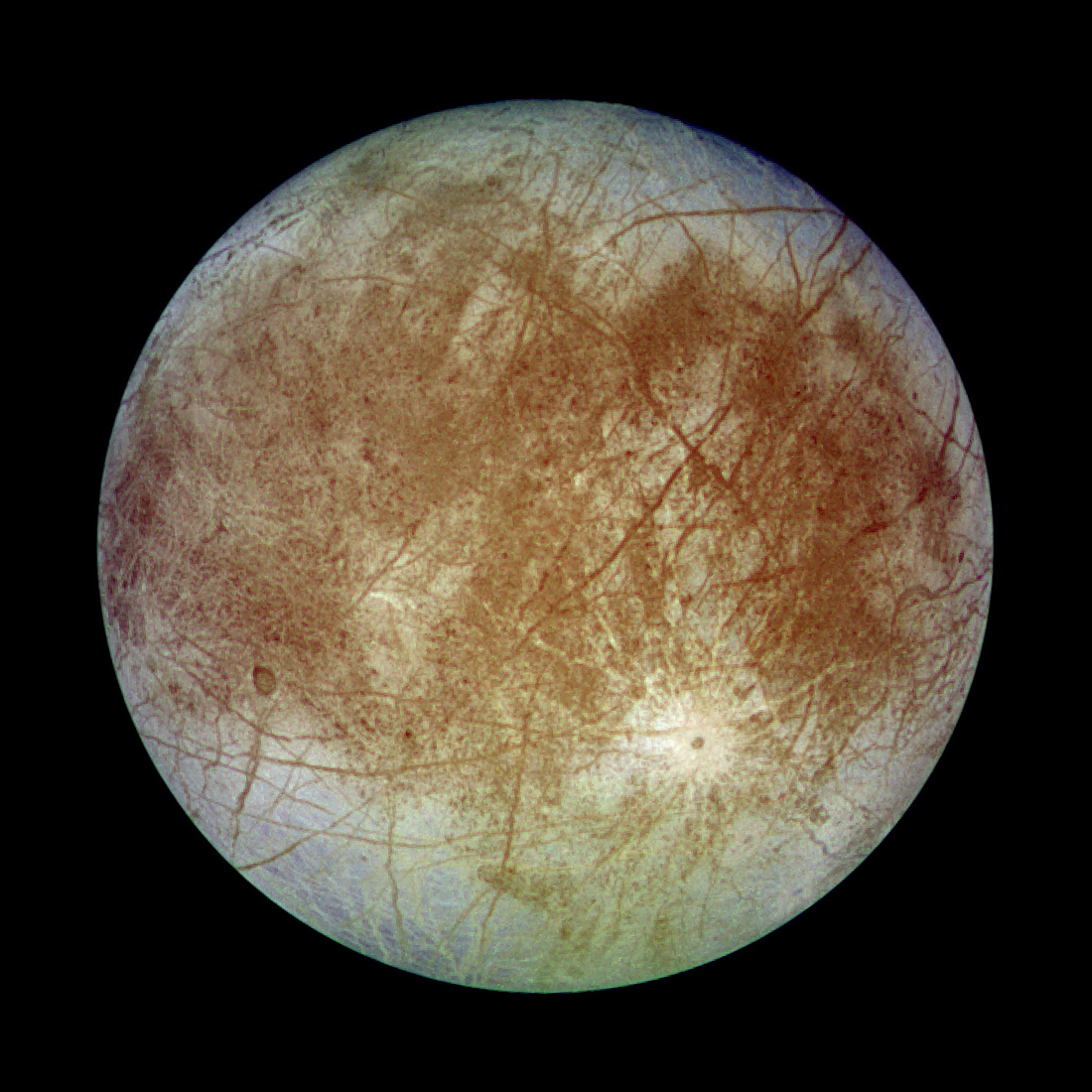
NASA/JPL/DLR · Public domain
Europa Orbiter was a NASA mission concept for Jupiter's moon Europa, canceled in 2002. Its primary goals were to confirm whether a subsurface ocean existed and to pinpoint possible landing sites for later missions. It received early funding in 1998 and grew out of NASA's Fire and Ice project.
The orbiter design weighed about 900 kg, with over half of that mass set aside as fuel. It would have used a radioisotope thermoelectric generator for power and launched from the Space Shuttle in 2003, reaching Jupiter by 2007. Once there, it would begin a three-phase science campaign focused on Europa. The spacecraft was built to withstand around 4 megarads of radiation. Its instruments included a radar to measure ice thickness and investigate what lay beneath, plus an altimeter and imaging systems.
In 1999, NASA put out a call for experiments for the Outer Planets/Solar Probe project, which included Europa Orbiter, Pluto Kuiper Express, and the Solar Probe (later renamed the Parker Solar Probe). Studies from this mission later informed the Jupiter Europa Orbiter (JEO), NASA’s part of the planned international Europa Jupiter System Mission (EJSM), which was canceled in 2011. The Europa Orbiter concept is distinct from the Jovian Europa Orbiter, a European Space Agency feasibility study that also fed into EJSM. Another contemporary Europa mission idea was the Europa Ice Clipper, a sample-return concept similar to Stardust.
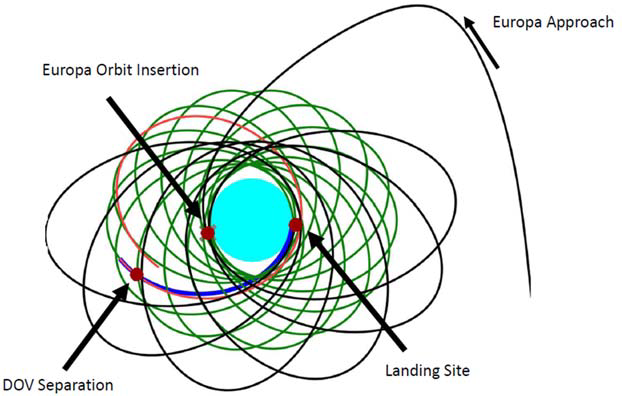
NASA’s next mission to Jupiter was Juno, selected in 2005 as a New Frontiers mission, launched in 2011, and arriving in 2016. A 2002 paper highlighted challenges for Europa Orbiter: the high energy needed for a direct trajectory, the mission’s long duration, intense radiation exposure, and the requirement for radioisotope thermoelectric generators. One plan involved entering Jovian orbit first, then using multiple gravity assists from Jupiter’s moons to enter Europa’s orbit with less fuel.
Later in the 21st century, some suggested the orbiter’s goal should have been to identify areas where fresh subsurface material had been brought to the surface, so a lander could study it without drilling. The concept was studied for about three years before its 2002 cancellation. Afterward, NASA shifted focus to a nuclear fission-powered orbiter for Europa under Project Prometheus.
Quick Facts
- Mission Type
- Europa orbiter
- Operator
- NASA
- Mission Duration
- Cancelled
- Launch Mass
- 900 kg
- Launch Date
- 2003
- Launch Rocket
- Space Shuttle
Facts from the source article.
Lore & Background
Europa Orbiter was designed as a 900 kg orbiter, with 500 kg of fuel for maneuvers. It would have been powered by radioisotope thermoelectric generators and launched from the Space Shuttle in 2003, arriving at Jupiter in 2007. The spacecraft would have been radiation hardened to survive a predicted 4 megarads of radiation. Its science payload included a radar to determine ice thickness and subsurface features, along with an altimeter and imaging systems. In 1999, NASA issued an announcement of opportunity for the Outer Planets/Solar Probe project, soliciting experiments for Europa Orbiter, Pluto Kuiper Express, and the Solar Probe (later named Parker Solar Probe).
Reader's Guide
Europa Orbiter's significance lies in its role as an early concept for exploring Europa's subsurface ocean, a key astrobiology target. Although cancelled in 2002, its studies informed the later Jupiter Europa Orbiter (JEO), NASA's contribution to the planned Europa Jupiter System Mission (EJSM), which was also cancelled in 2011. The mission faced challenges including substantial energy requirements for a direct trajectory, long mission duration, high total-radiation dose, and the need for radioisotope thermoelectric generators. One mission plan involved entering Jovian orbit and using multiple gravity assists from Jupiter's moons to enter Europa orbit with less fuel. After cancellation, NASA turned its attention to a nuclear fission powered orbiter for Europa under Project Prometheus. Later suggestions noted the goal should have been to find places where fresh subsurface material had been brought to the surface, targeting a lander to study that material without drilling. The concept should not be confused with the Jovian Europa Orbiter, a European Space Agency feasibility study also superseded by EJSM.
Did You Know?
- Europa Orbiter was cancelled in 2002 after about three years of study.
- The mission resulted from NASA's Fire and Ice project.
The Accidental Heliocentric Pioneer
The most unexpected entry in the registry of extraterrestrial orbiters belongs to a spacecraft that never intended to become one. Luna 1, launched in 1959, was built with the explicit goal of crashing into the Moon. When its trajectory missed the lunar surface, the spacecraft did not re-enter Earth's atmosphere or tumble back to the ground. Instead, it escaped Earth's gravitational hold entirely and settled into a path around the Sun, making it the first artificial object in history to leave Earth's orbit and circle our star. Remarkably, Luna 1 remains in that heliocentric orbit to this day, an accidental satellite of the Sun that has outlasted the very era that sent it. Its story is a reminder that the earliest chapters of space exploration were written as much by error as by intention, and that a single navigational miscalculation could produce a milestone no engineer had planned.
A Celestial Taxonomy of Orbital Achievements
The list of extraterrestrial orbiters is organized as a taxonomy of celestial destinations, grouping spacecraft by the body they successfully encircled. Beyond the Sun, the registry dedicates distinct sections to the Moon, Mars, Venus, Jupiter, Saturn, and Mercury, reflecting the full breadth of planetary targets that human-made machines have reached. A separate category captures orbiters that achieved circumnavigation of minor planets and comets, acknowledging that the frontier of spaceflight extends well beyond the major planets. This structural choice mirrors the hierarchy of the solar system itself, placing each achievement in its proper astronomical context. The very existence of these categories testifies to how far orbital mechanics and propulsion technology have advanced, from the first tentative lunar flybys to sustained orbits around the outer giants and the swift inner worlds.
The Wider Web of Interplanetary Exploration
The registry of extraterrestrial orbiters exists within a dense network of related concepts that together define the scope of human spaceflight. Cross-references point to lunar orbit and circumlunar trajectories, underscoring how the Moon served as the proving ground for orbital mechanics before humanity turned outward. The list also connects to records of landings on extraterrestrial bodies, interplanetary voyages, and visits to minor planets and comets, painting a picture of exploration that encompasses not just orbiting but touching down and traversing. The concept of a satellite system in astronomy provides the theoretical framework within which these engineering achievements are understood. Together, these interconnected topics reveal that achieving orbit around a distant world is only one facet of a much larger endeavor that includes descent, surface operations, and the continuous expansion of human presence across the solar system.
Cataloguing the Cosmos: Documentation and Curation
The preservation and documentation of spaceflight achievements extends well beyond the missions themselves. The list of extraterrestrial orbiters serves as a curated record, ensuring that each spacecraft's orbital milestone is formally recognized and accessible to researchers, historians, and the public. External resources, such as the comprehensive listing of space artifacts maintained by Philippe Pinczon du Sel at spaceartefacts.com, complement this effort by providing deeper cataloguing of humanity's physical presence in space. The existence of such documentation underscores a broader impulse to track and memorialize every machine that has broken free of Earth's gravity, whether it was designed to orbit or stumbled into doing so. In an era when spaceflight is increasingly commercialized and frequent, these registries anchor each achievement in a continuous historical narrative, reminding us that every new orbit adds a thread to a story that began with a single missed lunar impact in 1959.
Gallery
Frequently Asked Questions
What is the Europa Orbiter?
The Europa Orbiter was a NASA spacecraft concept intended to enter orbit around Jupiter's moon Europa and conduct detailed scientific observations. The mission was officially canceled in 2002, so no hardware was ever built or launched.
What science was the Europa Orbiter supposed to accomplish?
Its core objectives were to verify the existence of a liquid-water ocean hidden beneath Europa's ice shell and to map out candidate landing zones for subsequent surface probes. The planned three-phase observation campaign would have been devoted entirely to studying Europa after arrival at Jupiter.
What did the Europa Orbiter look like in terms of design and power?
The spacecraft was sized at roughly 900 kilograms total, with more than half of that budget allocated to propellant. It would have drawn electricity from a radioisotope thermoelectric generator, launched from the Space Shuttle in 2003, and cruised to Jupiter by 2007.
Where did the Europa Orbiter concept originate?
The mission grew directly out of NASA's Fire and Ice planetary-science program and secured its first round of funding in 1998. It was one of the flagship concepts that program produced before the initiative was wound down.
Why do space-exploration fans still talk about the Europa Orbiter?
It remains one of the most fully fleshed-out early proposals for a dedicated Europa orbiter, making it a favorite reference point when fans discuss how the moon's exploration roadmap evolved. Its 2002 cancellation also serves as a reminder of how ambitious planetary programs can be shelved before reaching the launch pad.
More in Extraterrestrial orbiters 1-21
Spotted an error? Know more?
Reader corrections go straight into our review queue. Suggest an edit · How this site is sourced