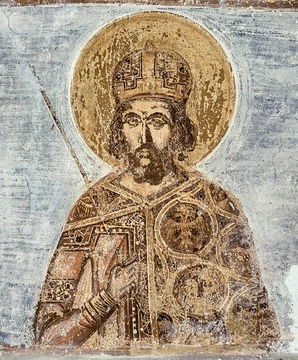
Constantius II
Roman emperor whose reign saw civil wars and religious strife.
Last updated
Flavius Julius Constantius was born in 317 at Sirmium, Pannonia, now Serbia.[1] Born in 317 at Sirmium, Pannonia (now Serbia), Constantius was the third son of Constantine the Great and the second child from his marriage to Fausta, who was Maximian's daughter.[1]
Life and work
Constantius defeated the usurper Magnentius at the Battle of Mons Seleucus in 353.[2] Constantius died at Mopsuestia in Cilicia after realizing he was fatally ill.[3] On 8 November 324, when he was 7 years old, Constantius's father appointed him caesar.[1] Constantius performed the burial of his father Constantine in the Church of the Holy Apostles following Constantine's death.[4]
After a meeting with his brothers in Pannonia to divide the empire, the eastern provinces were assigned to Constantius.[5] The Sassanid Empire under Shapur faced Constantius's repeated defenses of the eastern border.[6] Julian, Constantius's final surviving male relative, was raised to caesar on 6 November 355.[7] Constantius's sole visit to Rome occurred during April and May of 357.[8]
Faustina became Constantius's wife in 361; after his death she gave birth to their only child, a daughter named Constantia.[9]
What the cited sources add
According to DiMaio and Frakes, Constantius was born on 7 August 317 in Illyricum.[10] DiMaio and Frakes state that Constantius spent much of his reign on military campaigns.[10] The same source notes that Constantius shifted his base of operations to Mediolanum during the 350s.[10] Ammianus Marcellinus records that Constantius married Faustina after losing Eusebia.[11]
The historian Sozomen writes that Constantius was deceived by the distinction between homoousios and homoiousios.[12] Sozomen also states that Constantius held similar views to his father and brother for some time.[12]
References
- Wikipedia, "Constantius II" (CC BY-SA 4.0), which cites: Jones Martindale Morris, p. 226; Dodgeon Greatrex Lieu, p. 152–153; Dodgeon Greatrex Lieu, p. 152–153; Julian, Orationes I, 13B (original not read by us) en.wikipedia.org
- Wikipedia, "Constantius II" (CC BY-SA 4.0), which cites: Potter 2004, p. 471; Hunt 1998, p. 1; Drinkwater 2007, p. 199; Barnes 1993, p. 105 (original not read by us) en.wikipedia.org
- Wikipedia, "Constantius II" (CC BY-SA 4.0), which cites: Vagi 2001, p. 508; The manuscript of Ammianus Marcellinus, Res Gestae 21.15.2 reads tertium nonarum Octobrium, which is the equivalent of 5 October. The latest editor of the Res G (original not read by us) en.wikipedia.org
- Wikipedia, "Constantius II" (CC BY-SA 4.0), which cites: Hunt 1998, p. 1; Burgess 2008, p. 10; Hunt 1998, p. 1; Julian, "Letter to the senate and people of Athens", 270. (original not read by us) en.wikipedia.org
- Wikipedia, "Constantius II" (CC BY-SA 4.0), which cites: Hunt 1998, p. 1; Hunt 1998, p. 1 (original not read by us) en.wikipedia.org
- Wikipedia, "Constantius II" (CC BY-SA 4.0), which cites: Hunt 1998, p. 1; Festus, Brevarium XXVII; Dingas Winter 2007, p. 89; Hunt 1998, p. 1; Dingas Winter 2007, p. 89 (original not read by us) en.wikipedia.org
- Wikipedia, "Constantius II" (CC BY-SA 4.0), which cites: Ammianus Marcellinus, Res Gestae XV.8.17; Ammianus Marcellinus, Res Gestae XV.8.5–16; Ammianus Marcellinus, Res Gestae XV.8.18; Ammianus Marcellinus, Res Gestae XV.8.18 (original not read by us) en.wikipedia.org
- Wikipedia, "Constantius II" (CC BY-SA 4.0), which cites: Ammianus Marcellinus, Res Gestae XVI.12 (original not read by us) en.wikipedia.org
- Wikipedia, "Constantius II" (CC BY-SA 4.0), which cites: Marcellinus, "The Roman History of Ammianus Marcellinus", Harvard University Press, 1940 (we also read that source) en.wikipedia.org
- Michael DiMaio Jr. and Robert Frakes, Constantius II (337–361 A.D.). facts only, no text reused. roman-emperors.sites.luc.edu
- Marcellinus, "The Roman History of Ammianus Marcellinus", Harvard University Press, 1940. facts only, no text reused. penelope.uchicago.edu
- Sozomen Ecclesiastical History 3.18.. facts only, no text reused. newadvent.org
Each numbered sentence above was checked against the source it cites before publication. Sentences citing Wikipedia adapt text from the English Wikipedia article Constantius II (contributors), used under CC BY-SA 4.0; this entry is available under the same licence. Other sources were used for facts only; no text or images are copied from them.
More in Emperors Of The Byzantine And Roman World
Sources
Compiled from Wikipedia and the sources listed below. Text from Wikipedia is available under CC BY-SA 4.0; this entry is adapted from it.
- Wikipedia: Constantius II (CC BY-SA 4.0).
Spotted an error? Know more?
Reader corrections go straight into our review queue. Suggest an edit · How this site is sourced