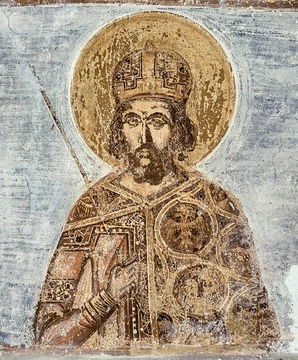
Antoninus Pius
Roman emperor whose reign was the most peaceful of the Principate.
Last updated
Antoninus Pius was Roman emperor from AD 138 to 161, the fourth of the Five Good Emperors from the Nerva–Antonine dynasty.[1][2] He was born into a senatorial family near Lanuvium in Italy in 86.[3]
Life and work
Between 110 and 115, he married Annia Galeria Faustina the Elder, with whom he is believed to have enjoyed a happy marriage.[4] He held the offices of quaestor and praetor with success, obtained the consulship in 120, and served as proconsul of Asia during 134–135.[5][2] Hadrian adopted him as his son and successor on 25 February 138, on the condition that Antoninus would adopt Marcus Annius Verus and Lucius, son of Lucius Aelius.[6] He built temples, theaters, and mausoleums, and promoted the arts and sciences.[7]
Antoninus was regarded as a skilled administrator and builder, and he left behind a sizable public treasury of around 2.7 billion sesterces.[8] Titus Aurelius Fulvus Boionius Antoninus, the future emperor, was born to Titus Aurelius Fulvus (who held the consulship in 89) and Arria Fadilla.[3] The title "Pius" most likely stems from his successful effort to convince the Senate to deify Hadrian, an honor they had initially denied.[9]
What the cited sources add
The Paul Halsall source states that the king of Ta-ts'in, An-tun, sent an embassy from the frontier of Jih-nan offering ivory, rhinoceros horns, and tortoise shell in 166 C.E.[10] The same source notes that during the Han period they have only once communicated with Zhongguo.[10] The first recorded group presenting itself as a Roman diplomatic mission to China appears in the Hou Hanshu, dated to 166 AD.[11] The Open Library record for ISBN 9781107148758 lists "Prostitutes and Matrons in the Roman World" as a 2016 publication by Cambridge University Press.[12]
The Open Library record for ISBN 9781134695690 lists "Marcus Aurelius" as a 2012 publication by Taylor & Francis Group.[13]
References
- Wikipedia, "Antoninus Pius" (CC BY-SA 4.0) en.wikipedia.org
- Wikipedia, "Antoninus Pius" (CC BY-SA 4.0), which cites: Bowman 2000, p. 150 (original not read by us) en.wikipedia.org
- Wikipedia, "Antoninus Pius" (CC BY-SA 4.0), which cites: Kienast 1990: 134.; Bowman 2000, p. 150; Harvey, "Religion in republican Italy", Cambridge University Press, 2006, p. 134; Bury 1893, p. 523 (original not read by us) en.wikipedia.org
- Wikipedia, "Antoninus Pius" (CC BY-SA 4.0), which cites: Weigel, Antoninus Pius (original not read by us) en.wikipedia.org
- Wikipedia, "Antoninus Pius" (CC BY-SA 4.0), which cites: Traver, Andrew G., From polis to empire, the ancient world, c. 800 B.C. – A.D. 500, (2002) p. 33; Historia Augusta, Life of Antoninus Pius 2:9; Weigel, Antoninus Pius; E.E. Bryant, The Reign of Antoninus Pius. Cambridge University Press, 1895, p. 12; Bowman 2000, p. 150 (original not read by us) en.wikipedia.org
- Wikipedia, "Antoninus Pius" (CC BY-SA 4.0), which cites: Bowman 2000, p. 150; Bury 1893, p. 523; Weigel, Antoninus Pius; Cooley, p. 492 (original not read by us) en.wikipedia.org
- Wikipedia, "Antoninus Pius" (CC BY-SA 4.0), which cites: Weigel, Antoninus Pius; Bowman 2000, p. 150 (original not read by us) en.wikipedia.org
- Wikipedia, "Antoninus Pius" (CC BY-SA 4.0), which cites: Allen, "Supply-Side Sustainability", Columbia University Press, 2012, p. 105–106 (original not read by us) en.wikipedia.org
- Wikipedia, "Antoninus Pius" (CC BY-SA 4.0), which cites: Bowman 2000, p. 150; Birley 2000, p. 54; Dio, 70:1:2; Bury 1893, p. 523 (original not read by us) en.wikipedia.org
- Paul Halsall, "East Asian History Sourcebook: Chinese Accounts of Rome, Byzantium and the Middle East, c. 91 B.C.E. – 1643 C.E.", Fordham.edu, 2000. facts only, no text reused. fordham.edu
- Wikipedia, "Antoninus Pius" (CC BY-SA 4.0), which cites: Paul Halsall, "East Asian History Sourcebook: Chinese Accounts of Rome, Byzantium and the Middle East, c. 91 B.C.E. – 1643 C.E.", Fordham.edu, 2000; Harper, "The Fate of Rome", Princeton University Press, 2017 (we also read that source) en.wikipedia.org
- Open Library record, ISBN 9781107148758 ("Prostitutes and Matrons in the Roman World"). CC0 (metadata); book content not read. openlibrary.org
- Open Library record, ISBN 9781134695690 ("Marcus Aurelius"). CC0 (metadata); book content not read. openlibrary.org
Each numbered sentence above was checked against the source it cites before publication. Sentences citing Wikipedia adapt text from the English Wikipedia article Antoninus Pius (contributors), used under CC BY-SA 4.0; this entry is available under the same licence. Other sources were used for facts only; no text or images are copied from them.
More in Emperors Of The Byzantine And Roman World
Sources
Compiled from Wikipedia and the sources listed below. Text from Wikipedia is available under CC BY-SA 4.0; this entry is adapted from it.
- Wikipedia: Antoninus Pius (CC BY-SA 4.0).
Spotted an error? Know more?
Reader corrections go straight into our review queue. Suggest an edit · How this site is sourced