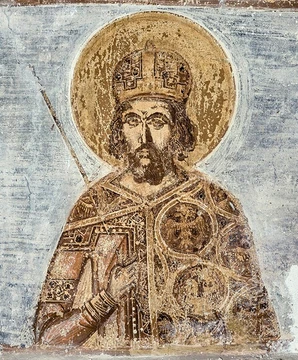
Aurelian
Restored the Roman Empire's territorial integrity through military victories.
Last updated
Aurelian, whose full name was Lucius Domitius Aurelianus, ruled as Roman emperor from 270 to 275, a period known as the Crisis of the Third Century. Born around 214 or 215, most likely in the region of Moesia Superior, he came from humble beginnings.
Rise to power
He joined the Roman army at some point in his youth—the exact year is unknown—and steadily rose through the ranks, eventually commanding the cavalry under Emperor Gallienus. After Gallienus was assassinated in 268, Claudius Gothicus took power, and upon his death in 270, Claudius’s brother Quintillus ruled for only a few weeks before Aurelian, already proclaimed emperor by his troops, took control. The Illyriciani, a group of military commanders, chose him as emperor.
Reunification of the empire
During his reign, Aurelian achieved a remarkable string of military victories that brought the Roman Empire back together after it had nearly fallen apart due to barbarian attacks and internal uprisings. He defeated the Alamanni after a devastating war, as well as the Goths, Vandals, Sarmatians, and the Juthungi (a subgroup of the Alamanni). In 272, he conquered the Palmyrene Empire (though a brief revolt flared up the following year), restoring the eastern provinces, and in 274 he took over the Gallic Empire in the west, reuniting the entire empire. For this, he was given the title Restitutor Orbis ("Restorer of the World").
He also built the Aurelian Walls in Rome, withdrew Roman forces from the original province of Dacia (a gradual process completed under his reign, with the new province of Dacia Aureliana created south of the Danube), and reformed the currency to try to stop its devaluation. While Emperor Domitian, two centuries earlier, was the first to demand being called dominus et deus ("master and god"), these titles did not appear in official documents until Aurelian’s reign. His successes played a key role in ending the crisis.
Early life
Details about Aurelian’s early life come mainly from the Historia Augusta, which is often unreliable. Comparing it with other sources makes some facts more certain. His birth date of 9 September is recorded in the Chronograph of 354, but the year is uncertain. The 6th-century writer John Malalas claimed he died at age 61, suggesting a birth year of 214, but Malalas is frequently unreliable, so this remains uncertain.
Lore & Background
Aurelian was born in modest circumstances, most likely in Moesia Superior. He entered the Roman army at some point in his youth—the exact year is not securely attested—and climbed the ranks, eventually leading the cavalry of Emperor Gallienus until Gallienus' assassination in 268. After the brief reigns of Claudius Gothicus and his brother Quintillus (who ruled for only a few weeks), Aurelian took the empire for himself, having already been proclaimed emperor by his troops and chosen by the Illyriciani as one of themselves.
During his reign, he defeated the Alamanni, Goths, Vandals, Sarmatians, and the Juthungi (a subgroup of the Alamanni). He restored the eastern provinces after conquering the Palmyrene Empire in 272 (with a brief revolt in 273), and in 274 conquered the Gallic Empire in the west, reuniting the Empire in its entirety. He also oversaw the gradual withdrawal from the original province of Dacia, creating the new province of Dacia Aureliana south of the Danube.
Reader's Guide
Aurelian's significance lies in his role as the emperor who restored the Roman Empire's unity during the Crisis of the Third Century. His military campaigns reversed the fragmentation caused by the breakaway Palmyrene and Gallic Empires, earning him the title Restitutor Orbis. His construction of the Aurelian Walls marked a defensive shift for Rome, while his monetary reforms attempted to stabilize a devalued currency. The abandonment of Dacia reflected a strategic consolidation of borders.
Although his reign lasted only five years, his victories ended the immediate crisis and set the stage for the later reforms of Diocletian. The adoption of the titles dominus et deus in official documents under his rule signaled a shift toward more autocratic imperial ideology. His legacy is that of a military emperor who, through force of arms, held the empire together at its moment of greatest peril.
Frequently Asked Questions
Who is Aurelian?
Lucius Domitius Aurelianus was a Roman emperor who reigned from 270 to 275, climbing from a common military background in Moesia Superior to the throne during the empire's most turbulent era. He is often called the 'Restorer of the World' for pulling the fractured state back together.
What is Aurelian most known for?
Fans and historians most associate him with the military reunification of the empire, the construction of Rome's famous Aurelian Walls, his monetary overhaul, and the pragmatic decision to withdraw Roman forces from Dacia beyond the Danube.
More in Emperors Of The Byzantine And Roman World
Sources
Compiled from Wikipedia and the sources listed below. Text from Wikipedia is available under CC BY-SA 4.0; this entry is adapted from it.
- Wikipedia: Aurelian (CC BY-SA 4.0).
Spotted an error? Know more?
Reader corrections go straight into our review queue. Suggest an edit · How this site is sourced