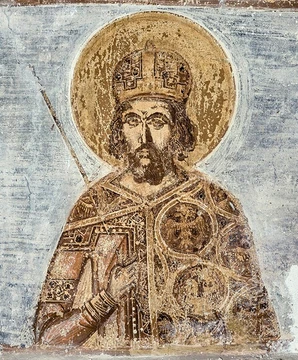
Andreas Palaiologos
Last prominent claimant to the Byzantine imperial throne.
Last updated
Andreas Palaiologos (17 January 1453 – June 1502) was the eldest son of Thomas Palaiologos, Despot of the Morea, and a nephew of Constantine XI Palaiologos, the final Byzantine emperor. After the fall of Constantinople in 1453 and the Ottoman invasion of the Morea in 1460, his family fled to Corfu and later to Rome. Following his father's death in 1465, Andreas became the head of the Palaiologos family and the chief claimant to the Byzantine throne. From 1483 onward, he styled himself 'Emperor of Constantinople,' a title his father never used, and spent his life seeking support to restore the Byzantine Empire.
Lore & Background
Andreas Palaiologos was born on 17 January 1453, just months before the fall of Constantinople. After the Ottoman invasion of the Morea in 1460, his father Thomas fled with the family to Corfu.
Thomas died in 1465, and the twelve-year-old Andreas moved to Rome, where he was placed under the care of Cardinal Bessarion. He converted to Roman Catholicism and was recognized by Pope Paul II as heir to Thomas and Despot of the Morea. From 1483, Andreas began using the title 'Emperor of Constantinople,' supported by some Byzantine refugees in Italy, though he never returned to Greece.
Reader's Guide
Andreas Palaiologos represents the final chapter of the Byzantine imperial tradition in exile. His life in Rome was marked by declining financial support from the papacy, leading to poverty despite his royal claims. He attempted to organize an expedition in 1481 after the death of Sultan Mehmed II, but it was canceled when Bayezid I stabilized Ottoman rule. Desperate for funds, he sold his imperial rights to Charles VIII of France in 1494, conditional on Charles conquering the Morea for him.
After Charles's death in 1498, Andreas resumed his titles until his own death in 1502. His will granted his titles to Ferdinand II of Aragon and Isabella I of Castile, who never used them. His legacy is that of a claimant who never regained his ancestral lands but kept the Byzantine imperial idea alive in Western Europe.
Did You Know?
- Andreas was born on 17 January 1453, just four months before the fall of Constantinople on 29 May 1453.
- There is no concrete evidence that Andreas left any descendants, though some primary sources allude to the possibility.
More in Emperors Of The Byzantine And Roman World
Sources
Compiled from Wikipedia and the sources listed below. Text from Wikipedia is available under CC BY-SA 4.0; this entry is adapted from it.
- Wikipedia: Andreas Palaiologos (CC BY-SA 4.0).
Spotted an error? Know more?
Reader corrections go straight into our review queue. Suggest an edit · How this site is sourced