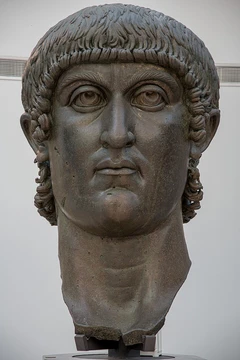
Flavia Maxima Fausta
Roman empress, daughter of Maximian, wife of Constantine the Great.
Last updated

via Wikipedia: Flavia Maxima Fausta · see source
Flavia Maxima Fausta Augusta (c. 289 – 326 AD) was a Roman empress. She was the daughter of Maximian and second wife of Constantine the Great, who had her executed and excluded from all official accounts for unknown reasons. Historians Zosimus and Zonaras reported that she was executed for adultery with her stepson, Crispus.
Family
Fausta was the daughter of the emperor Maximian and his wife Eutropia. Her date of birth is not directly attested; scholarly estimates range from 289/290 to the end of the 290s. To seal an alliance for control of the Tetrarchy, Maximian married her to Constantine I in 307.
Constantine initially presented Maximian's suicide as a tragedy but later spread a version involving Fausta in her father's downfall. She held the title nobilissima femina until 324, when Constantine granted her the title augusta, which she received together with Constantine's mother Helena. During her marriage she had five children.
Execution
In 326, Constantine had Fausta killed, not long after executing Crispus, his eldest son from a previous relationship. The reasons for both deaths remain murky, with several theories emerging over time. One account, from the Epitome de Caesaribus and Philostorgius’s history, claims Fausta died when she was locked inside an overheated bath. This was linked to Crispus’s death, which many believed resulted from an accusation Fausta made against him, though the nature of that charge is unclear.
Constantine, having secured control of the entire Roman Empire through military success, ordered Crispus’s execution at Fausta’s urging—or so it was thought. Later, under pressure from his mother Helena, who was devastated by the loss of her grandson, Constantine turned on Fausta and killed her in the same scalding bath. The historian Zosimus offers a different motive: adultery. Crispus, he says, was suspected of sleeping with his stepmother Fausta, and Constantine had him killed for it.
Helena’s grief then pushed Constantine to murder Fausta by the same hot bath method, as a way to appease his mother. A later writer, Zonaras, presents yet another version: Fausta made unwanted sexual advances toward Crispus, and when he rejected her, she falsely accused him of rape. Constantine, once he learned the truth, punished Fausta in a story that echoes the myth of Phaedra and Hippolytus. However, if Crispus was truly innocent, his official condemnation should have been reversed, but it never was.
Constantine imposed damnatio memoriae on both Fausta and Crispus around 326, wiping them from official records. No contemporary source describes Fausta’s fate in detail. The emperor’s biographer Paul Stephenson notes that Eusebius, a flattering chronicler, omitted both names from his Life of Constantine and even removed Crispus from a later edition of his Ecclesiastical History. Julian later praised Fausta in a speech for Constantius II, but no other evidence suggests her reputation was ever restored.
More in Constantine the Great
Sources
Compiled from Wikipedia and the sources listed below. Text from Wikipedia is available under CC BY-SA 4.0; this entry is adapted from it.
- Wikipedia: Flavia Maxima Fausta (CC BY-SA 4.0).
Spotted an error? Know more?
Reader corrections go straight into our review queue. Suggest an edit · How this site is sourced