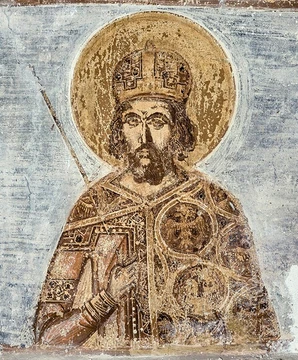
Arcadius
Weak emperor dominated by ministers and his wife.
Last updated
Arcadius (377 – 1 May 408) was Roman emperor from 383 until his death. He was the oldest son of Emperor Theodosius I and his first wife, Aelia Flaccilla, and the brother of Honorius. After their father’s death in 395, Arcadius took control of the eastern Roman Empire while Honorius ruled the west. Contemporaries viewed him as a weak leader, easily controlled by a succession of powerful ministers and by his wife, Aelia Eudoxia.
Born in 377 in Hispania, Arcadius was made Augustus and co-ruler of the eastern half of the empire by his father on 19 January 383, when he was five years old. Ten years later, Honorius received a similar title for the west. Arcadius spent his early years being educated by the rhetorician Themistius and the monk Arsenius Zonaras.
Early reign
Both sons of Theodosius were young and inexperienced, making them easy targets for ambitious subordinates. In 394, while his father campaigned in the west against Arbogastes and Eugenius, Arcadius briefly ruled independently with help from his advisors in Constantinople. When Theodosius died on 17 January 395, the seventeen-year-old Arcadius fell under the influence of Rufinus, the praetorian prefect of the East.
Meanwhile, the ten-year-old Honorius was placed under the guardianship of the general Stilicho. Rufinus hoped to marry his daughter to Arcadius and become the emperor’s father-in-law. However, while Rufinus was away in Antioch—where, according to Zosimus, he had the comes orientis Lucianus flogged to death—Arcadius was shown a painting of Aelia Eudoxia, daughter of the late Frankish general Bauto. The eunuch Eutropius, the praepositus sacri cubiculi, arranged for them to meet.
Arcadius fell in love, and they married on 27 April 395. Zosimus reports that Rufinus only learned his daughter was not the bride when the wedding procession headed to Eudoxia’s house instead of his own. This shift in influence, aided by a rival general, showed how power in the eastern court constantly changed hands around the malleable emperor.
The first major crisis of Arcadius’s reign was the Gothic revolt in 395, led by Alaric I, who hoped to exploit the inexperience of the two new emperors. As Alaric plundered Macedonia and Thrace and marched toward Constantinople, the eastern court could not respond because most of its army was in Italy with Theodosius, now under Stilicho’s command. Claiming that Theodosius had made him guardian of both sons, Stilicho moved east with his own forces and the Gothic mercenaries who had fought in the civil war against Eugenius, supposedly to confront Alaric.
Arcadius and Rufinus saw Stilicho as a greater threat than Alaric. When Stilicho landed in Thessaly, he received an imperial order to send the eastern regiments back but to go no further himself. Stilicho obeyed, retreating to Salona, while the general Gainas led the mercenaries to Constantinople.
On 27 November 395, Arcadius and his court welcomed Gainas at the Campus Martius parade ground. There, the Goths suddenly assassinated Rufinus, acting on Stilicho’s orders and possibly with Eutropius’s support. The murder opened the door for Eutropius and Arcadius’s wife, Eudoxia, to replace Rufinus as the emperor’s chief advisors.
While Eutropius tightened his grip on power in the capital, the distracted government still failed to deal with Alaric in Greece. Initially, Eutropius may have coordinated with Stilicho to defend Illyricum. But by 397, when Stilicho personally blockaded Alaric and forced him into Epirus, the eastern court’s mood had shifted.
Neither Arcadius nor Eutropius wanted Stilicho meddling in eastern affairs, so they refused him further military support, and Stilicho abandoned the blockade. At Eutropius’s urging, Arcadius declared Stilicho a public enemy and made a deal with Alaric, appointing him magister militum per Illyricum. Around the same time, the eastern court persuaded Gildo, the commander in Africa, to switch his allegiance from Honorius to Arcadius, worsening relations between the two imperial courts.
Eutropius’s influence lasted four years. He worked to sideline the military and promote civilian officials, bringing two prominent officers, Timasius and Abundantius, to trial.
He also had Arcadius introduce two administrative changes: the management of the cursus publicus and the office in charge of military equipment manufacturing were transferred from the praetorian prefects to the magister officiorum. Additionally, the position of praepositus sacri cubiculi, which Eutropius held, was elevated to the rank of illustris, making it equal to the praetorian prefects. In the autumn of 397, he issued a law in Arcadius’s name.
Lore & Background
Arcadius was born in 377 in Hispania, the eldest son of Theodosius I and Aelia Flaccilla, and brother of Honorius. On 19 January 383, his father declared the five-year-old Arcadius an Augustus and co-ruler for the eastern half of the Empire. Ten years later a corresponding declaration made Honorius the Augustus of the western half. Arcadius passed his early years under the tutelage of the rhetorician Themistius and Arsenius Zonaras, a monk.
Both of Theodosius's sons were young and inexperienced, susceptible to being dominated by ambitious subordinates. In 394 Arcadius briefly exercised independent power with the help of his advisors in Constantinople, when his father Theodosius went west to fight Arbogastes and Eugenius. Theodosius died on 17 January 395, and Arcadius, still aged only 17, fell under the influence of the praetorian prefect of the East, Rufinus. Honorius, aged 10, was consigned to the guardianship of the magister militum Stilicho.
Rufinus ambitiously sought to marry his daughter to Arcadius, but Arcadius married Aelia Eudoxia on 27 April 395. The rise of Eudoxia, facilitated by a general who was a rival of Rufinus, demonstrates the shifting of the centres of power in the eastern court. The first crisis facing the young Arcadius was the Gothic revolt in 395, under the command of Alaric I. As Alaric marched towards Constantinople, plundering Macedonia and Thrace, the eastern court could offer no response.
Stilicho declared that Theodosius had made him guardian over both his sons. He traveled eastward, ostensibly to face Alaric. Arcadius and Rufinus felt more threatened by Stilicho than by Alaric; upon landing in Thessaly Stilicho received an imperial order to send along the eastern regiments, but himself to proceed no further. Stilicho complied, falling back to Salona while Gainas led the mercenaries to Constantinople.
Arcadius and his entourage received Gainas in the Campus Martius on 27 November 395. There Rufinus was suddenly assassinated by the Goths, on the orders of Stilicho and possibly with the support of Eutropius. The murder created an opportunity for Eutropius and for Arcadius's wife, Eudoxia, who took Rufinus's place as advisors and guardians of the emperor. While Eutropius consolidated his hold on power, the distracted government still failed to react to the presence of Alaric in Greece.
Reader's Guide
Arcadius's reign was marked by his weakness and domination by ministers and his wife. Key events include the Gothic revolt under Alaric I (395), the assassination of Rufinus (395), the rise and fall of Eutropius (395–399), and the revolt of Tribigild (399).
Did You Know?
- Eutropius, a eunuch and former slave, became consul in 399, causing widespread protest.
More in Emperors Of The Byzantine And Roman World
Sources
Compiled from Wikipedia and the sources listed below. Text from Wikipedia is available under CC BY-SA 4.0; this entry is adapted from it.
- Wikipedia: Arcadius (CC BY-SA 4.0).
Spotted an error? Know more?
Reader corrections go straight into our review queue. Suggest an edit · How this site is sourced