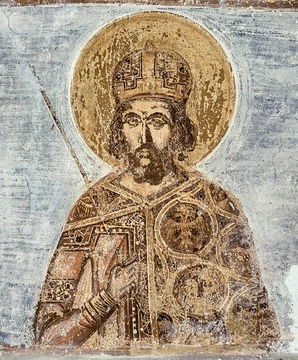
Anastasius I Dicorus
Eastern Roman emperor who reformed finances and built lasting defenses.
Last updated

Miguel Hermoso Cuesta · CC BY-SA 4.0
He was nicknamed Dicorus because he had one black eye and one blue eye, a condition called heterochromia.[1][2] Anastasius I Dicorus, who ruled as Eastern Roman emperor from 491 to 518, was born at Dyrrachium around 430, with his birth date thought to be no later than 431.[3][1][2] Having served as a civil servant, Anastasius ascended to the throne at about 61 years of age after Ariadne, the widow of the previous emperor Zeno, selected him.[3][2]
Life and work
Anastasius was born into an Illyro-Roman family and before becoming emperor he served as a silentiary.[1] He was acclaimed emperor on 11 April 491 and married Ariadne on 20 May 491, but the marriage produced no children.[2] His reign was characterized by reforms in government, finances, economy and bureaucracy, and his stable government allowed the empire to pursue more ambitious policies under his successors.[3] He abolished the unpopular chrysargyron tax on merchants and traders in 498, burning all the associated paperwork in a public spectacle.[4][2]
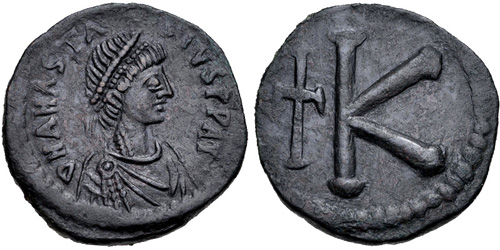
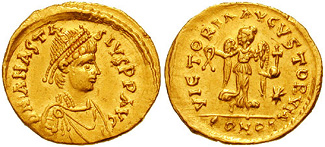
Anastasius revived the complex monetary system in 498, introducing new gold and copper denominations that circulated widely for long after his reign.[5] He built the Anastasian Wall to protect Constantinople and converted his birthplace Dyrrachium into a fortified city with Durrës Castle.[6] He died childless in Constantinople on 9 July 518, and the early 6th-century historian Victor of Tunnuna states he died at age 88.[7][8]
What the cited sources add
The Online Encyclopedia of Roman Emperors account notes that Anastasius was born in Dyrrachium ca. 430 and was a surprise to the aristocracy when chosen by Ariadne.[2] The same source states that Anastasius recognized Theoderic as king in Italy in 497, though conflict briefly ensued over Pannonia in 505-510.[2] That source also records that Anastasius despatched a squadron of a hundred ships to ravage the coasts of Apulia in 508.[9] The Anonymous Valesianus account describes Anastasius attempting to predict his successor by placing a message under one of three couches for his nephews.[10][11]
The Justin I account notes that Anastasius had no immediate heir though he had nephews, one of whom was Hypatius.[12]
References
- Wikipedia, "Anastasius I Dicorus" (CC BY-SA 4.0), which cites: Focanti, "The fragments of late antique patria", University of Gottingen, 1988, p. 214; Croke, "Count Marcellinus and his chronicle", Oxford University Press, 2001, p. 89; Anastasius (AD 491–518) Hugh Elton – Florida International University – An Online Encyclopedia of Roman Emperors; Martindale 1980, p. 78; Ostrogorski, "History of the Byzantine State", Rutgers University Press, 1969, p. 59 (we also read that source) en.wikipedia.org
- Anastasius (AD 491–518) Hugh Elton – Florida International University – An Online Encyclopedia of Roman Emperors. facts only, no text reused. roman-emperors.sites.luc.edu
- Wikipedia, "Anastasius I Dicorus" (CC BY-SA 4.0), which cites: Croke, "Anastasius I", The Classical Review, 1 January 2009, p. 208–210; Treadgold, "A Concise History of Byzantium", Palgrave, 2001, p. 57 (original not read by us) en.wikipedia.org
- Wikipedia, "Anastasius I Dicorus" (CC BY-SA 4.0), which cites: Kaldellis 2023, p. 223 (original not read by us) en.wikipedia.org
- Wikipedia, "Anastasius I Dicorus" (CC BY-SA 4.0), which cites: Pyatnitsky, "New Evidence for Byzantine Activity in the Caucasus During the Reign of the Emperor Anastasius I", American Journal of Numismatics, 1 January 2006, p. 113–122 (original not read by us) en.wikipedia.org
- Wikipedia, "Anastasius I Dicorus" (CC BY-SA 4.0), which cites: Norwich 1988, p. 184; (original not read by us) en.wikipedia.org
- Wikipedia, "Anastasius I Dicorus" (CC BY-SA 4.0), which cites: Marcellinus Comes 518: "The emperor Anastasius died suddenly, aged more than eighty. He reigned for twenty-seven years, two months and twenty-nine days [<nowiki; Zacharias Rhetor VII, xiv: "Anastasius died on the ninth of July."; Theophanes Confessor 518: "On 9 April of the ninth indiction Anastasios the impious emperor died after ruling for 27 years and 7 months." (partially inaccurate) (original not read by us) en.wikipedia.org
- Wikipedia, "Anastasius I Dicorus" (CC BY-SA 4.0), which cites: Chronicon Paschale 518: "Anastasius fell sick... gave up the spirit, aged 90 years and five months. [<nowiki/>Justin] became emperor in the consulship of Magnus; John Malalas XVI, 22. "He was terrified and breathed his last, at the age of 90 years and five months."; Victor of Tunnuna, s.a. 518. "anno viae suae III." [In his 88th year of life, i.e. born in 431]; Martindale 1980, p. 78 (original not read by us) en.wikipedia.org
- , History of the Later Roman Empire, pp. 454–455. facts only, no text reused. penelope.uchicago.edu
- Anonymous Valesianus II, Pars Posterior 74.. facts only, no text reused. penelope.uchicago.edu
- Wikipedia, "Anastasius I Dicorus" (CC BY-SA 4.0), which cites: Anonymous Valesianus II, Pars Posterior 74. (we also read that source) en.wikipedia.org
- "James Allan Evans, "Justin I (518–527 A.D.)"". facts only, no text reused. roman-emperors.sites.luc.edu
Each numbered sentence above was checked against the source it cites before publication. Sentences citing Wikipedia adapt text from the English Wikipedia article Anastasius I Dicorus (contributors), used under CC BY-SA 4.0; this entry is available under the same licence. Other sources were used for facts only; no text or images are copied from them.
More in Emperors Of The Byzantine And Roman World
Sources
Compiled from Wikipedia and the sources listed below. Text from Wikipedia is available under CC BY-SA 4.0; this entry is adapted from it.
- Wikipedia: Anastasius I Dicorus (CC BY-SA 4.0).
Spotted an error? Know more?
Reader corrections go straight into our review queue. Suggest an edit · How this site is sourced