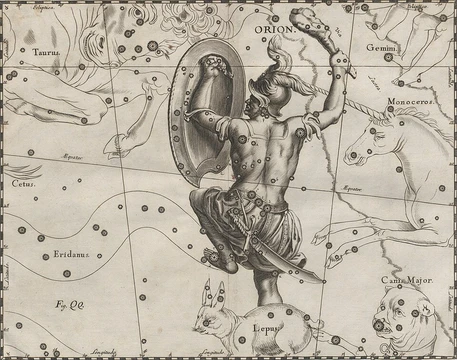
Orion (constellation)
A winter constellation named after a hunter in Greek mythology.
Last updated
Orion is a well-known star pattern that lights up winter skies in the Northern Hemisphere. It is one of the 88 official constellations used today, and it was already cataloged by the 2nd-century astronomer Ptolemy among his 48 constellations. The constellation takes its name from a hunter in Greek mythology. Orion shines brightest on winter evenings in the Northern Hemisphere, joining five other constellations that contribute to the Winter Hexagon asterism.
Features
Its two most brilliant stars, Rigel and Betelgeuse, are both supergiants that vary slightly in brightness and rank among the brightest stars in the entire night sky. Six other stars in Orion are brighter than magnitude 3.0, including the three that form the short, straight line of Orion’s Belt. The constellation is also home to the radiant of the annual Orionid meteor shower—the strongest meteor display linked to Halley’s Comet—and the Orion Nebula, one of the sky’s most luminous nebulae. Orion is bordered by Taurus to the northwest, Eridanus to the southwest, Lepus to the south, Monoceros to the east, and Gemini to the northeast.
Characteristics
Covering 594 square degrees, it ranks 26th in size among the 88 constellations. Its boundaries, defined in 1930 by Belgian astronomer Eugène Delporte, form a 26-sided polygon. In equatorial coordinates, the constellation’s borders span right ascension from 04h 43.3m to 06h 25.5m and declination from 22.87° to −10.97°.
The International Astronomical Union adopted the three-letter abbreviation “Ori” for Orion in 1922. Orion is easiest to see in the evening sky from January to April—winter in the Northern Hemisphere, summer in the Southern. Near the equator (within about 8° latitude), it passes directly overhead. From May to July, Orion is in the daytime sky and invisible from most places on Earth.
However, in much of Antarctica during the Southern Hemisphere’s winter, the Sun stays below the horizon even at noon, so the brightest stars—including Orion’s—can be glimpsed at twilight for a few hours around local noon, low in the northern sky where the Sun is just beneath the horizon. At the South Pole itself, Rigel rises only 8° above the horizon, and the Belt sweeps along it. During the Southern Hemisphere’s summer, when Orion is normally visible at night, it cannot be seen in Antarctica because the Sun never sets south of the Antarctic Circle. In countries near the equator, such as Kenya, Indonesia, Colombia, and Ecuador, Orion appears overhead around midnight in December and in the evening sky in February.
Navigational aid
Orion is a handy guide for finding other stars. Extending the line of the Belt southeastward leads to Sirius; northwestward points to Aldebaran. A line eastward across Orion’s two shoulders points toward Procyon. A line from Rigel through Betelgeuse points to Castor and Pollux.
Rigel is also part of the Winter Circle asterism, and both Sirius and Procyon—which can be located using Orion—are part of the Winter Triangle and the Winter Circle. The seven brightest stars in Orion form a distinctive hourglass shape. Four stars—Rigel, Betelgeuse, Bellatrix, and Saiph—make a large, roughly rectangular frame, with the three stars of Orion’s Belt (Alnitak, Alnilam, and Mintaka) at the center. A fairly bright star called Meissa marks the hunter’s head.
Below the Belt, a smaller line of three stars forms Orion’s Sword; the middle “star” in this line is actually the Orion Nebula. Many of these stars are hot, luminous blue supergiants, and the stars of the Belt and Sword belong to the Orion OB1 association. Betelgeuse, with its distinctive red hue, may be a runaway member of the same group. Betelgeuse, also called Alpha Orionis, is a massive M-type red supergiant nearing the end of its life.
It is the second-brightest star in Orion and a semiregular variable. It marks the hunter’s right shoulder (assuming he faces the observer). Usually the 11th-brightest star in the night sky, its brightness has varied from 10th to 23rd by the end of 2019.
Its eventual supernova explosion will be highly visible from Earth, possibly outshining the Moon and appearing during the day, likely within the next 100,000 years. Rigel, or Beta Orionis, is a B-type blue supergiant and the seventh-brightest star in the night sky. Like Betelgeuse, it is fusing heavy elements in its core and will soon pass through its supergiant stage on an astronomical timescale, possibly ending in a supernova. It marks the hunter’s left foot.
Bellatrix, designated Gamma Orionis by Johann Bayer, is the 27th-brightest star in the night sky. It is a B-type blue giant, but too small to explode as a supernova. Its brightness comes from its high temperature rather than a large radius. Bellatrix marks Orion’s left shoulder.
Lore & Background
Covering 594 square degrees, Orion ranks 26th of the 88 constellations in size. The constellation boundaries, as set by Belgian astronomer Eugène Delporte in 1930, are defined by a polygon of 26 sides. In the equatorial coordinate system, the right ascension coordinates of these borders lie between 04h 43.3m and 06h 25.5m, while the declination coordinates are between 22.87° and −10.97°. The constellation's three-letter abbreviation, as adopted by the International Astronomical Union in 1922, is 'Ori'.
Orion is most visible in the evening sky from January to April, winter in the Northern Hemisphere, and summer in the Southern Hemisphere. In the tropics (less than about 8° from the equator), the constellation transits at the zenith. From May to July (summer in the Northern Hemisphere, winter in the Southern Hemisphere), Orion is in the daytime sky and thus invisible at most latitudes. However, for much of Antarctica in the Southern Hemisphere's winter months, the Sun is below the horizon even at midday.
Stars (and thus Orion, but only the brightest stars) are then visible at twilight for a few hours around local noon, just in the brightest section of the sky low in the North where the Sun is just below the horizon. At the same time of day at the South Pole itself (Amundsen–Scott South Pole Station), Rigel is only 8° above the horizon, and the Belt sweeps just along it. In the Southern Hemisphere's summer months, when Orion is normally visible in the night sky, the constellation is actually not visible in Antarctica because the Sun does not set at that time of year south of the Antarctic Circle. In countries close to the equator (e.g. Kenya, Indonesia, Colombia, Ecuador), Orion appears overhead in December around midnight and in the February evening sky.
Mythological Roots & Astronomical Heritage
Orion carries the name of a hunter from Greek mythology, a designation that has persisted since at least the 2nd century AD when the astronomer Ptolemy catalogued it among his 48 constellations. Today it holds its place as one of the 88 modern constellations recognized by the International Astronomical Union, whose three-letter abbreviation "Ori" was formally adopted in 1922. The constellation's boundaries were precisely defined in 1930 by Belgian astronomer Eugène Delporte as a 26-sided polygon, spanning 594 square degrees and ranking 26th in size among all 88.
Its right ascension stretches from 04h 43.3m to 06h 25.5m, while declination ranges from +22.87° to −10.97°. Orion is flanked by Taurus to the northwest, Eridanus to the southwest, Lepus to the south, Monoceros to the east, and Gemini to the northeast. This constellation has thus maintained an unbroken thread of astronomical recognition from the ancient Mediterranean world through modern international standardization.
The Hunter's Stellar Anatomy
The seven brightest stars of Orion arrange themselves into a striking hourglass pattern. Four stars—Rigel, Betelgeuse, Bellatrix, and Saiph—outline a broad rectangle, with the three stars of Orion's Belt (Alnitak, Alnilam, and Mintaka) sitting at its center. An eighth star, Meissa, marks the hunter's head, while a descending trio called Orion's Sword hangs below the Belt; notably, the middle element of this sword is not a star at all but the luminous Orion Nebula. Many of these stars are hot blue supergiants grouped in the Orion OB1 association, though Betelgeuse stands apart as a red supergiant nearing the end of its life.
Rigel, a B-type blue supergiant and the seventh-brightest star visible from Earth, fuses heavy elements in its core and may one day end in a supernova. Betelgeuse, generally the 11th-brightest star (though its ranking has fluctuated between tenth and 23rd), is expected to produce a supernova visible from Earth within roughly 100,000 years, potentially outshining the Moon. Bellatrix, the "Amazon Star" at the left shoulder, is the closest major star in the constellation at 244.6 light-years.
Seasonal Drama & Global Visibility
Orion commands the winter evening sky of the Northern Hemisphere, sharing that seasonal spotlight with five other constellations whose stars form the Winter Hexagon asterism. It is most visible from January through April, and in equatorial nations like Kenya, Indonesia, Colombia, and Ecuador, it transits nearly overhead around midnight in December and fills the February evening sky. The constellation's visibility, however, is far from uniform across the globe. From May to July, Orion sits in the daytime sky and vanishes at most latitudes.
Yet in Antarctica the situation inverts: during the Southern Hemisphere's winter, the Sun stays below the horizon even at midday, allowing Orion's brightest stars to appear in twilight low in the northern sky for a few hours around local noon. At the Amundsen-Scott South Pole Station, Rigel sits just 8 degrees above the horizon while the Belt sweeps along it. Conversely, during the Southern Hemisphere's summer—when Orion would normally dominate the night sky—the midnight sun renders it invisible south of the Antarctic Circle.
Cosmic Wayfinder & Deep-Sky Treasures
Beyond its mythological allure, Orion serves as a practical celestial compass. Extending the Belt's line southeastward leads the eye to Sirius, while pointing northwestward reveals Aldebaran. A line drawn eastward across the two shoulders indicates Procyon, and a line from Rigel through Betelgeuse points toward Castor and Pollux. Rigel also anchors the Winter Circle asterism, and both Sirius and Procyon—locatable from Orion—form vertices of the Winter Triangle.
The constellation also hosts the radiant of the Orionids, the most powerful meteor shower linked to Halley's Comet, and the Orion Nebula, one of the brightest nebulae visible in the night sky. Mintaka, the westernmost and northernmost Belt star, is actually a multiple system of a B-type blue giant and a more massive O-type main-sequence star, functioning as an eclipsing binary whose periodic dimming reveals the orbit of its companion. Alnilam, the middle and brightest Belt star, is a B-type blue supergiant nearly twice as distant from the Sun as its Belt neighbors.
Reader's Guide
Orion is very useful as an aid to locating other stars. By extending the line of the Belt southeastward, Sirius (α CMa) can be found; northwestward, Aldebaran (α Tau). A line eastward across the two shoulders indicates the direction of Procyon (α CMi).
A line from Rigel through Betelgeuse points to Castor and Pollux (α Gem and β Gem). Additionally, Rigel is part of the Winter Circle asterism. Sirius and Procyon, which may be located from Orion by following imaginary lines, also are points in both the Winter Triangle and the Circle.
Orion's seven brightest stars form a distinctive hourglass-shaped asterism, or pattern, in the night sky. Four stars—Rigel, Betelgeuse, Bellatrix, and Saiph—form a large roughly rectangular shape, at the center of which lie the three stars of Orion's Belt—Alnitak, Alnilam, and Mintaka. His head is marked by an additional eighth star called Meissa, which is fairly bright to the observer.
Descending from the Belt is a smaller line of three stars, Orion's Sword (the middle of which is in fact not a star but the Orion Nebula), also known as the hunter's sword. Many of the stars are luminous hot blue supergiants, with the stars of the Belt and Sword forming the Orion OB1 association. Standing out by its red hue, Betelgeuse may nevertheless be a runaway member of the same group.
Betelgeuse, also designated Alpha Orionis, is a massive M-type red supergiant star nearing the end of its life. It is the second-brightest star in Orion, and is a semiregular variable star. It serves as the right shoulder of the hunter (assuming that he is facing the observer).
It is generally the 11th-brightest star in the night sky, but this has varied between being the tenth to the 23rd-brightest by the end of 2019. The end of its life is expected to result in a supernova explosion that will be highly visible from Earth, possibly outshining the Moon and being visible during the day. This is most likely to occur within the next 100,000 years.
Rigel, also known as Beta Orionis, is a B-type blue supergiant that is the seventh-brightest star in the night sky. Similar to Betelgeuse, Rigel is fusing heavy elements in its core and will pass its supergiant stage soon (on an astronomical timescale), possibly eventually ending in a supernova explosion. It serves as the left foot of the hunter.
Frequently Asked Questions
What is the Orion constellation?
Orion is a winter constellation in the northern celestial hemisphere, named after a hunter from Greek mythology. It is one of the 88 officially recognized constellations and was included in Ptolemy's 2nd-century catalog of 48.
What is the mythological story behind Orion?
In Greek mythology, Orion was a giant hunter, and the constellation preserves his image as a figure with a belt of three stars. His story typically involves his hubris and eventual death, often at the hands of a scorpion sent by Gaia.
More in Constellations
Sources
Compiled from Wikipedia and the sources listed below. Text from Wikipedia is available under CC BY-SA 4.0; this entry is adapted from it.
- Wikipedia: Orion (constellation) (CC BY-SA 4.0).
Spotted an error? Know more?
Reader corrections go straight into our review queue. Suggest an edit · How this site is sourced