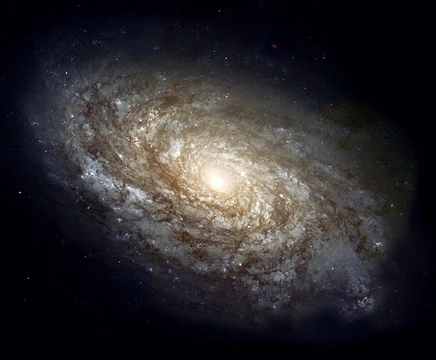
Abell 963 BCG
Massive cD elliptical, brightest cluster galaxy of Abell 963.

Abell 963 BCG, the brightest cluster galaxy in the Abell 963 cluster, is a massive Type-cD elliptical found in Leo Minor. Discovered in November 1965, it was initially described as a supergiant galaxy that may have a double nucleus. With a redshift of 0.205, this galaxy shows no emission lines in its optical spectrum and is considered a fossil galaxy. Its estimated luminosity is 7.08 ± 0.21 × 10¹¹ solar luminosities, and its total stellar mass is about 1.56 × 10¹² solar masses. The galaxy is roughly 10.8 billion years old. Its core appears red based on its color profile, and the total ultraviolet star formation rate is about 2.70 solar masses per year. The central velocity dispersion is 337 ± 6 kilometers per second. In June 1988, a study reported two patchy blue arc structures on either side of the galaxy, lying within its extended envelope. One arc sits 18.5 arcseconds away at a position angle of 70°, while the other is 12 arcseconds away at 30°. The BCG itself is large and elliptical, with an estimated axis diameter of 110 kiloparsecs. Its major axis bisects one or both of these arc structures.
- Type
- cD elliptical
- Constellation
- Leo Minor
- Redshift
- 0.205
- Discovery date
- November 1965
- Luminosity
- 7.08 ± 0.21 × 10^11 L☉
- Stellar mass
- 1.56 × 10^12 M☉
- Age
- 10.8 billion years
- Central velocity dispersion
- 337 ± 6 km/s
- Axis diameter
- 110 kiloparsecs
Lore & Background
Abell 963 BCG was first discovered in November 1965 by astronomers who noted it as a supergiant galaxy possibly containing a double nucleus. It is the brightest cluster galaxy of the X-ray luminous galaxy cluster Abell 963. The galaxy displays no signs of any emission lines in its optical spectrum and is categorized as a fossil galaxy. Its estimated luminosity is 7.08 ± 0.21 × 10^11 L☉, with a total stellar mass of 1.56 × 10^12 M☉ and an age of about 10.8 billion years. The core of the BCG has a red appearance based on its color profile shape, and the total ultraviolet star formation has been estimated at 2.70 M☉ per year. A central velocity dispersion of 337 ± 6 kilometers per second has been calculated for the BCG.
Reader's Guide
A study in June 1988 reported two patchy blue arc structures positioned on both sides of the BCG, located within its extended envelope. The first arc is estimated to be 18.5 arcseconds away with a position angle of 70°, while the other arc is 12 arcseconds away with a position angle of 30°. The BCG itself is both large and has an elliptical appearance with an estimated axis diameter of 110 kiloparsecs. The major axis of the BCG also bisects one or both arc structures. These features contribute to the galaxy's significance as a fossil galaxy with no emission lines, offering insights into the evolution of massive cluster galaxies and their interactions with surrounding structures. Its legacy lies in its role as a central dominant galaxy in an X-ray luminous cluster, with the arc structures possibly indicating gravitational lensing or tidal interactions, though the article does not specify their origin.
Did You Know?
- Two patchy blue arc structures were reported in June 1988, located on both sides of the BCG within its extended envelope.
- The BCG has an estimated age of 10.8 billion years and a total stellar mass of 1.56 × 10^12 M☉.
Frequently Asked Questions
What is Abell 963 BCG and what type of galaxy is it?
Abell 963 BCG is the brightest cluster galaxy in the Abell 963 cluster, classified as a massive cD elliptical. It sits in the constellation Leo Minor and is estimated to be roughly 10.8 billion years old, making it one of the oldest systems we can study.
How massive and luminous is Abell 963 BCG compared to the Milky Way?
Its total stellar mass is about 1.56 × 10¹² solar masses, and it shines at roughly 7.08 × 10¹¹ solar luminosities (with an uncertainty of ±0.21 × 10¹¹). That puts it in the supergiant category, vastly outshining our own galaxy.
Why is Abell 963 BCG called a 'fossil galaxy'?
The designation comes from the fact that its optical spectrum shows no emission lines at all, meaning there is little to no ongoing star formation or ionized gas activity. Fans and researchers treat it as a relic of an earlier cosmic era, essentially frozen in time.
When was Abell 963 BCG discovered and what did early observers think they saw?
It was first identified in November 1965, and the initial description called it a supergiant galaxy that might possess a double nucleus. That early hint of a paired core has kept it interesting to observers ever since.
What does the redshift of Abell 963 BCG tell us about its distance?
With a redshift of 0.205, the galaxy is receding fast enough to place it well beyond the local universe, roughly 2.4 billion light-years away in standard cosmological estimates. That distance is also why its core color profile appears distinctly red, consistent with an old, metal-rich stellar population.
More in Elliptical and Irregular Galaxies, Part 2 1-24
Spotted an error? Know more?
Reader corrections go straight into our review queue. Suggest an edit · How this site is sourced