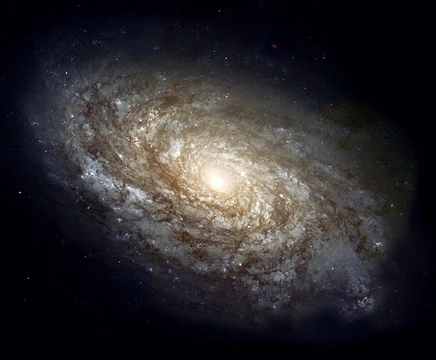
6C B091638.9+362215
A massive elliptical radio galaxy in Lynx, BCG of cluster WHL J091944.8+360949.

6C B091638.9+362215, also cataloged as OGC 151, J091944.82+360949.4, and NYU-VAGC 0986260, is a radio galaxy in the constellation Lynx. It was first identified in 1973 from a sample of 3,227 radio sources observed with the Bologna Cross Telescope, where it received the designation B2 0916+36A. This galaxy is a massive Type E elliptical and a luminous red galaxy, serving as the brightest cluster galaxy (BCG) of the cluster WHL J091944.8+360949, which has eight confirmed member candidates. Its redshift (z) is 0.223, and the Sloan Digital Sky Survey (SDSS) measures its r-band magnitude at 16.38. The absolute magnitude is -23.86, with a stellar mass of 11.49 h⁻² M☉. At its center lies a supermassive black hole with a mass of 9.04 M☉.
The galaxy has an active nucleus and is classified as a Fanaroff-Riley Class Type I radio galaxy. The NRAO VLA Sky Survey reports a total radio flux density of 130.40 mJy at 1.4 GHz. Its optical spectrum shows both hydrogen-alpha and doubly ionized oxygen emission lines, with estimated luminosities of 6.579 and 6.861 L☉, respectively. The radio lobes are resolved, spanning a total size of 212.30 kiloparsecs. A 2019 study identified it as a C-shaped radio galaxy, with a total extent of 0.27 megaparsecs and a total radio luminosity at 1.4 GHz of 25.36 W Hz⁻¹. It resides in a poor galaxy environment, with the cluster having a richness of less than 10. A separate 2018 study estimated its radio luminosity at 25.31 W Hz⁻¹ and its 1.4 GHz flux density at 142.8 mJy. Classified as an early-type galaxy (class b radio galaxy), its stellar velocity dispersion is 328 kilometers per second, and its effective radius is 15.1 kiloparsecs.
- Redshift
- 0.223
- R-band magnitude
- 16.38
- Absolute magnitude
- -23.86
- Stellar mass
- 11.49 h−2 M☉
- Supermassive black hole mass
- 9.04 M☉
- Total radio flux density (1.4 ghz)
- 130.40 mJy
- Total radio luminosity (1.4 ghz)
- 25.36 W Hz−1
Lore & Background
6C B091638.9+362215 was first discovered in 1973 from a sample of 3,227 radio sources observed with the Bologna Cross Telescope, where it was designated B2 0916+36A. It is classified as a massive Type E elliptical galaxy and a luminous red galaxy, with its r-band magnitude calculated at 16.38 by the Sloan Digital Sky Survey. The galaxy resides as the brightest cluster galaxy of the cluster WHL J091944.8+360949, which has eight confirmed member candidates. Its nucleus is active, and it has been classified as a Fanaroff-Riley Class Type I radio galaxy. The optical spectrum displays both hydrogen-alpha and doubly ionized oxygen emission lines, with estimated luminosities of 6.579 and 6.861 L☉ respectively. Both radio lobes are resolved, with a total lobe size of 212.30 kiloparsecs.
Reader's Guide
A study published in 2019 found that 6C B091638.9+362215 is a C-shaped radio galaxy, with a total extent of 0.27 megaparsecs and a total radio luminosity at 1.4 GHz estimated at 25.36 W Hz−1. It resides in a poor galaxy environment, with the cluster having a richness less than 10. A study published in 2018 estimated the radio luminosity as 25.31 W Hz−1 and the 1.4 GHz flux density as 142.8 mJy. The galaxy is an early-type galaxy based on its categorization as a class b radio galaxy. Its stellar velocity dispersion is 328 kilometers per second, and its effective radius is 15.1 kiloparsecs. The supermassive black hole at its center has a mass of 9.04 M☉. The galaxy's significance lies in its role as a BCG in a poor cluster, its C-shaped morphology, and its well-studied radio properties across multiple surveys.
Frequently Asked Questions
What is 6C B091638.9+362215?
It is a massive Type E elliptical galaxy and radio source situated in the constellation Lynx. The object appears in multiple catalogs under names such as OGC 151, J091944.82+360949.4, and NYU-VAGC 0986260.
What role does 6C B091638.9+362215 play in its cluster?
It acts as the brightest cluster galaxy (BCG) of the group WHL J091944.8+360949, which has eight confirmed member candidates. As a luminous red galaxy, it outshines every other member in that cluster.
How massive is 6C B091638.9+362215?
Its stellar mass is estimated at roughly 11.49 h⁻² solar masses, and it hosts a central supermassive black hole. These figures place it squarely among the most massive ellipticals known in its cluster.
What are the key measurements for 6C B091638.9+362215?
SDSS records an r-band magnitude of 16.38 and an absolute magnitude of −23.86, with a redshift of 0.223. Its total radio flux density at 1.4 GHz is measured at 130.40 mJy.
How was 6C B091638.9+362215 first discovered?
It was identified in 1973 as part of a survey of 3,227 radio sources observed with the Bologna Cross Telescope. In that original Bologna catalog it carried the designation B2 0916+36A before receiving its current 6C name.
More in Elliptical and Irregular Galaxies, Part 2 1-24
Spotted an error? Know more?
Reader corrections go straight into our review queue. Suggest an edit · How this site is sourced