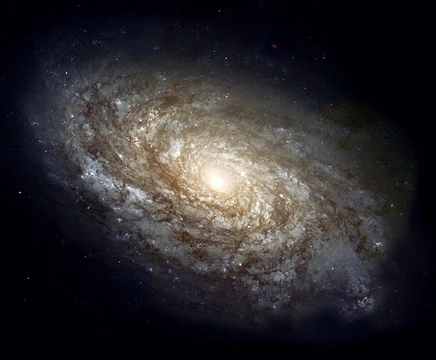
Abell 267 BCG
A radio-quiet brightest cluster galaxy in a fossil cluster.

Abell 267 BCG (Brightest Cluster Galaxy) is a massive type-cD galaxy that serves as the central dominant galaxy of the fossil galaxy cluster Abell 267. It is notable for being radio-quiet, displaying no signs of associated radio emission at six centimeters, and for its red core and absence of emission lines in its optical spectrum.
- Redshift
- 0.229
- Discovery date
- January 1993
- R-band magnitude
- 15.72
- Effective surface brightness
- 19.50 ± 0.12 magnitudes per arcsecond square
- Supermassive black hole mass
- 2.11 × 10^9 M☉
- Central velocity dispersion
- 321 ± 8 km/s
- Total stellar mass
- 12.42+0.01−0.02 M☉
Lore & Background
Abell 267 BCG was first discovered in January 1993 by astronomers. It resides as the brightest cluster galaxy in the fossil galaxy cluster Abell 267, with a redshift of 0.229. When observed with the Very Large Array (VLA) at six centimeters, it displays no signs of any associated radio emission, making it technically radio-quiet, with total radio power estimated at less than 23.55 W Hz−1. The BCG also shows an absence of emission lines in its own optical spectrum, and no radio flux was detected based on optical follow-up studies.
The core of the BCG has a red appearance based on its inner color profile shape. Its projected offset relative to the X-ray emission peak of the cluster is estimated at 77.5 kiloparsecs. A study published in 2012 found it belongs to a fossil galaxy cluster and determined its R-band magnitude as 15.72, with an effective surface brightness of 19.50 ± 0.12 magnitudes per arcsecond square. The supermassive black hole at its center has an estimated mass of 2.11 × 10^9 M☉, and the galaxy's rotation is estimated at 0.05 ± 0.06 Vmax with a central velocity dispersion of 321 ± 8 km/s.
Evidence suggests the BCG has an unresolved radio source based on VLA observations at 1.4 GHz frequencies, with total radio luminosity less than 21.3 × 10^38 keV s−1 Hz−1. The radio core imaged at 10 GHz has an upper limit of less than 0.18 mJy with a flat normalization of 0.29. A study published in 2016 found the BCG has an intermediate stellar population of stars aged 4,070 ± 130 and 4,010 ± 200 million years respectively. Its total stellar mass is calculated as 12.42+0.01−0.02 M☉ with a stellar velocity dispersion of 297 ± 16 km/s, and the total ultraviolet star formation rate is estimated at 2.86 M☉ per year.
Reader's Guide
Abell 267 BCG is significant as a massive type-cD galaxy that serves as the brightest cluster galaxy in a fossil galaxy cluster, a rare type of cluster dominated by a single giant elliptical. Its radio-quiet nature, with no detected radio emission at six centimeters and an absence of emission lines, distinguishes it from many other BCGs that often host active radio jets. The galaxy's red core and unresolved radio source at 1.4 GHz suggest a quiescent central engine, while the estimated supermassive black hole mass of 2.11 × 10^9 M☉ and intermediate stellar population ages around 4 billion years provide insights into its evolutionary history. The measured offset of 77.5 kiloparsecs from the cluster's X-ray peak hints at past dynamical interactions. Its legacy lies in offering a case study of a fossil group BCG that is both massive and radio-quiet, contributing to understanding galaxy formation in dense environments.
Did You Know?
- It has a supermassive black hole with an estimated mass of 2.11 × 10^9 M☉.
- The galaxy is radio-quiet, with total radio power less than 23.55 W Hz−1.
- Its stellar population is intermediate-aged, around 4,070 and 4,010 million years.
Frequently Asked Questions
What is Abell 267 BCG?
Abell 267 BCG is a massive cD-type elliptical galaxy that sits at the gravitational heart of the fossil cluster Abell 267, at a redshift of 0.229. It was catalogued in January 1993 and appears at an R-band magnitude of 15.72.
Why is Abell 267 BCG called a 'fossil' cluster galaxy?
The 'fossil' label means this galaxy so overwhelmingly outshines every other cluster member that no second galaxy rivals it in luminosity. It effectively stands alone as the singular dominant anchor of the Abell 267 system.
What does 'radio-quiet' mean for Abell 267 BCG?
No associated radio emission is detected at six centimeters, so the galaxy lacks the extended jets or lobes typical of radio-loud brightest cluster galaxies. Together with its red core and the absence of emission lines in its optical spectrum, this points to a quiescent, aging central engine.
How massive is the supermassive black hole in Abell 267 BCG?
Dynamical estimates place the central black hole at roughly 2.11 billion solar masses. That figure is derived from the galaxy's central velocity dispersion of 321 ± 8 km/s.
What are Abell 267 BCG's surface brightness and spectral traits?
Its effective surface brightness is 19.50 ± 0.12 mag per square arcsecond, consistent with a bright, extended elliptical profile. Spectroscopically the galaxy shows a red core and no detectable emission lines, indicating an old stellar population with little ongoing star formation.
More in Elliptical and Irregular Galaxies, Part 2 1-24
Spotted an error? Know more?
Reader corrections go straight into our review queue. Suggest an edit · How this site is sourced