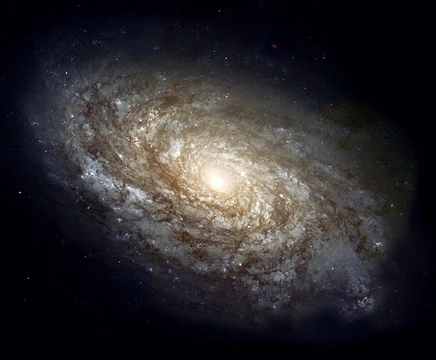
6C B084407.8+582055
Elliptical radio galaxy and brightest cluster galaxy in Ursa Major.

6C B084407.8+582055, also designated J084803.3+580947, is a radio galaxy in the constellation Ursa Major. First identified in the 1990 Sixth Cambridge Survey of Radio Sources, it is an elliptical galaxy (type E) and serves as the brightest cluster galaxy (BCG) for the cluster WHL J084803.3+580948. Its redshift is 0.221618, and its r-band magnitude is 15.93. Classified as a red luminous galaxy, it hosts an active nucleus and is a Fanaroff-Riley Class Type II radio source. The central supermassive black hole has a mass of 9.10 solar masses, and its accretion disk emits at a luminosity of 43.95 ergs per second. The radio source spans 27 arcseconds (96.47 kiloparsecs linearly), with a flux density of 58.7 mJy at 1.4 GHz and a total radio luminosity of 25.41 watts per hertz at that frequency. The source is straight, with a position angle of 165.1°, and shows no detected radio core or hot spots. A 2013 study resolved the radio lobes, which together measure 48.24 kiloparsecs. The galaxy also exhibits emission lines of hydrogen-alpha and doubly ionized oxygen, with luminosities of 7.061 and 7.068 solar luminosities, respectively. A radio jet is present, with an estimated power of 44.47 ergs per second.
- Redshift
- 0.221618
- Morphological classification
- E
- Total r-band magnitude
- 15.93
- Central supermassive black hole mass
- 9.10 M☉
- Accretion disk luminosity
- 43.95 ergs−1
- Total angular size
- 27 arcseconds
- Total linear size
- 96.47 kiloparsecs
- Radio flux density at 1.4 ghz
- 58.7 mJy
- Total 1.4 ghz radio luminosity
- 25.41 W Hz−1
- Radio source position angle
- 165.1°
Lore & Background
6C B084407.8+582055 is an elliptical galaxy with an active nucleus, categorized as a Fanaroff-Riley Class Type II radio galaxy. The galaxy hosts a central supermassive black hole with a mass of 9.10 M☉, and its accretion disk has a luminosity of 43.95 ergs−1. The radio source is straight at a position angle of 165.1°, with no detections of either a radio core or hot spot features. A study published in 2013 showed that the radio lobes are resolved, with a total size of 48.24 kiloparsecs. The galaxy also exhibits a radio jet with an estimated jet power of 44.47 ergs−1.
Reader's Guide
6C B084407.8+582055 is significant as a red luminous galaxy and the brightest cluster galaxy of WHL J084803.3+580948, making it a key object for studying galaxy cluster dynamics and evolution. Its classification as a Fanaroff-Riley Class Type II radio galaxy indicates powerful radio emission driven by its active nucleus, with resolved radio lobes and a straight jet. The detection of hydrogen-alpha and doubly ionized oxygen emission lines provides insight into the ionized gas content and star formation activity within the galaxy. The absence of a detected radio core or hot spots suggests that the radio emission may be dominated by extended lobe structures rather than compact features. The galaxy's redshift of 0.221618 places it at a substantial distance, and its total linear size of 96.47 kiloparsecs underscores its large physical extent. The radio flux density and luminosity at 1.4 GHz further characterize its radio power, contributing to the understanding of radio galaxy populations in the Sixth Cambridge Survey.
Did You Know?
- The galaxy has a central supermassive black hole mass of 9.10 M☉.
- Its radio lobes have a total size of 48.24 kiloparsecs.
- The galaxy is the brightest cluster galaxy of the cluster WHL J084803.3+580948.
- It was first discovered from the Sixth Cambridge Survey of Radio Sources in 1990.
More in Elliptical and Irregular Galaxies, Part 2 1-24
Spotted an error? Know more?
Reader corrections go straight into our review queue. Suggest an edit · How this site is sourced