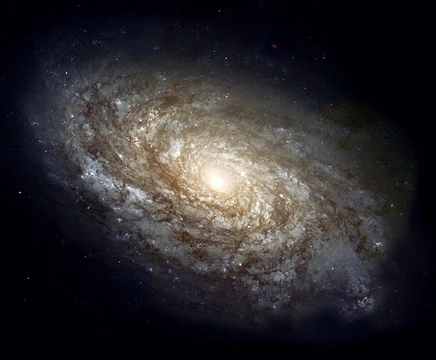
Abell 697 BCG
Massive cD elliptical galaxy dominating Abell 697 cluster center.

Abell 697 BCG (Brightest Cluster Galaxy), also known as OGC 43, is a massive elliptical galaxy of Type-cD located in the constellation of Lynx. It is the brightest cluster galaxy of the galaxy cluster Abell 697, with a redshift of 0.282. The galaxy is notable for its dominant position at the cluster center, a large and slightly asymmetric halo, and evidence of a secondary nucleus, suggesting a history of multiple galaxy mergers.
- Type
- cD elliptical galaxy
- Redshift
- 0.282
- V band magnitude
- 18.1
- R band magnitude
- 15.1
- Total infrared star formation rate
- 13.33 M☉ per year
- Total stellar mass
- 13.70 × 10^10 M☉
- Radio power at 1.4 ghz
- 23.30 W Hz−1
Lore & Background
Abell 697 BCG is an elliptical galaxy that dominates the center of its cluster. It displays a galactic halo with a v band magnitude of 18.1. The halo has a roughly elliptical shape but becomes slightly asymmetric at larger radii, with its extension visible up to 40 arcseconds toward the southeast. The inner isophotes are oriented at a position angle of 163°. A secondary nucleus is present in the northwest direction, with evidence of an extended low surface brightness feature from its center. It is suggested that the halo formed through several galaxy mergers.
The core of the BCG has a red appearance based on its inner color profile. The BCG is offset from the X-ray emission peak of the cluster by 20.3 kiloparsecs. The radio core has a flux density less than 0.21 mJy in total, and the optical spectrum lacks emission lines. The total radio power has an estimated spectral density flux of 23.30 W Hz−1 at 1.4 GHz frequencies. The galaxy also belongs to a fossil galaxy group.
Reader's Guide
Abell 697 BCG is significant as the brightest cluster galaxy of Abell 697, a massive cD elliptical that anchors its cluster. Its asymmetric halo and secondary nucleus indicate a history of mergers, which likely built its extended structure. The galaxy's offset from the X-ray emission peak by 20.3 kiloparsecs suggests dynamical interactions within the cluster. The lack of emission lines in its optical spectrum and low radio core flux density point to a quiescent central engine, while its total radio power at 1.4 GHz provides a measure of its non-thermal emission. Its membership in a fossil galaxy group adds context to its evolutionary state. The galaxy's red core and star formation rate of 13.33 M☉ per year, along with a stellar mass of 13.70 × 10^10 M☉, characterize its current activity and mass. These features make it a key object for studying galaxy evolution in dense cluster environments.
Did You Know?
- Abell 697 BCG has a secondary nucleus in the northwest direction.
- The galaxy is offset from the X-ray emission peak of its cluster by 20.3 kiloparsecs.
- Its total infrared star formation rate is estimated at 13.33 M☉ per year.
- The optical spectrum of the BCG lacks emission lines.
Frequently Asked Questions
What is Abell 697 BCG?
Abell 697 BCG, also catalogued as OGC 43, is a massive cD-type elliptical galaxy that sits at the gravitational heart of the Abell 697 cluster. It holds the title of brightest cluster galaxy within that group and is visible in the night-sky constellation of Lynx.
What type of galaxy is Abell 697 BCG?
It is classified as a cD elliptical, meaning it possesses an extended, diffuse halo that blends into the surrounding cluster environment. This 'cD' designation sets it apart from ordinary ellipticals by its particularly large and luminous outer envelope.
What makes Abell 697 BCG unusual among elliptical galaxies?
Observers have detected a secondary nucleus within the galaxy, alongside a large but slightly lopsided halo, both of which point to a past shaped by several major mergers. These structural scars make it a useful natural laboratory for studying how giant ellipticals grow.
How massive is Abell 697 BCG and is it still forming stars?
Its stellar mass works out to roughly 13.7 × 10¹⁰ solar masses, placing it firmly among the most massive galaxies known. Despite its elliptical classification, infrared measurements indicate it is still producing stars at a rate of about 13.3 solar masses per year.
What is the redshift of Abell 697 BCG and what does that tell us?
The galaxy has a redshift of 0.282, which corresponds to a considerable cosmological distance and means its light has been stretched by the expansion of the universe. Its r-band magnitude of 15.1 and v-band magnitude of 18.1 reflect how bright it appears through standard optical filters.
More in Elliptical and Irregular Galaxies, Part 2 1-24
Spotted an error? Know more?
Reader corrections go straight into our review queue. Suggest an edit · How this site is sourced