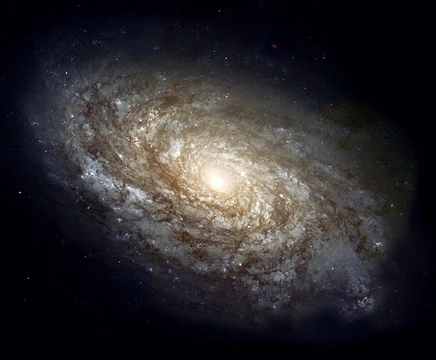
Abell 521 BCG
Massive elliptical with multiple nuclei and galactic cannibalism evidence.

Abell 521 BCG (Brightest Cluster Galaxy) is a massive elliptical galaxy that serves as the brightest cluster galaxy of the young, rich merging Bautz-Morgan Class type III galaxy cluster Abell 521. Located in the constellation Eridanus at a redshift of 0.248, it is notable for its multiple nuclei and evidence of ongoing galactic cannibalism.
- Redshift
- 0.248
- Constellation
- Eridanus
- Radio flux density at 610 mhz
- 0.47 mJy
- Radio power
- 22.92 W Hz−1
- Total stellar mass
- 0.55 × 10^12 M☉
- Mass of three gravitationally bound knot
- 7.97 × 10^10 M☉
- Offset peak from cluster
- 32.8 kiloparsecs
Lore & Background
Abell 521 BCG is an early-type galaxy containing an unresolved radio source. It exhibits multiple nuclei, including a secondary nucleus and three smaller, fainter ones in its inner regions. One nucleus shows a measured peculiar motion of -413 ± 57 km/s and distorted isophotes, indicating an interaction. These multiple nuclei are interpreted as remains of galaxies that have merged with the BCG through galactic cannibalism.
The galaxy features bright extended knot features superposed on an arc-like structure. Three of these knots are gravitationally bound to the BCG, with a combined mass of 7.97 × 10^10 M☉. The arc-like structure has a curvature of approximately 7.5 arcseconds and is centered nearly on the BCG's position. The BCG extends more than 20 × 30 arcseconds, with total surface brightness between 22 and 27 arcsec−2 based on a de Vaucouleurs profile.
The core of the BCG has a red appearance from its inner color profile. It has an offset peak of 32.8 kiloparsecs from the cluster and lies in the X-ray northern group region. Four blob features are found inside the arc-like structure within 24 kiloparsecs of the BCG's center. The BCG lacks both hydrogen-alpha emission and optical emission lines.
Reader's Guide
Abell 521 BCG is significant as a massive elliptical galaxy that serves as the brightest cluster galaxy of a young, rich merging cluster, providing a laboratory for studying galactic cannibalism. The presence of multiple nuclei, one with a measured peculiar motion and distorted isophotes, directly supports the process of galaxy mergers within the cluster environment. The arc-like structure with gravitationally bound knots and blob features further indicates ongoing dynamical interactions. The galaxy's offset peak from the cluster center and its location in the X-ray northern group region suggest it is not yet dynamically relaxed. The absence of hydrogen-alpha and optical emission lines indicates a lack of ongoing star formation, consistent with its early-type classification. Its radio emission, though unresolved, adds to its characterization as a radio source. The measured stellar mass and surface brightness profile provide quantitative data for understanding the evolution of BCGs in merging clusters.
Did You Know?
- Abell 521 BCG has a redshift of 0.248 and is located in the constellation Eridanus.
- It contains multiple nuclei, including a secondary nucleus and three smaller faint ones, suggesting galactic cannibalism.
- One nucleus has a measured peculiar motion of -413 ± 57 km/s with distorted isophotes.
- The BCG has an offset peak of 32.8 kiloparsecs from its cluster center.
A Drop in an Ocean of Billions
The observable universe holds an estimated two trillion or more galaxies. Within that staggering number, the Local Supercluster contains roughly one hundred thousand galaxies, while the Local Group—our immediate neighborhood—numbers about fifty-one members. Abell 521 BCG, as a brightest cluster galaxy, exists within this vast hierarchical structure of cosmic organization. The sheer scale of these figures underscores how individual objects, however luminous or massive, represent a minuscule fraction of the total population. The Local Group's fifty-one galaxies serve as a manageable reference point, yet even that modest collection dwarfs what a single observer can perceive. The Sagittarius Dwarf Spheroidal Galaxy, for instance, is not even listed among naked-eye galaxies because it cannot be discerned as a separate object in the sky, illustrating how many members of our own galactic neighborhood remain invisible to the unaided eye. Abell 521 BCG occupies a position within this layered architecture, a single node in a web of trillions.
From Paper Catalogues to Citizen Science
The first systematic attempts to catalogue galaxies emerged in the 1960s. The Catalogue of Galaxies and Clusters of Galaxies recorded twenty-nine thousand, four hundred and eighteen entries spanning both individual galaxies and their clusters. Around the same era, the Morphological Catalogue of Galaxies aimed to be a putatively complete inventory of all galaxies with a photographic magnitude above fifteen, listing thirty thousand, six hundred and forty-two objects. By the 1980s, the Lyons Groups of Galaxies had identified four hundred and eighty-five galaxy groups containing a total of three thousand, nine hundred and thirty-three member galaxies. The effort to build a more comprehensive picture accelerated dramatically with Galaxy Zoo, launched in July 2007. That project has since classified over one million galaxy images drawn from the Sloan Digital Sky Survey, the Hubble Space Telescope, and the Cosmic Assembly Near-Infrared Deep Extragalactic Legacy Survey. Objects like Abell 521 BCG were identified and contextualized through these successive waves of cataloguing, each generation expanding the known population and refining the taxonomic framework.
The Peril of Unconfirmed Redshifts
Determining the true distance of a galaxy is far from a simple exercise. The timeline of most-distant-galaxy records is littered with objects that never made the confirmed list. MACS0647-JD, discovered in 2012 with a redshift of 10.7, was excluded because it lacked spectroscopic confirmation. UDFy-38135539, found in 2009 at redshift 8.6, suffered a disputed redshift that follow-up observations failed to replicate. Abell 68 c1 and Abell 2219 c1, both discovered in 2007 at redshift 9, were likewise never confirmed. Earlier still, STIS 123627+621755 from 1999 was based on a misidentified emission line—oxygen mistaken for hydrogen. In 1975, 3C 123 was incorrectly placed at redshift 0.637 when it actually sits at 0.218. These repeated failures highlight the evidentiary standard required: a spectroscopic redshift must be independently verified before a galaxy can claim its place in the record. Abell 521 BCG, as a confirmed brightest cluster galaxy, stands in contrast to these unresolved candidates.
Sorting the Cosmos by Category
Galaxies are sorted into numerous taxonomic categories that reveal different facets of their physical nature. Beyond simple named entries or coordinate-based designations, the literature distinguishes naked-eye galaxies—those visible to keen-eyed observers in dark, high-altitude, clear-sky conditions—from those that remain invisible. Prototypes occupy a special niche: galaxies that became the defining example of an entire class. Other organizing principles include brightness and power, mass and density, physical size, and interaction status, with galaxy mergers forming a distinct subcategory. The closest and most distant known galaxies are tracked separately by type, creating a two-dimensional map of proximity and redshift. From 1964 to 1997, the title of most distant object in the universe was held by a succession of quasars rather than ordinary galaxies. Abell 521 BCG, as a brightest cluster galaxy, is positioned within this multi-axis classification system, identifiable by its dominance in luminosity within its cluster and its placement among the broader population of catalogued extragalactic objects.
Frequently Asked Questions
What is Abell 521 BCG and where can it be found?
Abell 521 BCG is a massive elliptical galaxy that holds the title of brightest cluster galaxy within the young, rich, and actively merging Abell 521 cluster (a Bautz-Morgan Class III system). It sits in the southern constellation Eridanus and is observed at a redshift of 0.248, placing it roughly 3.3 billion light-years away.
How massive is Abell 521 BCG compared to other galaxies?
Its total stellar mass works out to about 0.55 × 10¹² solar masses, which is typical for a dominant central elliptical in a rich cluster. Additionally, three gravitationally bound knots within the galaxy account for roughly 7.97 × 10¹⁰ solar masses of material.
What makes Abell 521 BCG visually or structurally unusual?
The galaxy displays multiple distinct nuclei rather than a single smooth core, a hallmark of recent or ongoing mergers. Spectroscopic and morphological evidence points to active galactic cannibalism, meaning it is still absorbing smaller companion galaxies.
What do radio observations reveal about Abell 521 BCG?
At 610 MHz the source shows a flux density of 0.47 mJy, corresponding to a radio power of 22.92 W Hz⁻¹. These values indicate a modest but detectable radio-loud component, consistent with a central active galactic nucleus feeding on the infalling gas from its cannibalized neighbors.
Why do astronomers consider Abell 521 BCG an important study target?
Because it sits at the heart of a young, still-merging Bautz-Morgan Class III cluster, it offers a rare snapshot of how a brightest cluster galaxy assembles its mass and multiple nuclei in real time. Studying it helps test models of BCG growth, hierarchical merging, and the role of galactic cannibalism in shaping the most massive ellipticals.
More in Elliptical and Irregular Galaxies, Part 2 1-24
Spotted an error? Know more?
Reader corrections go straight into our review queue. Suggest an edit · How this site is sourced