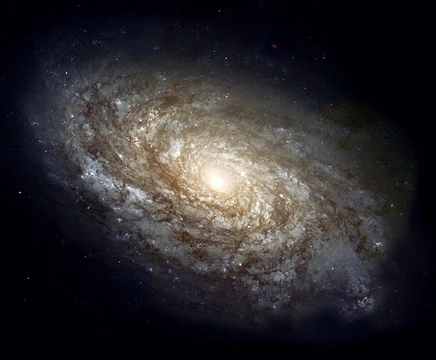
6C 1132+3209
Supergiant elliptical radio galaxy in Ursa Major.

6C 1132+3209, also cataloged as J113526.69+315332.6 and OGC 671, is a radio galaxy located in Ursa Major. It is a supergiant elliptical galaxy with a Type E morphology and serves as the brightest cluster galaxy (BCG) in the cluster GMBCG J173.86121+31.89240, which is also known as MACS J1135.4+3153.
This galaxy was first identified from a sample of 3,235 radio sources using the Bologna Northern Cross telescope in March 1970, where it received the designation B2 1132+32. Its redshift (z) is 0.231. The r-band magnitude is estimated at 16.75, and its stellar mass is calculated to be 11.36 M☉. The absolute magnitude is -22.67.
The active nucleus is classified as a Fanaroff-Riley Class Type I radio galaxy. The NRAO VLA Sky Survey (NVSS) reports a total flux density of 64.00 mJy at 1.4 GHz, corresponding to a total radio luminosity of 24.99 W Hz⁻¹. The radio structure is compact and elongated, with a single elliptical profile component. The Faint Images of the Radio Sky at Twenty-Centimeters (FIRST) survey detected a radio core with a flux density of 61.08 mJy, while the overall radio emission has a total flux density of 63.80 mJy.
The source exhibits a steep radio spectrum. At 151 MHz, the Sixth Cambridge Survey of Radio Sources measured a flux density of 0.63 ± 0.04 mJy, and the rest-frame radio luminosity at that frequency is 24.84 W Hz⁻¹ sr⁻¹. It is categorized as having an ultra-steep spectrum, with a radio spectral index of -1.05α between 352 MHz and 1.4 GHz. The galaxy's total k-band magnitude is 14.50 within a three-arcsecond angular aperture.
- Redshift
- 0.231
- R-band magnitude
- 16.75
- Stellar mass
- 11.36 M☉
- Total flux density at 1.4 ghz
- 64.00 mJy
- Total radio luminosity
- 24.99 W Hz−1
- K-band magnitude
- 14.50
- Absolute magnitude
- -22.67
Lore & Background
6C 1132+3209 was first discovered from a sample of 3,235 astronomical radio sources by astronomers using the Bologna Northern Cross telescope in March 1970, where it was designated B2 1132+32. The galaxy is classified as a supergiant elliptical galaxy of Type E morphology, with an r-band magnitude of 16.75. It is a red luminous galaxy and serves as the brightest cluster galaxy (BCG) of the cluster GMBCG J173.86121+31.89240, also known as MACS J1135.4+3153. Its stellar mass has been calculated to be 11.36 M☉.
The nucleus is active and classified as a Fanaroff-Riley Class Type I radio galaxy. The total flux density at 1.4 GHz from the NRAO VLA Sky Survey (NVSS) is 64.00 mJy, and the total radio luminosity is 24.99 W Hz−1. The radio structure is compact with an elongated morphology, described as having a single elliptical profile component. A radio core detected by the Faint Images of the Radio Sky at Twenty-Centimeters (FIRST) survey has a flux density of 61.08 mJy, and the total radio emission flux density is 63.80 mJy.
The source has a steep radio spectrum. The flux density at 151 MHz from the Sixth Cambridge Survey of Radio Sources is 0.63 ± 0.04 mJy. The rest-frame radio luminosity at 151 MHz is 24.84 W Hz−1 sr−1. The source is categorized as having an ultra steep spectrum, with a radio spectral index between 352 MHz and 1.4 GHz of -1.05α. The absolute magnitude of the galaxy is -22.67.
Reader's Guide
6C 1132+3209 is significant as a supergiant elliptical radio galaxy and the brightest cluster galaxy of its host cluster, providing a key example of a Fanaroff-Riley Class Type I radio source. Its discovery in March 1970 using the Bologna Northern Cross telescope from a sample of 3,235 sources highlights the role of early radio surveys in identifying powerful extragalactic objects. The galaxy's steep and ultra steep radio spectrum, along with its compact elongated radio structure and detected radio core, contribute to understanding the physics of radio-loud active galactic nuclei in massive elliptical galaxies. Its measured stellar mass of 11.36 M☉ and absolute magnitude of -22.67 place it among the most luminous and massive galaxies in the local universe. The multi-frequency flux density measurements from NVSS, FIRST, and the Sixth Cambridge Survey provide a detailed view of its radio emission, while its classification as a red luminous BCG underscores its importance in studies of galaxy cluster evolution and the coevolution of supermassive black holes with their host galaxies.
Frequently Asked Questions
What is 6C 1132+3209?
It is a supergiant elliptical radio galaxy classified with Type E morphology, also listed under the identifiers J113526.69+315332.6 and OGC 671. The object is notable for its strong radio emission and its position as the dominant elliptical in its host cluster.
Where is 6C 1132+3209 located in the sky?
The galaxy sits in the constellation Ursa Major and anchors the center of the cluster MACS J1135.4+3153 (also called GMBCG J173.86121+31.89240). Its redshift of 0.231 places it several billion light-years from the Milky Way.
What role does 6C 1132+3209 play in its cluster?
It functions as the brightest cluster galaxy (BCG) in MACS J1135.4+3153, meaning it is the most luminous elliptical at the cluster's core. Its stellar mass is calculated at 11.36 M☉ per the catalog entry, underscoring its central dominance.
How was 6C 1132+3209 first discovered?
In March 1970, it was picked out from a sample of 3,235 radio sources observed with the Bologna Northern Cross telescope, earning the designation B2 1132+32. Subsequent surveys added the 6C catalog number and the J and OGC identifiers as the object was cross-referenced.
What are 6C 1132+3209's key measurable properties?
The galaxy shows an r-band magnitude of 16.75 and a k-band magnitude of 14.50, while its total flux density at 1.4 GHz is 64.00 mJy. Its total radio luminosity is roughly 24.99 W Hz⁻¹, which is what cements its classification as a radio galaxy.
More in Elliptical and Irregular Galaxies, Part 2 1-24
Spotted an error? Know more?
Reader corrections go straight into our review queue. Suggest an edit · How this site is sourced