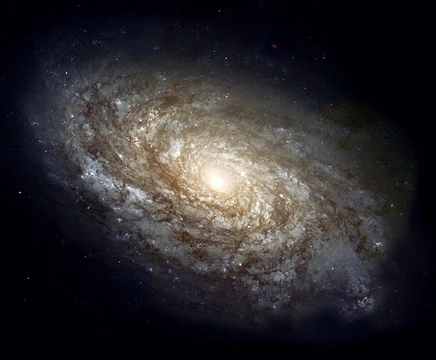
Abell 478 BCG
Brightest cluster galaxy of Abell 478, a radio galaxy.

Abell 478 BCG, the brightest cluster galaxy in the cool-core cluster Abell 478, sits at the cluster's center in the constellation Taurus. This Type-cD galaxy was first identified in July 1993 through a 20-centimeter Very Large Array study of Abell clusters, which classified it as a radio galaxy.
This central dominant galaxy forms stars at a rate of about 10 solar masses per year. Its supermassive black hole is growing at a rate of 1.6+1.2−0.4 × 10⁻² solar masses per year, and the total bulge mass is 28 ± 1 × 10¹¹ solar masses. The galaxy's active nucleus hosts a point-like central radio source. Its inner core contains four hotspot features: three to the north and one to the south, each separated by 30 to 60 kiloparsecs. Two weak radio lobes, each about four kiloparsecs across, extend toward the southwest and northeast. X-ray emission is double-peaked on the eastern and western sides of the nucleus. The total radio flux at 1.4 GHz is 30 mJy, with roughly 35 percent coming from the lobes. X-ray cavities are present, where radio plasma has swept out gas, and the total cavity power is estimated at 100.0+80.0−20.0 × 10⁴² erg per second. The radio core has a flat spectrum, with a total luminosity of 39.85 ± 0.03 at 5 GHz.
A December 2001 study detected molecular gas in the galaxy, with a total mass of 4.5 ± 2.6 × 10⁹ solar masses and a mass outflow rate of 616 solar masses per year. The dust mass is approximately 1.0 × 10⁷ solar masses.
- Redshift
- 0.086
- Type
- Type-cD
- Constellation
- Taurus
- Discovery
- July 1993, from a 20 cm VLA study of Abell clusters
- Star formation rate
- ~10 M☉ per year
- Black hole growth rate
- 1.6+1.2−0.4 × 10⁻² M☉ per year
- Total bulge mass
- 28 ± 1 × 10^11 M☉
Lore & Background
Abell 478 BCG is classified as a central dominant galaxy. Its nucleus is active with a central radio source described as point-like. The inner core contains four hotspot features, three located in the northern direction and one in the southern direction, all estimated to be between 30 and 60 kiloparsecs from each other. Radio observations have found two weak radio lobes extending four kiloparsecs in diameter, pointing toward the southwest and northeast. X-ray emission is double peaked on both eastern and western sides of its nucleus. The total radio flux at 1.4 GHz is 30 mJy, with about 35% contributed by the lobes. Evidence also shows X-ray cavities, with radio plasma sweeping out gas; the total cavity power is estimated to be 100.0+80.0−20.0 × 10^42 erg−1. The radio core has a flat spectrum with total luminosity of 39.85 ± 0.03 at 5 GHz.
Reader's Guide
A study published in December 2001 detected molecular gas in the galaxy, with a total mass of 4.5 ± 2.6 × 10^9 M☉ and a mass outflow rate of 616 M☉ per year. The dust mass is approximately 1.0 × 10^7 M☉. The continuous star formation is estimated at around 10 M☉ per year, and the supermassive black hole at the center is growing at a rate of 1.6+1.2−0.4 × 10⁻² M☉ per year. The total bulge mass is 28 ± 1 × 10^11 M☉. As the brightest cluster galaxy of a cool-core cluster, Abell 478 BCG is significant for studying galaxy-cluster interactions, radio-loud active galactic nuclei, and feedback processes such as X-ray cavities and molecular outflows.
Did You Know?
- Abell 478 BCG was first discovered from a 20 centimeter VLA study of Abell clusters in July 1993.
- The galaxy has four hotspot features in its core, three to the north and one to the south.
Frequently Asked Questions
What is Abell 478 BCG?
Abell 478 BCG is the brightest cluster galaxy anchoring the cool-core cluster Abell 478, situated in the constellation Taurus. It is a Type cD elliptical galaxy whose active nucleus produces a point-like central radio source.
How was Abell 478 BCG first identified?
It was first catalogued in July 1993 during a 20-centimeter Very Large Array survey of Abell clusters, where its radio emission led researchers to classify it as a radio galaxy.
How fast does Abell 478 BCG form stars?
The galaxy is currently building new stars at a rate of roughly ten solar masses per year, a figure that helps astronomers gauge ongoing star formation in central dominant ellipticals.
What are the mass and growth rate of Abell 478 BCG's supermassive black hole?
The central black hole is accreting at about 1.6 × 10⁻² solar masses per year (uncertainty +1.2/−0.4 × 10⁻²), while the galaxy's total bulge mass is measured at 28 ± 1 × 10¹¹ solar masses.
Why is Abell 478 BCG important to galaxy researchers?
As the dominant central galaxy of a cool-core cluster, it provides a concrete case study of how massive ellipticals anchor their host environments while sustaining active nuclear processes. Its well-characterized star formation, black hole accretion, and radio emission make it a useful benchmark for modeling BCG evolution.
More in Elliptical and Irregular Galaxies, Part 2 1-24
Spotted an error? Know more?
Reader corrections go straight into our review queue. Suggest an edit · How this site is sourced