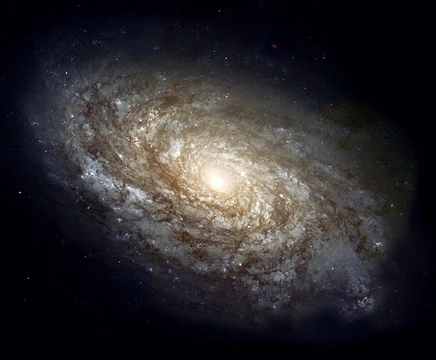
A2261-BCG
One of the largest known galaxies, with a mysteriously diffuse core.

A2261-BCG, also known as Abell 2261 Brightest Cluster Galaxy, is a supergiant elliptical galaxy residing within the Abell 2261 galaxy cluster. With an isophotal diameter of roughly 166.98 kiloparsecs (about 544,620 light-years), it is one of the largest galaxies known—approximately six times the size of the Milky Way. As the cluster's brightest and most massive member, it also possesses one of the largest galactic cores ever recorded, stretching more than 10,000 light-years across.
This cD elliptical galaxy lies about 992.5 megaparsecs (3.24 billion light-years) from Earth and is a known radio source. Its core is densely packed with old stars, yet it appears unusually diffuse, giving the galaxy its notably large core.
Evidence suggests a possible supermassive black hole at its center. Observations from the Hubble Space Telescope's Wide Field Camera 3 in September 2012 indicated an active black hole with a mass of at least 10 billion times that of the Sun. This could result from a black hole merger that generated gravitational waves, or from two central black holes orbiting each other—one native to the galaxy and the other acquired from a smaller galaxy A2261-BCG may have consumed. However, because a supermassive black hole is only visible while accreting material, it can be nearly invisible except through its influence on stellar orbits. This means the central black hole might be accreting at a low rate or have a mass significantly below 10 billion solar masses.
Despite the lack of direct confirmation, several studies have estimated the black hole's mass. Using the M-sigma relation and core break radius, estimates range from about 5.37 to 64.6 billion solar masses, while other calculations place it between 6 billion and 11 billion solar masses—which would make it one of the most massive black holes known.
- Type
- cD elliptical galaxy
- Isophotal diameter
- 166.98 kiloparsecs (544,620 light-years)
- Distance from earth
- 992.5 megaparsecs (3.24 billion light-years)
- Core size
- over 10,000 light-years
- Central black hole mass estimate
- at least 10 billion solar masses (10^10 M☉), with other estimates ranging from 5.37 to 64.6 billion M☉
Lore & Background
A2261-BCG is a cD elliptical galaxy located in the galaxy cluster Abell 2261. Its core is highly populated by a dense number of old stars, but is mysteriously diffuse, giving it a large core. The galaxy is also well known as a radio source.
On September 10, 2012, using the Hubble Space Telescope's Wide Field Camera 3, A2261-BCG was found to contain an active supermassive black hole of at least 10 billion times the mass of the Sun at its center. This may be due to a black hole merger that created gravity waves, or two central black holes orbiting each other, with one native to the galaxy and the second possibly added from a smaller former galaxy that A2261-BCG may have gobbled up.
Since a supermassive black hole is only visible while accreting, it can be nearly invisible except in its effects on stellar orbits. This implies that either A2261-BCG has a central black hole accreting at a low level or has a mass rather below 10^10 M☉. Despite the lack of evidence, several studies derived mass estimates for a possible central black hole, such as between 5.37 and 64.6 billion M☉ using the M-sigma relation and core break radius, or between 6 billion and 11 billion M☉, which would make it one of the most massive black holes.
Reader's Guide
A2261-BCG is significant as one of the largest galaxies known, with an isophotal diameter roughly six times that of the Milky Way. Its status as the brightest and most massive galaxy in the Abell 2261 cluster, combined with its enormous core spanning over 10,000 light-years, makes it a key object for studying galaxy formation and evolution. The galaxy's core is notably diffuse despite being densely populated with old stars, a mystery that challenges standard models of galactic structure. The possible presence of a supermassive black hole with mass estimates ranging from at least 10 billion to as high as 64.6 billion solar masses—potentially one of the most massive black holes—adds to its importance. The uncertainty surrounding the black hole's mass and activity, including the possibility of a black hole merger or a binary system, highlights ongoing debates in astrophysics. As a radio source, A2261-BCG also contributes to understanding active galactic nuclei and their environments. Its legacy lies in its role as a natural laboratory for testing theories of black hole growth, galaxy mergers, and the dynamics of cD galaxies.
Did You Know?
- A2261-BCG has an isophotal diameter of about 544,620 light-years, roughly six times larger than the Milky Way.
- Its core spans over 10,000 light-years, one of the largest galactic cores ever observed.
- The galaxy is located 3.24 billion light-years from Earth in the cluster Abell 2261.
- A possible supermassive black hole at its center may be one of the most massive, with estimates between 6 billion and 11 billion solar masses.
Frequently Asked Questions
What is A2261-BCG?
A2261-BCG is the dominant cD-type elliptical galaxy sitting at the heart of the Abell 2261 cluster, earning its name as the brightest cluster member. It is widely regarded as one of the most massive and extended galaxies catalogued to date.
How does A2261-BCG compare in size to the Milky Way?
Its isophotal diameter reaches roughly 167 kiloparsecs, which works out to about 545,000 light-years—approximately six times the width of our own galaxy. This makes it one of the largest stellar systems known in the universe.
What makes A2261-BCG's core unusual?
The central region is extraordinarily diffuse, stretching well over 10,000 light-years across, far exceeding what is typical for elliptical galaxies of its class. This mysteriously extended core has made the galaxy a popular subject for structural and dynamical studies.
How far away is A2261-BCG from Earth?
It resides at a distance of about 992.5 megaparsecs, or roughly 3.24 billion light-years, placing it deep in the distant universe. The light we detect today set out more than three billion years ago, so we are seeing the galaxy as it was in the early cosmic past.
How massive is the supermassive black hole at the center of A2261-BCG?
Published estimates for the central black hole span a wide range, from roughly 5.4 billion up to 64.6 billion solar masses, with a frequently cited lower bound of at least 10 billion. Regardless of the exact figure, it is among the most massive black holes associated with any known galaxy.
More in Elliptical and Irregular Galaxies, Part 2 1-24
Spotted an error? Know more?
Reader corrections go straight into our review queue. Suggest an edit · How this site is sourced