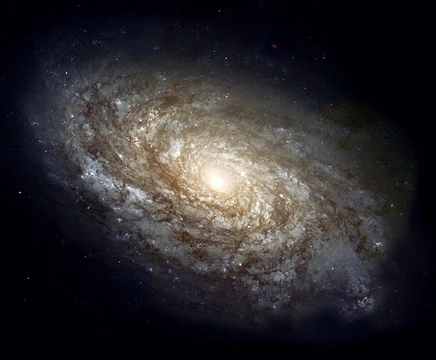
Abell 402 BCG
Massive elliptical galaxy with a possible binary supermassive black hole pair.

Abell 402 BCG (Abell 402 Brightest Cluster Galaxy) is a massive elliptical galaxy that resides at the center of the galaxy cluster Abell 402, also known as MACS J0257.6-2209. It is notable for hosting an ultramassive black hole and for evidence suggesting it may contain a binary pair of supermassive black holes, the largest such pair ever found.
- Redshift
- 0.306
- Constellation
- Eridanus
- Total stellar mass
- 0.74 × 10^12 M☉
- Ultramassive black hole mass
- 10^10 M☉
- Binary black hole combined mass
- 6 ± 2 × 10^10 M☉
- X-ray peak offset
- 28 kiloparsecs
- Emission line separation
- 370 kilometers per second
Lore & Background
Abell 402 BCG is the central galaxy of the Abell 402 cluster. A bright point-like source with wavelength dependence characteristic of a typical active galactic nucleus (AGN) is present. A dark region east of the source is thought to be a region of dust near the BCG's center. A large diffused core suggests it hosts an ultramassive black hole with an estimated mass of 10^10 M☉. The total stellar mass of the BCG is estimated to be 0.74 × 10^12 M☉.
The cavity region of the BCG contains two sets of emission lines that are kinematically distinctive, separated by 370 kilometers per second along the line of sight. Other emission lines rich in h-alpha, h-beta, and doubly ionized oxygen are present, but they are categorized as narrow, indicating no broad-line AGN lies in the BCG. The components are offset: the redshifted source displays doubly ionized oxygen emission without detections of singly ionized nitrogen, while the blueshifted source shows more of a LINER-type emission-line ratio. Further evidence suggests the cavity region may contain a binary pair of supermassive black holes, making them the largest pair ever found, with a combined binary mass of 6 ± 2 × 10^10 M☉, suggesting a recent galaxy merger.
A study found faint traces of radio emission centering on the BCG with discrete sources possibly associated with other cluster galaxies. The BCG also has an X-ray peak offset of 28 kiloparsecs.
Reader's Guide
Abell 402 BCG is significant as a massive elliptical galaxy that serves as the brightest cluster galaxy of Abell 402. Its most notable feature is the evidence for a possible binary pair of supermassive black holes in its cavity region, with a combined mass of 6 ± 2 × 10^10 M☉, described as the largest such pair ever found. This suggests a recent galaxy merger. The galaxy also hosts an ultramassive black hole of 10^10 M☉ and a large diffused core. The presence of an AGN-like point source, narrow emission lines, and a dark dust region east of the source add to its complexity. The offset X-ray peak of 28 kiloparsecs and faint radio emission further characterize its environment. The galaxy's legacy lies in its potential to inform studies of supermassive black hole binaries and galaxy mergers, though the article notes the binary pair is suggested but not confirmed.
Did You Know?
- The galaxy has a large diffused core suggesting it hosts an ultramassive black hole of 10^10 M☉.
- Its cavity region has two sets of emission lines separated by 370 kilometers per second along the line of sight.
- The X-ray peak of the BCG is offset by 28 kiloparsecs.
Frequently Asked Questions
What is Abell 402 BCG?
Abell 402 BCG is the dominant elliptical galaxy sitting at the core of the rich cluster Abell 402, also catalogued as MACS J0257.6-2209. It is one of the most massive ellipticals known, with a total stellar mass of roughly 0.74 trillion solar masses.
What makes Abell 402 BCG's central black hole so remarkable?
Observations hint that the galaxy hosts not one but two supermassive black holes in a binary configuration, with a combined mass of about 6 × 10¹⁰ solar masses (± 2 × 10¹⁰). If confirmed, this would be the most massive binary black-hole pair ever detected.
Where in the sky can I find Abell 402 BCG?
The galaxy lies in the southern constellation Eridanus at a redshift of approximately 0.306, placing it roughly a third of the way back toward the cosmic microwave background in lookback time.
How did astronomers get evidence for the binary black hole?
X-ray imaging revealed a bright peak offset by about 28 kiloparsecs from the galaxy's optical center, a spatial signature consistent with two massive black holes still settling into a shared orbit after their parent galaxies merged.
Why is Abell 402 BCG important for galaxy-merger theory?
As the brightest cluster galaxy in one of the most massive known clusters, it serves as a natural laboratory for studying how repeated mergers build up ultramassive central black holes. The possible binary pair would be a direct fossil record of a recent, incomplete coalescence event.
More in Elliptical and Irregular Galaxies, Part 2 1-24
Spotted an error? Know more?
Reader corrections go straight into our review queue. Suggest an edit · How this site is sourced