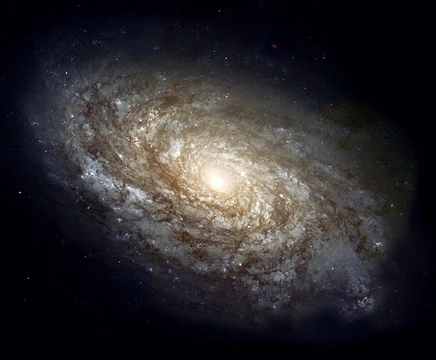
Abell 2244 BCG
A massive cD galaxy offset from its cluster's X-ray peak.

Abell 2244 BCG is a massive Type-cD elliptical galaxy in the constellation Hercules. It serves as the brightest cluster galaxy of the Abell 2244 cluster, from which it gets its name. The galaxy was first identified in January 1983 through a CCD photometry study. Its redshift is 0.099, and it sits 69 kiloparsecs away from the cluster’s X-ray peak.
As a central dominant galaxy, Abell 2244 BCG is much larger than other members of its cluster. Its K-band magnitude is -26.97 ± 0.09, and its U-R color gradient is -0.05 ± 0.10 magnitude. The total stellar mass is 0.62 × 10¹² solar masses.
Radio observations at six centimeters with the Very Large Array (VLA) show that the central radio source is mostly unresolved, with a radio power of 21.96 W/Hz. In 1994, VLA measurements gave a radio luminosity of 21.82 W Hz⁻¹. At 10 GHz, the radio core is resolved, with a total flux density of 0.6 mJy and a steep spectral index of 1.29 ± 0.30. A 2004 study found no signs of recent activity from the active galactic nucleus (AGN). The hydrogen-alpha emission line luminosity is 0.333 × 10⁴⁰ erg s⁻¹.
Evidence points to an offset nucleus or a companion object within the galaxy’s envelope. This companion lies 2.5 arcseconds south of the galaxy’s center. The galaxy’s isophotes appear elliptical near the center. The peak surface brightness of the cD galaxy is 20.5 magnitude per arcsecond, while the companion’s is 19.8. The companion is thought to be merging with the cD galaxy, moving toward it at just 50 kilometers per second.
- Type
- cD (central dominant galaxy)
- Constellation
- Hercules
- Redshift
- 0.099
- Discovery
- First discovered from a CCD photometry study by astronomers in January 1983
- K-band magnitude
- -26.97 ± 0.09
- Total stellar mass
- 0.62 × 10^12 M☉
- Radio power (6 cm)
- 21.96 W/Hz
Lore & Background
Abell 2244 BCG was first discovered from a CCD photometry study by astronomers in January 1983. It is a Type-cD central dominant galaxy, much larger than other members of the Abell 2244 cluster. The galaxy's K-band magnitude is estimated at -26.97 ± 0.09, and its U-R color gradient is -0.05 ± 0.10 magnitude. The total stellar mass is 0.62 × 10^12 M☉.
Radio mapping at six centimeters by the Very Large Array (VLA) found the central radio source is mostly unresolved, with a radio power of 21.96 W/Hz. When observed with VLA in 1994, the source's radio luminosity was calculated to be 21.82 W Hz⁻¹. The radio core is resolved at 10 GHz frequencies with a total flux density of 0.6 mJy and has a steep index of 1.29 ± 0.30. A study published in 2004 found the active galactic nucleus (AGN) of the cD galaxy does not exhibit any signs of recent activity. The hydrogen-alpha emission line luminosity is 0.333 × 10^40 erg s⁻¹.
Evidence also shows the cD galaxy has an offset nucleus or a companion object in its envelope, located 2.5 arcseconds toward the south. The galaxy's isophotes are depicted as having an elliptical appearance closer toward the center. The peak surface brightness of the cD galaxy is estimated to be 20.5 magnitude per arcsecond, while the surface brightness of the companion is 19.8. This companion is suggested to be merging with the cD galaxy, with its velocity toward it only 50 kilometers per second.
Reader's Guide
Abell 2244 BCG is significant as the brightest cluster galaxy of Abell 2244, a massive cD galaxy that dominates its cluster. Its offset of 69 kiloparsecs from the X-ray peak of the cluster suggests a dynamical disturbance or past interaction. The presence of a companion object with a low relative velocity of 50 km/s, likely merging, provides insight into galaxy assembly processes in dense environments. The radio observations from the VLA reveal a mostly unresolved central source with a steep spectral index, while the AGN shows no signs of recent activity as of a 2004 study. The galaxy's large stellar mass and K-band magnitude underscore its role as a central dominant galaxy. Its discovery in 1983 via CCD photometry marks it as an early target for modern imaging studies of cluster galaxies.
Did You Know?
- Abell 2244 BCG is offset by 69 kiloparsecs from the X-ray peak of its cluster.
- The galaxy's radio core has a steep spectral index of 1.29 ± 0.30 at 10 GHz.
- A companion object is located 2.5 arcseconds south of the galaxy and is merging with it at a velocity of only 50 km/s.
- The AGN of this cD galaxy showed no signs of recent activity as of a 2004 study.
More in Elliptical and Irregular Galaxies, Part 2 1-24
Spotted an error? Know more?
Reader corrections go straight into our review queue. Suggest an edit · How this site is sourced