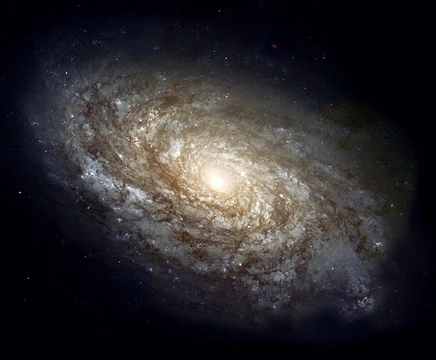
Abell 2111 BCG
Massive elliptical galaxy in the Butcher-Oemler cluster Abell 2111.

Abell 2111 BCG, the brightest cluster galaxy in the rich Butcher-Oemler cluster Abell 2111, is a massive elliptical located in Corona Borealis. Its redshift is 0.228. The galaxy's Gunn-r absolute magnitude is -22.67, and its bulge has an effective surface brightness of 22.02 magnitudes per square arcsecond, with an effective radius of 0.992 arcseconds. The bulge and disk have position angles of 174.27° and 41.05°, respectively. The BCG forms ultraviolet stars at a rate of 2.17 solar masses per year and holds a total stellar mass of 0.39 × 10¹² solar masses. Its core appears red in color based on its inner color profile, and the best-fit surface brightness profile parameter is 26.42 kiloparsecs, with an uncertainty of +0.56 and −0.31 kiloparsecs. The stellar population consists of intermediate-aged stars older than one billion years. A 2015 study found the BCG to be a weak radio source: its radio core has a total flux density below 0.21 mJy and less than 0.18 mJy at 10 GHz, while its optical spectrum shows no emission lines. Total radio power is under 23.55 W Hz⁻¹ at 1.4 GHz, and radio luminosity is less than 21.1 × 10³⁸ keV s⁻¹ Hz⁻¹.
- Redshift
- 0.228
- Gunn-r absolute magnitude
- -22.67
- Effective surface brightness of bulge
- 22.02 magnitude per square arcsecond
- Effective radius of bulge
- 0.992 arcseconds
- Bulge position angle
- 174.27°
- Disk position angle
- 41.05°
- Total ultraviolet star formation rate
- 2.17 M☉ per year
- Total stellar mass
- 0.39 × 10^12 M☉
- Best fit surface brightness profile para
- 26.42+0.56−0.31 kiloparsecs
- Total radio power at 1.4 ghz
- less than 23.55 W Hz−1
Lore & Background
Abell 2111 BCG is an elliptical galaxy with a bulge effective radius of 0.992 arcseconds and a Gunn-r absolute magnitude of -22.67. Its bulge and disk have position angles of 174.27° and 41.05°, respectively. The core of the BCG exhibits a red color appearance based on its inner color profile shape, and its stellar population consists of intermediate-aged stars greater than one billion years old.
The galaxy is a weak radio source, with its radio core showing a flux density of less than 0.21 mJy total and less than 0.18 mJy at 10 GHz frequencies. Its optical spectrum lacks any emission lines. The total radio power is less than 23.55 W Hz−1 at 1.4 GHz, and the radio luminosity is less than 21.1 × 10^38 keV s−1 Hz−1. The total ultraviolet star formation rate is estimated at 2.17 M☉ per year, and the total stellar mass is 0.39 × 10^12 M☉.
Reader's Guide
Abell 2111 BCG is significant as the brightest cluster galaxy of Abell 2111, a rich Butcher-Oemler cluster, providing a laboratory for studying galaxy evolution in dense environments. Its weak radio emission and absence of emission lines suggest a quiescent active galactic nucleus or low-level activity. The galaxy's red core and intermediate-aged stellar population indicate a history of star formation that has largely ceased, consistent with its elliptical morphology. The measured surface brightness profile and bulge parameters offer constraints on its structure and formation history. As a BCG in a Butcher-Oemler cluster, it helps astronomers understand how cluster environment influences galaxy properties, particularly the transition from star-forming to passive systems. Its legacy lies in contributing to the census of massive galaxies at moderate redshift and in testing models of galaxy growth and feedback.
Did You Know?
- Abell 2111 BCG has a total stellar mass of 0.39 × 10^12 M☉.
- Its radio core flux density is less than 0.21 mJy total.
- The galaxy's optical spectrum lacks any emission lines.
- The effective radius of its bulge is 0.992 arcseconds.
More in Elliptical and Irregular Galaxies, Part 2 1-24
Spotted an error? Know more?
Reader corrections go straight into our review queue. Suggest an edit · How this site is sourced