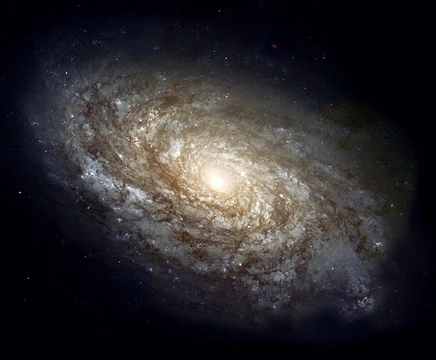
Abell 2009 BCG
Dominant elliptical galaxy with active nucleus and radio lobes.

Abell 2009 BCG (Brightest Cluster Galaxy) is a massive elliptical galaxy that serves as the dominant member of the galaxy cluster Abell 2009. It is notable for its active nucleus, classification as a Fanaroff-Riley Class Type I radio galaxy, and a supermassive black hole with a mass estimate derived from the fundamental plane relation.
- Redshift
- 0.151
- Discovery year
- July 1999
- Radio classification
- Fanaroff-Riley Class Type I
- Radio lobe length
- 17 kiloparsecs
- Total radio flux density
- 23 ± 1.0 mJy
- Radio power
- 1.45 ± 0.06 × 10^24 W Hz−1
- Supermassive black hole mass
- 9.74 ± 0.08 M☉
- Total stellar mass
- 12.17 ± 0.04 M☉
Lore & Background
Abell 2009 BCG was first discovered by astronomers in July 1999, who observed emission lines in its optical spectrum. It is the brightest cluster galaxy of Abell 2009. Radio imaging with the Very Large Array at 1.5 GHz frequencies revealed a resolved radio core and a pair of butterfly-shaped radio lobes 17 kiloparsecs in length, oriented from northwest to southeast. The galaxy has an elliptical appearance according to Hubble Space Telescope imaging data. The central nucleus is active and classified as a Fanaroff-Riley Class Type I radio galaxy. The total radio flux density is 23 ± 1.0 mJy, with radio power calculated as 1.45 ± 0.06 × 10^24 W Hz−1. The radio core flux density at 10 GHz is 3.3 ± 1.4 mJy, with a steep index spectrum of 1.81 ± 0.05. The emission is associated with another radio galaxy in the cluster located 50 arcseconds away. The supermassive black hole at the center is estimated to be 9.74 ± 0.08 M☉, based on the fundamental plane relation with a total stellar mass of 12.17 ± 0.04 M☉. The infrared luminosity is less than 1.0 × 10^44 erg s−1, making it less luminous compared to others. A study published in 2024 found the BCG is offset from the X-ray center by about 7 kiloparsecs.
Reader's Guide
Abell 2009 BCG is significant as a massive elliptical galaxy that dominates its cluster and exhibits an active nucleus with resolved radio lobes, characteristic of Fanaroff-Riley Class Type I radio galaxies. Its radio properties, including flux density and power, provide data for studying radio emission in cluster environments. The galaxy's supermassive black hole mass, derived from the fundamental plane relation, and its total stellar mass offer insights into the relationship between black holes and their host galaxies. The offset from the X-ray center, noted in a 2024 study, suggests dynamical interactions within the cluster. Its relatively low infrared luminosity compared to other BCGs highlights diversity among brightest cluster galaxies. The association with another radio galaxy 50 arcseconds away indicates possible interactions or a shared environment. These features make Abell 2009 BCG a useful object for understanding galaxy evolution, radio activity, and cluster dynamics.
More in Elliptical and Irregular Galaxies, Part 2 1-24
Spotted an error? Know more?
Reader corrections go straight into our review queue. Suggest an edit · How this site is sourced