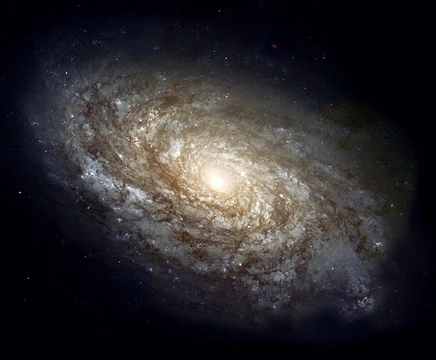
Abell 1942 BCG
A giant cD galaxy formed through galactic cannibalism.

Abell 1942 BCG, also cataloged as PGC 1256558, is a cD-type elliptical galaxy that acts as the brightest member of the Abell 1942 cluster in Virgo. Its redshift of 0.224 places it roughly 2.7 billion light-years from Earth.
Spanning 939,200 light-years in diameter, this galaxy ranks among the largest known. The Sloan Digital Sky Survey classifies it as a luminous red galaxy, with a total stellar mass around 3 × 10¹¹ solar masses. It is also an active wide-angled tailed radio galaxy, with jet speeds between 0.3 and 0.7 times the speed of light. Its radio spectrum peaks between 1.4 GHz and 325 MHz, and at 1.4 GHz its radio luminosity falls below 10²² watts per hertz. The galaxy appears in both the 408-MHz Molonglo Reference Catalogue and the Parkes Catalogue of radio sources, with its luminosity function estimated at 400 and 2700 MHz.
The galaxy’s major axis aligns with its parent cluster. Its extensive halo shows a surface brightness that drops from 27.5 magnitudes per square arcsecond at 100 kiloparsecs to about 32 magnitudes per square arcsecond at 700 kiloparsecs, as seen in r-band observations. Such light profiles in massive galaxies can extend hundreds of kiloparsecs. Because of these traits, researchers suspect Abell 1942 BCG formed through galactic cannibalism—merging with surrounding satellite galaxies, which boosts its brightness and builds its mass while reducing the number of satellites.
Star formation in this galaxy contributes little to its mass, with a stellar age of about 200 million years. The cluster’s X-ray properties and the presence of young stars suggest that gas cooling from the intracluster medium fuels this star formation. Observations from the Galaxy Evolution Explorer, Spitzer Space Telescope, and Two Micron All Sky Survey reveal that the galaxy emits 38% more ultraviolet light and 43% more mid-infrared light (from 8 to 160 micrometers) than expected.
The Abell 1942 cluster itself is rich. It has a mean redshift of z = 0.22513 ± 0.0008 and a velocity dispersion of 908⁺¹⁴⁷₋₁₃₉ kilometers per second. The cluster appears relaxed, with no obvious irregularities and a smooth X-ray emission distribution. Two possible optical substructures lie about 5 arcminutes from the center, toward the northwest and southwest, but the velocity field does not confirm them. These clumps are, however, kinematically bound to the main cluster.
- Type
- cD elliptical galaxy
- Redshift
- 0.224
- Distance
- ~2.7 billion light-years
- Diameter
- 939,200 light-years
- Stellar mass
- ~3 × 10^11 Msolar
- Radio jet speed
- 0.3–0.7 c
- Surface brightness range
- 27.5 mag arcsec-2 at 100 kpc to ~32 mag arcsec-2 at 700 kpc
Lore & Background
Abell 1942 BCG is one of the largest known galaxies, with a diameter of 939,200 light-years. It is classified as an active wide-angled tailed radio galaxy, with astrophysical jet speeds in the range of 0.3–0.7 c and a peaked spectrum source between 1.4 GHz and 325 MHz. Its radio luminosity is below 10^22 W Hz−1 at 1.4 GHz, and it appears in the 408-MHz Molonglo Reference Catalogue and Parkes Catalogue of radio sources. The galaxy is aligned along its major axis toward its parent cluster and possesses a large galactic halo with a light profile showing surface brightness from 27.5 mag arcsec-2 at 100 kpc to ~32 mag arcsec-2 at 700 kpc in r-bands.
Researchers theorize that Abell 1942 BCG formed through galactic cannibalism, merging with surrounding satellite galaxies, which increases its luminosity and builds its mass while reducing the number of satellites. Its star formation contributes less mass friction, with a stellar age of 200 Myr. The host cluster's X-ray properties and young star population suggest that star formation is fueled by gas cooling out of the intracluster medium. Observations by GALEX, Spitzer, and 2MASS show ultraviolet (38%) and mid-infrared emission (43%) from 8 to 160 μm above expected levels.
The Abell 1942 cluster is rich, with a mean redshift of z = 0.22513 ± 0.0008 and a velocity dispersion of 908^{+147}_{-139} km/s. It is relaxed with no remarkable features and a fair X-ray emission distribution. Two possible optical substructures are seen at ~5 arcmin toward the northwest and southwest, but are not confirmed by velocity field; they are kinematically bound to the main structure. Photometric redshift analysis suggests a weak lensing signal at the south part is contributed by dark matter from background sources possibly distributed as a single filamentary structure.
Reader's Guide
Abell 1942 BCG is significant as one of the largest elliptical galaxies known, with a diameter of 939,200 light-years, and as a bright cluster galaxy in a rich, relaxed cluster. Its classification as an active wide-angled tailed radio galaxy, with jet speeds up to 0.7 c and radio emission cataloged in major surveys, highlights its role in understanding radio-loud active galactic nuclei. The galaxy's formation via galactic cannibalism—merging with satellite galaxies to increase luminosity and mass—provides a key example of how massive cluster galaxies evolve. The presence of young stars (200 Myr) and gas cooling from the intracluster medium links its star formation to cluster dynamics. The cluster's weak lensing signal and possible filamentary dark matter structure offer insights into large-scale structure. Its legacy lies in illustrating the interplay between galaxy mergers, radio activity, and cluster environment.
Did You Know?
- Abell 1942 BCG has a diameter of 939,200 light-years, making it one of the largest known galaxies.
- Its astrophysical jet speed ranges from 0.3 to 0.7 times the speed of light.
- The galaxy is thought to have formed through galactic cannibalism, merging with satellite galaxies.
More in Elliptical and Irregular Galaxies, Part 2 1-24
Spotted an error? Know more?
Reader corrections go straight into our review queue. Suggest an edit · How this site is sourced