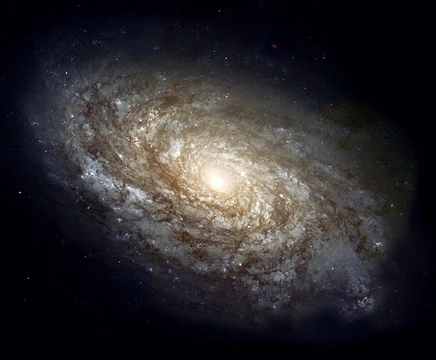
Abell 1835 BCG
A luminous cD galaxy with an active nucleus and starburst.

Abell 1835 BCG (Abell 1835 Brightest Cluster Galaxy) is a Type-cD galaxy located in the constellation of Virgo. It is the brightest cluster galaxy of Abell 1835 and was first discovered by astronomers conducting a study of X-ray clusters in 1992. It is notable for its high luminosity, active nucleus, and intense star formation.
- Redshift
- 0.25
- Type
- cD
- Total infrared luminosity
- 7.3 ± 1.5 × 10^11 L☉
- Total flux density
- 255.6 ± 3.9 mJy
- Total radio luminosity
- 3.55 ± 0.09 × 10^41 erg s−1 (10 MHz–10 GHz)
- Jet power
- 1.4 × 10^45 erg s−1
- Star formation rate
- 123 M☉ per year
Lore & Background
Abell 1835 BCG dominates the center of the Abell 1835 cluster. Its nucleus is active and created two X-ray cavities in the hot gas about 40 million years ago. The galaxy hosts a compact radio source with a jet that originates from the nucleus, heading west before bending northwest. It is classified as a luminous infrared galaxy and a starburst galaxy, undergoing an intense wave of star formation that began around 320 million years ago, producing stars at a rate of 100–180 M☉ per year (calculated as 123 M☉ per year). The star formation is concentrated in a region 35 kiloparsecs from the nucleus. The galaxy has a halo light profile rising above 63 kiloparsecs and central colors 1.3 magnitudes bluer than the halo, with a blue central core.
Reader's Guide
Abell 1835 BCG is significant as a type-cD galaxy that serves as the brightest cluster galaxy of Abell 1835, providing insights into galaxy evolution in dense cluster environments. Its active galactic nucleus (AGN) drives powerful outflows and creates X-ray cavities, demonstrating feedback between the AGN and the surrounding hot gas. The detection of molecular gas (about 5 × 10^10 M☉) in a thick face-on turbulent disk, along with bipolar molecular outflows traveling between -250 and +480 km/s, reveals ongoing star formation and AGN-driven mechanical energy. The presence of doubly ionized oxygen and carbon oxide (3-2) emission extending over a 13.5 kiloparsec radius with filament features further highlights its complex structure. Its legacy lies in illustrating how AGN activity and star formation coexist and interact in a massive cluster galaxy.
Did You Know?
- Abell 1835 BCG was first discovered in 1992 during a study of X-ray clusters.
- The galaxy has a total infrared luminosity of 7.3 ± 1.5 × 10^11 L☉.
- Its radio jet has a power of 1.4 × 10^45 erg s−1 and bends from west to northwest.
- The galaxy contains about 5 × 10^10 M☉ of molecular gas in a face-on turbulent disk.
More in Elliptical and Irregular Galaxies, Part 2 1-24
Spotted an error? Know more?
Reader corrections go straight into our review queue. Suggest an edit · How this site is sourced