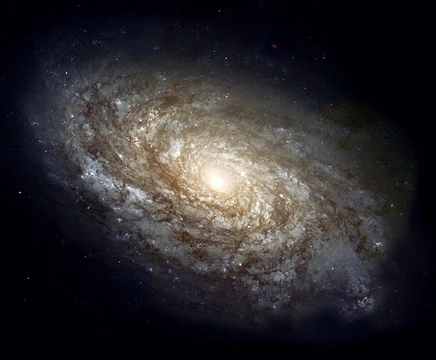
Abell 1650 BCG
A massive, radio-quiet cD galaxy in Abell 1650.

Abell 1650 BCG, the brightest cluster galaxy in the Abell 1650 cluster, is a massive cD-type elliptical in the constellation Virgo. It sits at a redshift of 0.084 and has an extrapolated luminosity of about 10.31 × 10¹¹ solar luminosities. The galaxy is radio-quiet; deep 1.4 GHz imaging with the Very Large Array detected only a faint radio source at its position, with a flux density of 0.44 ± 0.09 mJy and a radio power of 7.6 × 10²¹ W/Hz. Its optical center is offset by 23 kiloparsecs to the southeast from the X-ray surface brightness peak, and X-ray emission is present around the galaxy.
Color measurements give U–R and U–I values of -0.05 ± 0.11 and -0.02 ± 0.11, respectively. The core appears red, and a 2020 study found an intermediate stellar population: the inner stars are 6,640 ± 970 million years old, while the outer population is younger at 5,550 ± 370 million years. The total stellar mass is 7.2 ± 1.4 × 10¹¹ solar masses. At its center lies a supermassive black hole with a mass of 7.58 × 10⁹ solar masses. Kinematically, the galaxy has a central velocity dispersion of 412 ± 18 km/s and a rotation of 0.10 ± 0.07 Vmax.
- Type
- cD elliptical galaxy
- Constellation
- Virgo
- Redshift
- 0.084
- Extrapolated magnitude
- 10.31 ± 0.41 × 10^11 L☉
- Total stellar mass
- 7.2 ± 1.4 × 10^11 M☉
- Central black hole mass
- 7.58 × 10^9 M☉
- Central velocity dispersion
- 412 ± 18 km/s
Lore & Background
Abell 1650 BCG is classified as a type-cD galaxy dominating the center of the Abell 1650 cluster. It is radio-quiet based on Very Large Array (VLA) imaging, with no sign of radio emission associated with it, though a faint radio source has been detected through deep imaging at 1.4 GHz frequencies coinciding with the BCG's position, with a total flux density of 0.44 ± 0.09 mJy and a radio power of 7.6 × 10^21 W/Hz. The optical center of the BCG is misaligned by 23 kiloparsecs towards the southeast direction along with the X-ray surface brightness peak, and there is evidence of X-ray emission around the BCG.
The BCG's U–R color magnitude is estimated to be -0.05 ± 0.11, while the U–I color magnitude is -0.02 ± 0.11. A study published in November 2020 found the BCG has an intermediate stellar population, with the inner population aged 6,640 ± 970 million years and the outer population aged 5,550 ± 370 million years; the core has a red appearance. The BCG also displays kinematic properties: a central velocity dispersion of 412 ± 18 kilometers per second and a rotation measured at 0.10 ± 0.07 Vmax.
Reader's Guide
Abell 1650 BCG is significant as the dominant galaxy of the Abell 1650 cluster, a Bautz-Morgan Type I-II cluster. Its classification as a type-cD galaxy highlights its role as a central, massive elliptical that likely grew through mergers. The galaxy's radio-quiet nature, despite a faint detected radio source, distinguishes it from many other BCGs that host active radio jets. The misalignment of its optical center with the X-ray peak by 23 kiloparsecs suggests dynamical or environmental interactions within the cluster. The measured stellar masses and ages of its inner and outer populations, along with the presence of a supermassive black hole of 7.58 × 10^9 M☉, provide constraints on its formation history. The kinematic data—velocity dispersion and rotation—further characterize its internal dynamics. Its legacy lies in serving as a case study for the evolution of massive cluster galaxies, particularly those that are radio-quiet and exhibit complex structural features.
Did You Know?
- Its inner stellar population is aged 6,640 ± 970 million years, while the outer population is aged 5,550 ± 370 million years.
- The BCG is radio-quiet, but a faint radio source with a flux density of 0.44 ± 0.09 mJy has been detected at 1.4 GHz.
More in Elliptical and Irregular Galaxies, Part 2 1-24
Spotted an error? Know more?
Reader corrections go straight into our review queue. Suggest an edit · How this site is sourced