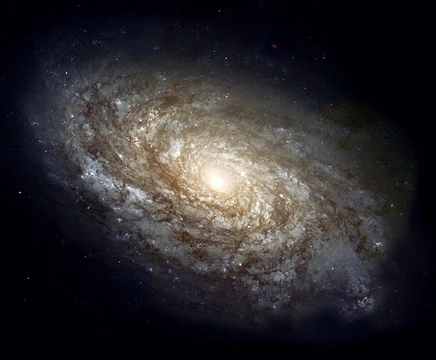
Abell 1201 BCG
A gravitational-lensing elliptical galaxy hosting a candidate ultramassive black hole.

Abell 1201 BCG (Abell 1201 Brightest Cluster Galaxy) is a type-cD massive elliptical galaxy that serves as the brightest cluster galaxy of the Abell 1201 galaxy cluster. It is notable for acting as a gravitational lens, bending light from a more distant background galaxy into an apparent tangential arc, making it an important case in investigations of the intrinsic properties of dark matter. The galaxy also hosts a candidate ultramassive black hole, one of the most massive ever identified without relying on quasar luminosity assumptions.
- Redshift
- 0.169
- Distance
- 2.735 billion light-years (838.5 million parsecs)
- Ellipticity
- 0.32±0.02
- Total stellar luminosity sdss r band
- 4×10^11 L☉
- Total stellar luminosity 2mass k band
- 1.6×10^12 L☉
- Effective radius
- 15 kpc
- Central velocity dispersion
- 285 km/s within 5 kpc, rising to 360 km/s at 20 kpc
- Black hole mass 2023 estimate
- (3.27±2.12)×10^10 M☉ (range 11.5 billion to 53.9 billion M☉)
Lore & Background
Abell 1201 BCG resides at a redshift of 0.169, about 2.735 billion light-years from Earth, and is offset about 11 kiloparsecs from the X-ray peak of the intracluster gas. Its stellar distribution is far from spherical, with an ellipticity of 0.32±0.02. The galaxy's total stellar luminosity is 4×10^11 L☉ in SDSS r-band and 1.6×10^12 L☉ in 2MASS K-band. Half the stars orbit within an effective radius of 15 kpc, and the central velocity dispersion is about 285 km/s within 5 kpc, rising to 360 km/s at 20 kpc distance.
The BCG acts as a gravitational lens, bending light from a background galaxy at redshift 0.451 into an apparent tangential arc about 6 kpc to one side. Years later, a faint smaller counterimage to the arc was discovered at a closer radius. Explaining the position and brightness of this counterimage requires a dark central concentration of unseen mass, which lens modeling suggested could be a supermassive black hole equivalent to (1.3±0.6)×10^10 M☉. This candidate was one of the most massive black hole candidates at the time, potentially ten times larger than expected from usual scaling relations.
However, alternative modeling of stellar velocity dispersion maps revealed an ambiguity between the black hole mass and the dark halo profile: in solutions where the black hole is more massive, the dark matter is more cuspy; where the black hole is smaller or absent, the dark matter is more cored. The dark halo's ellipticity and the mass-to-light ratio of stars also enter the ambiguity, presenting a dilemma for either conventional black hole growth ideas or simplest dark matter theories.
Reader's Guide
The significance of Abell 1201 BCG lies in its dual role as a gravitational lens and a laboratory for studying dark matter and black hole physics. Detailed models of the lens mass distribution, starlight, and stellar kinematics indicate that the galaxy cluster's dark halo has a shallow inner density gradient and perhaps a soft dark matter core, which at face value is incompatible with the dark matter cusp predicted by collisionless cold dark matter theories. This adds to evidence that dark matter experiences additional non-gravitational forces.
In 2023, a follow-up study using higher resolution images with greater signal-to-noise ratio strongly supported the presence of a central supermassive black hole, providing a revised mass estimate of (3.27±2.12)×10^10 M☉ (range 11.5 billion to 53.9 billion M☉). If correct, this would be the first identification and mass determination of a supermassive black hole using analysis of a gravitational lens, a method the authors suggest could be useful for discovering more supermassive black holes at higher redshift, outside the local universe, which previously had been limited to actively accreting black holes. The ambiguity between black hole mass and dark halo profile remains a challenge to either conventional ideas of black hole growth or the simplest theories about dark matter, or both.
Did You Know?
- The galaxy's central velocity dispersion rises from 285 km/s within 5 kpc to 360 km/s at 20 kpc.
- The 2023 lens modeling study provided a black hole mass range of 11.5 billion to 53.9 billion M☉.
- This would be the first supermassive black hole mass determined using gravitational lens analysis.
More in Elliptical and Irregular Galaxies, Part 2 1-24
Spotted an error? Know more?
Reader corrections go straight into our review queue. Suggest an edit · How this site is sourced