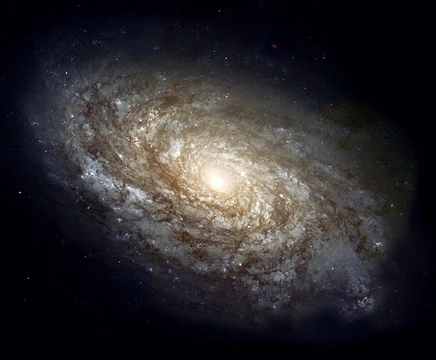
Abell 1068 BCG
A massive cD galaxy with a starburst and a supermassive black hole.

Abell 1068 BCG (Abell 1068 Brightest Cluster Galaxy) is a massive type-cD galaxy located in the constellation of Ursa Major. It is the brightest cluster galaxy in the galaxy cluster Abell 1068 and is classified as a fossil galaxy. Discovered in the IRAS Faint Catalogue survey in 1990, it is notable for its central blue nucleus, starburst activity, and a supermassive black hole at its center.
- Redshift
- 0.138
- Integrated total luminosity
- 0.46 × 10^31 erg s−1 Hz−1
- Surface brightness half magnitude radius
- 81 kiloparsecs
- Surface brightness
- around 25 magnitude
- Star formation rate
- between 20 and 70 M☉ per year
- Central gas reservoir mass
- 4 × 10^10 M☉
- Supermassive black hole mass
- 1.0+0.6−0.4 × 10^9 M☉
- Eddington rate
- 1.6+1.0−0.6 × 10^−4 Medd
- Total infrared luminosity at 24 μm
- 582 × 10^42 erg s−1
- Radio flux density
- 8.5 ± 0.6 mJy
Lore & Background
Abell 1068 BCG is a central dominant galaxy lying at the center of the galaxy cluster Abell 1068. It displays a central blue nucleus and has a surface brightness profile that increases above the half magnitude of the R1/4 profile, with a measured radius of 81 kiloparsecs and a surface brightness of around 25 magnitude. The galaxy's halo contains several blue structures projected into it, and an arc-like feature with a bridge connecting to its nucleus. A wisp feature curves toward the southwest direction of a luminous galaxy. The galaxy is classified as a starburst galaxy, with stars forming continuously at a rate between 20 and 70 M☉ per year over the past 100 million years, expected to continue for at least one billion years due to a central gas reservoir of 4 × 10^10 M☉. Red supergiant stars may be present based on detections of calcium ion triplets in its spectrum, and evidence indicates a secondary starburst occurred southeast of the core region. The radio source is compact, as shown by Very Large Array mapping. The supermassive black hole at the center is estimated at 1.0+0.6−0.4 × 10^9 M☉, with an Eddington rate of 1.6+1.0−0.6 × 10^−4 Medd from a 2006 study. In 2011, infrared spectroscopy revealed a red continuum with weak emission features. A 2009 study found radio emission associated with the galaxy, with a flux density of 8.5 ± 0.6 mJy and an extension toward the northwest. An emission-line nebula surrounds the galaxy, emitting strong doubly ionized oxygen, and weak features of Wolf-Rayet stars suggest the nebula's ionization is powered by starbursts.
Reader's Guide
Abell 1068 BCG is significant as a fossil galaxy and the brightest cluster galaxy in Abell 1068, offering insights into galaxy evolution in dense cluster environments. Its classification as a starburst galaxy, with a sustained star formation rate of 20 to 70 M☉ per year and a large central gas reservoir, highlights ongoing vigorous star formation expected to persist for a billion years. The presence of a supermassive black hole with a mass around 1.0 × 10^9 M☉ and a measured Eddington rate provides a case study for black hole growth and feedback. The detection of a compact radio source, an emission-line nebula with doubly ionized oxygen, and Wolf-Rayet star features underscores the interplay between star formation and ionization processes. The galaxy's blue nucleus, halo structures, and arc-like feature add to its complexity, making it a valuable target for studying starburst-driven phenomena and central dominant galaxy properties in clusters.
Did You Know?
- Abell 1068 BCG was first discovered in the IRAS Faint Catalogue survey in 1990.
- The galaxy's star formation rate is between 20 and 70 M☉ per year, sustained for at least 100 million years.
- A 2009 study found radio emission with a flux density of 8.5 ± 0.6 mJy extending northwest.
Frequently Asked Questions
What is Abell 1068 BCG?
Abell 1068 BCG is the most luminous galaxy in the Abell 1068 cluster, sitting in the constellation Ursa Major. It is a massive cD-type galaxy classified as a fossil, meaning it likely built up its enormous size by merging with many smaller companions over cosmic time.
What makes Abell 1068 BCG stand out among other cluster galaxies?
It is hosting an active starburst with a formation rate of roughly 20 to 70 solar masses per year, which is extraordinary for a galaxy this old and massive. A bright blue nucleus and a supermassive black hole at the center further distinguish it from the typically quiescent, red ellipticals that dominate rich clusters.
How large and luminous is Abell 1068 BCG?
Its half-light radius extends to about 81 kiloparsecs, making it one of the most spatially extended members of the cluster. The integrated total luminosity works out to roughly 0.46 × 10³¹ erg s⁻¹ Hz⁻¹, while the surface brightness sits near 25 magnitudes.
How much gas does Abell 1068 BCG carry to fuel its ongoing starburst?
The galaxy holds a central gas reservoir of approximately 4 × 10¹⁰ solar masses, more than enough to sustain the current burst of new star formation. This abundant fuel is what keeps the young, blue stellar population visible in the nucleus despite the surrounding ancient red stars.
When was Abell 1068 BCG identified and how far away is it?
It was picked up in the IRAS Faint Catalogue survey in 1990, where infrared data revealed its extended profile and unusual brightness. A redshift of 0.138 places the galaxy at a distance of roughly 1.7 billion light-years, firmly within the Abell 1068 cluster.
More in Elliptical and Irregular Galaxies, Part 2 1-24
Spotted an error? Know more?
Reader corrections go straight into our review queue. Suggest an edit · How this site is sourced