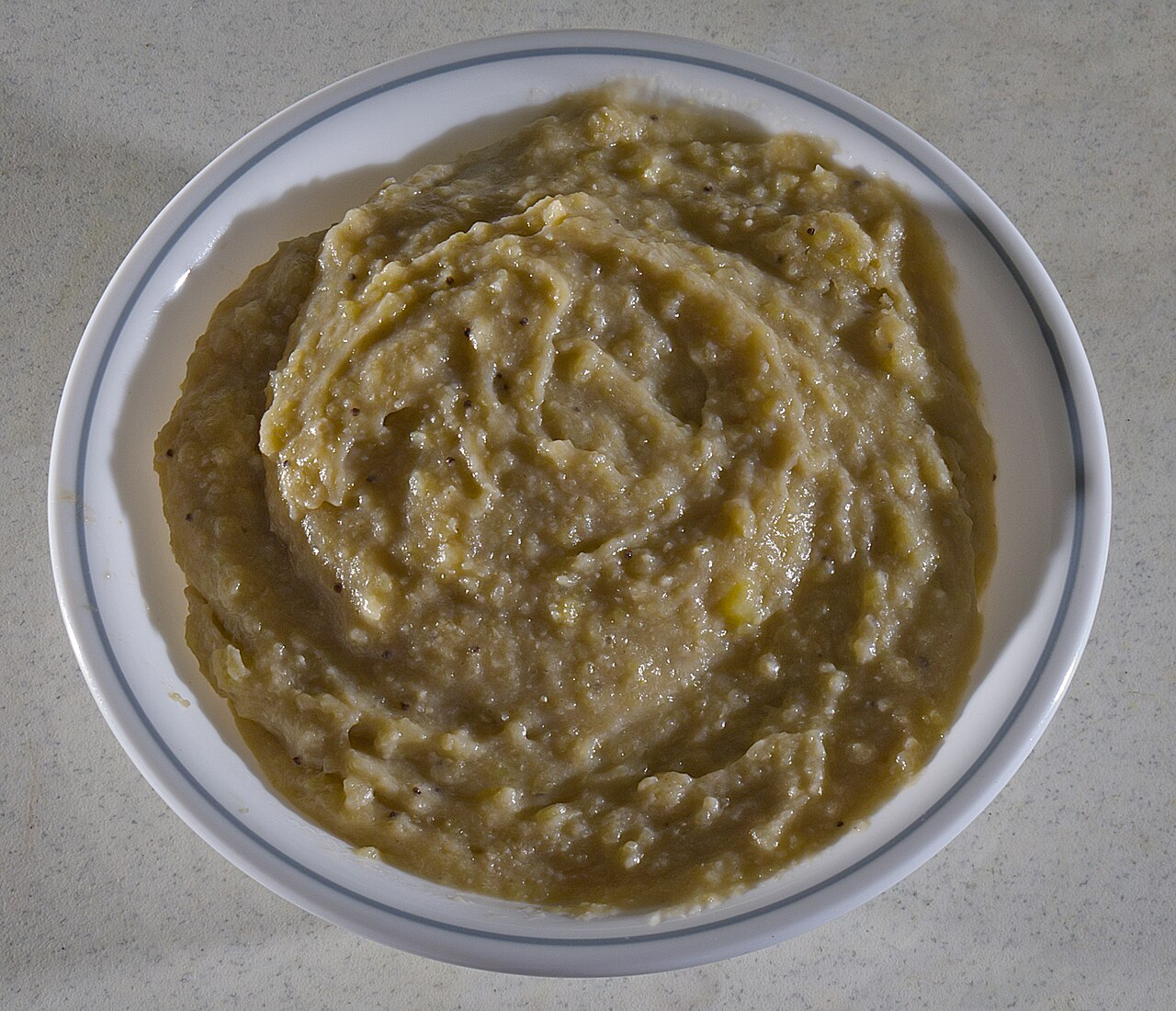
Mangú
Mashed green plantains with pickled onions and three hits.

Grace789 · CC BY-SA 4.0
Mangú is the national breakfast dish of the Dominican Republic, also served for lunch or dinner. It is made from boiled green plantains that are mashed and topped with pickled red onions, traditionally accompanied by fried cheese, salami, and eggs—a combination known as 'los tres golpes' ('the three hits'). The dish's origins are linked to West African fufu, brought to the Caribbean and Latin America through the transatlantic slave trade, and adapted by enslaved Africans and their descendants using local ingredients and techniques.
Quick Facts
- Country
- Dominican Republic
- National Cuisine
- Dominican Republic cuisine
- Course
- Breakfast, main course or side dish
- Served
- Hot
- Main Ingredient
- Green plantains, red onion, vinegar
- Minor Ingredient
- Queso frito, fried eggs, fried Dominican salami
- Variations
- Mofongo, fufu, tacacho, cayeye
Facts from the source article.
Lore & Background
Mangú is made from boiled green plantains, mashed with a fork and some of the boiling water until smooth with no lumps. It is topped with pickled red onions, known as escabeche, a Spanish introduction that adds tangy, slightly sweet crunch. The dish is naturally bland and starchy, so the onions balance and enhance the richness of the plantains.
The classic accompaniment 'los tres golpes' consists of fried cheese, fried eggs, and fried Dominican-style salami. Dominican salami is uncured, pre-cooked, smoked, and made with beef, pork, red onions, garlic, black pepper, false oregano, egg whites, annatto, and flour. It is often coated in flour before frying for a light, crispy coating, and its smoky, salty flavor contrasts the starchy mangú.
Other variations include mangú with longaniza (a grilled or fried sausage) or, in coastal regions, with fried fish such as tilapia or snapper. The etymology of the name is disputed: one theory traces it to an African word 'mangusi' for boiled mashed root vegetables, while another suggests it originated from an American soldier's exclamation 'Man, good!' during the occupation period, though neither theory is confirmed by official documents.
Reader's Guide
Mangú holds significance as the national breakfast dish of the Dominican Republic, reflecting the country's culinary heritage and the adaptation of African food traditions in the Caribbean. Its preparation—boiling and mashing green plantains—echoes the West African fufu brought by enslaved people, but mangú has evolved into a distinct dish with local ingredients and accompaniments. The 'los tres golpes' combination showcases Dominican salami, a unique processed meat with a soft, bologna-like texture and smoky flavor, often coated in flour before frying. The dish's legacy lies in its everyday presence across meals and its role in Dominican identity, while the disputed etymology highlights the complex cultural exchanges—African, Spanish, and American—that shaped it. Mangú's variations, such as with longaniza or fried fish, demonstrate regional adaptability, and its pairing with pickled red onions illustrates the integration of Spanish escabeche techniques. As a staple, mangú represents both continuity and change in Caribbean foodways.
Did You Know?
- The dish is traditionally served with 'los tres golpes': fried cheese, fried salami, and fried eggs.
- Dominican salami used in mangú is uncured, pre-cooked, smoked, and made with beef, pork, and annatto.
- One theory says the name 'mangú' may come from an American soldier's exclamation 'Man, good!' during the occupation period.
Culinary Identity & National Significance
Mangú stands as the Dominican Republic's defining breakfast dish, though its presence extends well beyond the morning table into lunch and dinner service. The dish's cultural weight is perhaps best captured in the colloquial pairing known as "los tres golpes" — literally "the three hits" — a trio of fried cheese, fried eggs, and fried Dominican-style salami served alongside the mashed plantains. In many households, the salami and cheese are dusted in flour before hitting the pan, producing a light, crispy shell that contrasts the soft, starchy base. Dominican salami itself is a distinctive product: uncured, pre-cooked, traditionally smoked, and crafted from beef, pork, red onions, garlic, black pepper, false oregano, egg whites, annatto, and flour. Its slightly smoky, salty, robust character and bologna-like texture make it a natural counterpoint to the creamy plantains. Beyond this classic pairing, regional and personal variations flourish — mangú with longaniza sausage, or in coastal areas, with fried tilapia or snapper — all reinforcing the dish's central place in Dominican food culture.
African Roots & Colonial Transformation
The story of mangú begins far from the Caribbean, in the Congo region of West Africa, where boiled and mashed root vegetables formed a staple of daily sustenance. This tradition traveled across the Atlantic aboard slave ships, carried by enslaved Africans who brought not only their labor but their culinary knowledge to the Caribbean, Latin America, and the Southern United States. The broader family of mashed-plantain and root dishes includes mofongo in Puerto Rico, fufu de plátano in Cuba, bolón in Ecuador, cayeye in Colombia, and what is called hot water cornbread in the American South. Before cassava and corn arrived in these regions, plantains, cocoyam, green bananas, and yams were boiled and mashed in a mortar with their own cooking water, yielding a smooth, dense, stretchy, dough-like mass meant to be swallowed in small, unchewed balls. Enslaved Africans and their descendants then adapted these techniques using whatever local ingredients were available, and over generations that process crystallized into the distinctly Dominican dish known today as mangú.
Preparation & Flavor Architecture
The preparation of mangú is deceptively simple yet demands attention to texture. Green plantains are boiled, then mashed with a fork and a portion of the water in which they were cooked. The objective is a completely smooth, lump-free consistency — a creamy, starchy base that is deliberately bland. Because the mashed plantains carry little inherent flavor, the dish relies on its accompaniments for balance. The traditional topping is pickled red onions, known as escabeche, a preparation introduced to Latin America and the Caribbean from Spain. These onions contribute a tangy, slightly sweet, and crunchy dimension that cuts through the richness of the plantains. The broader "los tres golpes" arrangement adds further textural and flavor layers: the crispy exterior of floured, fried salami against the smooth mangú, the richness of fried eggs, and the savory depth of the cheese. In coastal communities, fried fish such as tilapia or snapper replaces or supplements the meat components, while longaniza offers a smoky, savory alternative to salami. Each variation preserves the core principle: a neutral, starchy canvas designed to be elevated by bold, contrasting companions.
Etymology & Historical Debate
The name "mangú" carries two competing origin stories, and the debate between them illuminates broader questions about how Caribbean food histories are recorded. One theory traces the word to mangusi, a term allegedly used in the Congo region to describe any root vegetable that had been boiled and mashed. However, this etymology lacks verified support in known African languages or published dictionaries, weakening its scholarly standing. The alternative narrative places the naming during the American occupation of the Dominican Republic. According to this account, an American soldier tasted the dish and exclaimed "Man, good!" — a phrase that local speakers may have phonetically absorbed and reshaped into "mangú." While no official documents confirm the soldier's remark, proponents of this theory argue that its timing aligns more closely with available historical records than the unverified African-word hypothesis does. The persistence of both stories in Dominican popular culture reflects a broader pattern: the dish's African origins are well established in its ingredients and technique, yet the very name it carries in everyday speech may owe something to the colonial and occupation layers that shaped the island's modern identity.
Gallery
Frequently Asked Questions
Who is Mangú?
Mangú is the Dominican Republic's national breakfast dish, built on a base of boiled green plantains mashed into a smooth, starchy mound. It's most often crowned with pickled red onions and served alongside the famous 'tres golpes' trio of fried cheese, salami, and eggs.
What are Mangú's powers and role at the table?
Mangú anchors the Dominican meal as a hearty, savory foundation that pairs effortlessly with fried proteins and sharp onions. While it reigns at breakfast, it flexes just as naturally into lunch or dinner service.
Why is Mangú so important to Dominican culture?
As the country's national dish, Mangú sits at the center of Dominican culinary identity and everyday home cooking. Its origins trace to West African fufu, carried through the transatlantic slave trade and reimagined by enslaved Africans and their descendants using local ingredients.
Where does Mangú's name actually come from?
One leading theory ties the word to the African term 'mangusi,' echoing the dish's West African roots. A more lighthearted alternative suggests it was coined by an American soldier who exclaimed 'Man, good!' after his first taste.
More in Dominican Republic cuisine 1-23
Spotted an error? Know more?
Reader corrections go straight into our review queue. Suggest an edit · How this site is sourced