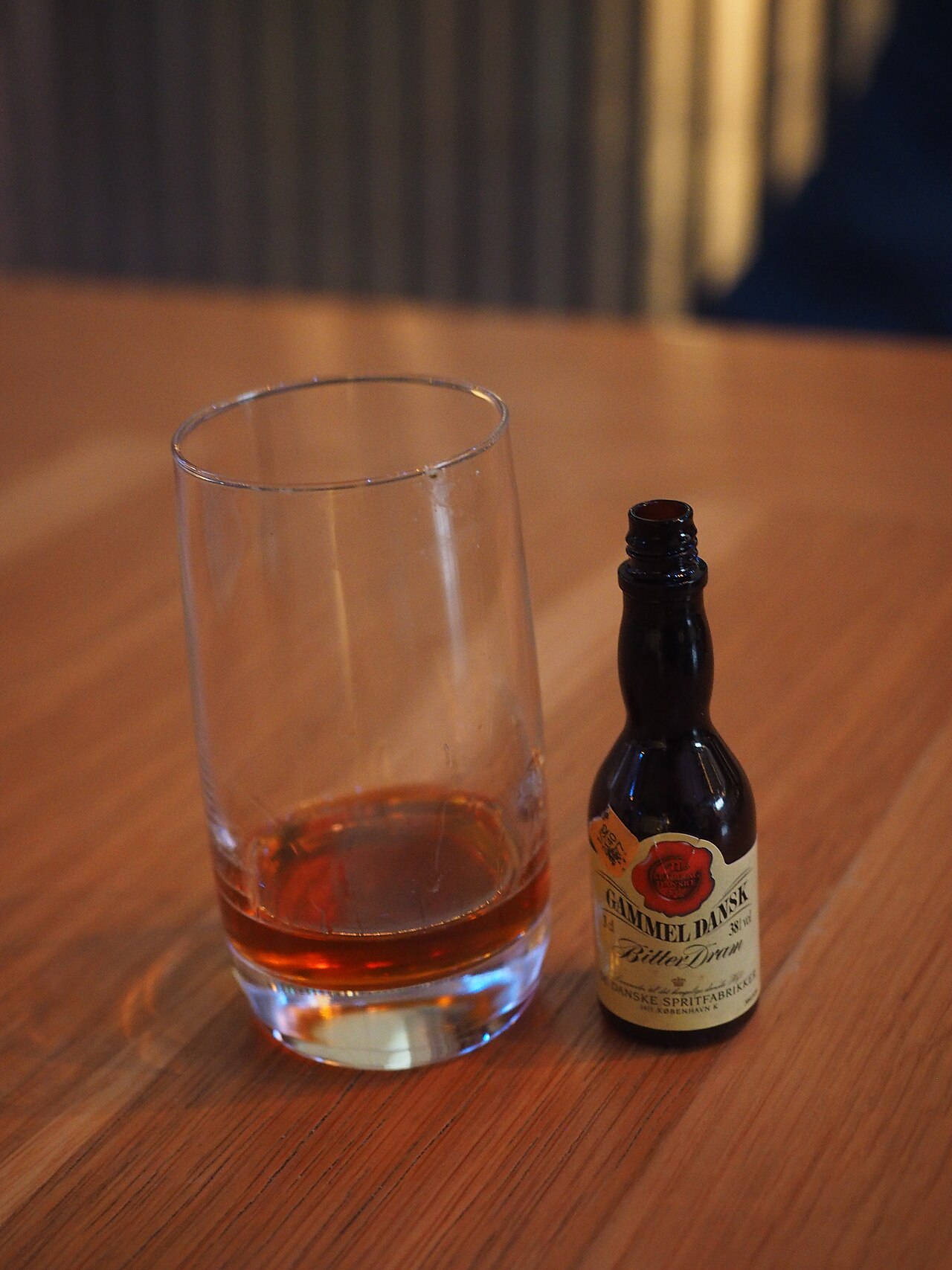
Gammel Dansk
Herbal bitters originally created to compete with Underberg and Fernet Branca.

JIP · CC BY-SA 4.0
Gammel Dansk is a bitters, an herbal alcoholic drink, now made by Arcus-Gruppen in Gjelleråsen, outside Oslo, Norway. It was first created and produced by Danish Distillers in Denmark. Danes traditionally drink it on special occasions, often with breakfast, brunch, or at morning wedding anniversaries and birthday parties. The name means "Old Danish" in Danish.
The drink was developed starting in 1964 by master blender J.K. Asmund, who was also the factory manager at Danish Distillers in Aalborg. Production began three years later, and it became one of the most well-known strong alcoholic drinks in Denmark. It was created to compete with other bitters like Underberg and Fernet Branca on the Danish market. Gammel Dansk is aged with 29 types of herbs, spices, and flowers, making it similar to other stomach bitters such as Peychaud's Bitters or Jägermeister. These ingredients include rowan berry, angelica, star anise, nutmeg, anise, ginger, laurel, yellow gentian, Seville orange, and cinnamon, though the full recipe remains secret.
In the 1960s and 1970s in Denmark, drinking bitters like Gammel Dansk in the morning was not considered unusual. The bottle reads: *Gør godt om morgenen, efter dagens dont, under jagten, på fisketuren eller som apéritif* ("Will do you good in the morning, after a day's work, when hunting or fishing, or as an apéritif."). During the 1980s, health concerns grew, and bitters lost popularity to lower-alcohol beer and wine. Still, Gammel Dansk makes up two-thirds of all bitters sold in Denmark.
In 2008, Danish Distillers released Asmund Special, a new product honoring J.K. Asmund. On 14 March 2014, Arcus, the brand's owner, announced production would move to Norway. That same year, Arcus launched Gammel Dansk Shot, a variation with liquorice and chili, meant to be drunk as a shooter. In 2019, they introduced "Gammel Dansk Halv bitter" ("Half the bitterness"), a less bitter, sweeter version with more honey and licorice, aimed at younger customers.
- Nationality
- Danish (originally), Norwegian (current production)
Lore & Background
The development of Gammel Dansk commenced in 1964 and was led by master blender J.K. Asmund, who also worked as factory manager for Danish Distillers in Aalborg. Three years later production started, and it has since become one of the most recognizable strong alcoholic beverages on the Danish market. The recipe includes 29 types of herbs, spices, and flowers, such as rowan berry, angelica, star anise, nutmeg, anise, ginger, laurel, yellow gentian, Seville orange, and cinnamon, though the complete recipe is kept secret.
In the Denmark of the 1960s and 1970s, drinking bitters like Gammel Dansk in the morning was not considered taboo. The bottle even reads: 'Gør godt om morgenen, efter dagens dont, under jagten, på fisketuren eller som apéritif.' With the 1980s came greater concern for public health, and bitters fell out of favor compared to lower ABV beer and wine. Even so, Gammel Dansk still constitutes two-thirds of all bitters sold in Denmark.
In 2008 Danish Distillers launched a new product labeled Asmund Special as a tribute to J.K. Asmund. On 14 March 2014, Arcus announced that production would move to Norway. In 2015, Arcus launched Gammel Dansk Shot, flavored with liquorice and chili.
Reader's Guide
Gammel Dansk holds a significant place in Danish drinking culture as a traditional bitters consumed at festive occasions, particularly morning celebrations like birthdays and wedding anniversaries. Its development in the 1960s by J.K. Asmund positioned it as a competitor to established bitters such as Underberg and Fernet Branca. Despite a decline in popularity during the 1980s due to public health concerns, it remains dominant, accounting for two-thirds of all bitters sold in Denmark. The brand's evolution includes a tribute product (Asmund Special), a move of production to Norway in 2014, and modern variations like the liquorice-chili Shot and the sweeter Halv bitter aimed at younger drinkers. Its legacy is tied to its secret 29-herb recipe and its enduring role in Danish social rituals, bridging traditional morning drinking habits with contemporary market adaptations.
Origins & the Master Blender
Gammel Dansk was conceived in 1964 as a deliberate attempt to carve out a place in Denmark's competitive bitters market, where established names like Underberg and Fernet Branca already held strong ground. The project was spearheaded by J.K. Asmund, a master blender who simultaneously served as factory manager for Danish Distillers in Roskilde. Under his guidance, the formulation took shape, and three years after development began, the first bottles of the bitter hit Danish shelves. The name itself is a straightforward translation from Danish: "Old Danish," evoking a sense of heritage and timelessness. What started as a calculated market entry quickly grew into something far more significant. Over the decades that followed, Gammel Dansk cemented its status as one of the most instantly recognizable strong alcoholic beverages in Denmark. Its origins in a single Roskilde facility, guided by one dedicated craftsman, gave the product an authenticity that resonated with consumers long after Asmund's direct involvement had ended.
The Alchemy of Twenty-Nine Botanicals
At its heart, Gammel Dansk is a botanical maturation exercise of considerable complexity. The spirit is aged with twenty-nine distinct herbs, spices, and flowers, a blend that places it in the same family as other well-known stomach bitters such as Peychaud's Bitters and Jägermeister. Among the identifiable ingredients are rowan berry, angelica, star anise, nutmeg, anise, ginger, laurel, yellow gentian, Seville orange, and cinnamon. Together these components create a layered, bitter profile designed to stimulate digestion and add depth to the drinking experience. What remains deliberately opaque is the full recipe; the complete formulation is guarded as a trade secret, meaning that while enthusiasts can appreciate the named botanicals, the precise proportions and any additional elements beyond those listed are known only to the producers. This secrecy adds an element of mystique to an otherwise straightforward category of liquor, reinforcing the impression that Gammel Dansk is not merely a product but a carefully protected craft.
A Morning Ritual and a Shifting Cultural Tide
In Denmark, Gammel Dansk occupies a uniquely ceremonial niche. It is traditionally poured during festive gatherings that take place in the morning hours—wedding anniversaries, birthday celebrations (which in Danish custom begin at breakfast), brunches, and other special family occasions. During the 1960s and 1970s, sipping a bitters in the early part of the day carried no social stigma whatsoever. The bottle itself carried the reassuring inscription: "Will do you good in the morning, after a day's work, when hunting or fishing, or as an apéritif," framing the drink as a wholesome tonic rather than an indulgence. However, the cultural landscape shifted markedly in the 1980s. Growing public-health awareness and a broader preference for lower-alcohol beverages like beer and wine caused bitters to lose ground in the marketplace. Despite this headwind, Gammel Dansk has retained a remarkable share of the category, accounting for roughly two-thirds of all bitters sold in Denmark, a testament to the depth of its cultural entrenchment.
Reinvention Across Borders and Generations
The story of Gammel Dansk did not end with its Danish origins. In 2007, Danish Distillers honored the memory of its founding master blender by releasing Asmund Special, a product explicitly dedicated to J.K. Asmund's legacy. Then, on 14 March 2014, the brand's owners, Arcus, announced a significant geographical shift: production would relocate to Norway, where it is now manufactured by Arcus-Gruppen in Oslo. The brand has also actively courted new audiences. In 2014, Gammel Dansk Shot entered the market—a variation on the classic recipe infused with liquorice and chili, designed to be consumed as a quick shooter rather than a slow-sipped bitter. Three years later, in 2019, the company introduced Gammel Dansk Halv bitter, literally "half the bitterness," a reformulation aimed squarely at younger consumers. Advertised as sweeter and less bitter, with elevated levels of honey and licorice, this variant represents a conscious effort to keep the Gammel Dansk name relevant for a generation that may find the original's intensity less appealing.
Gallery


Frequently Asked Questions
What exactly is Gammel Dansk?
Gammel Dansk is a Danish-origin herbal bitters — a small, strong alcoholic digestif whose name translates simply to "Old Danish." It sits in the same category as other bitter aperitifs like Underberg or Fernet Branca.
Who developed Gammel Dansk and when?
Master blender and Aalborg factory manager J.K. Asmund began formulating the recipe in 1964 at Danish Distillers. Commercial production kicked off three years later, in 1967.
How do Danes traditionally enjoy Gammel Dansk?
It is typically sipped in small measures during special morning gatherings — think brunches, wedding-anniversary toasts, or birthday celebrations — rather than as an everyday drink.
Where is Gammel Dansk produced now?
Although it was originally brewed in Denmark, current production sits with Arcus-Gruppen at their facility in Gjelleråsen, just outside Oslo, Norway.
Why was Gammel Dansk created in the first place?
Danish Distillers set out to craft a domestic bitter that could stand shoulder-to-shoulder with established rivals like Underberg and Fernet Branca on the Scandinavian shelf. The goal was a distinctly Danish alternative to those imported classics.
More in Danish cuisine 1-24
Spotted an error? Know more?
Reader corrections go straight into our review queue. Suggest an edit · How this site is sourced