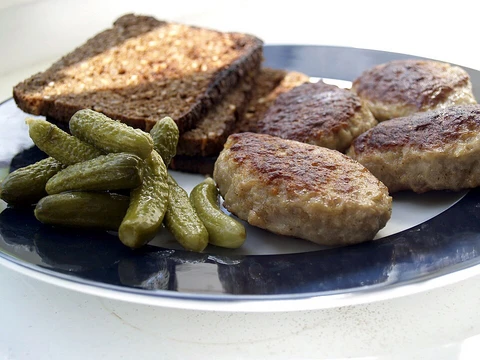
Bøfsandwich
Classic Danish hamburger sold from hot dog stands.

Orf3us · CC0
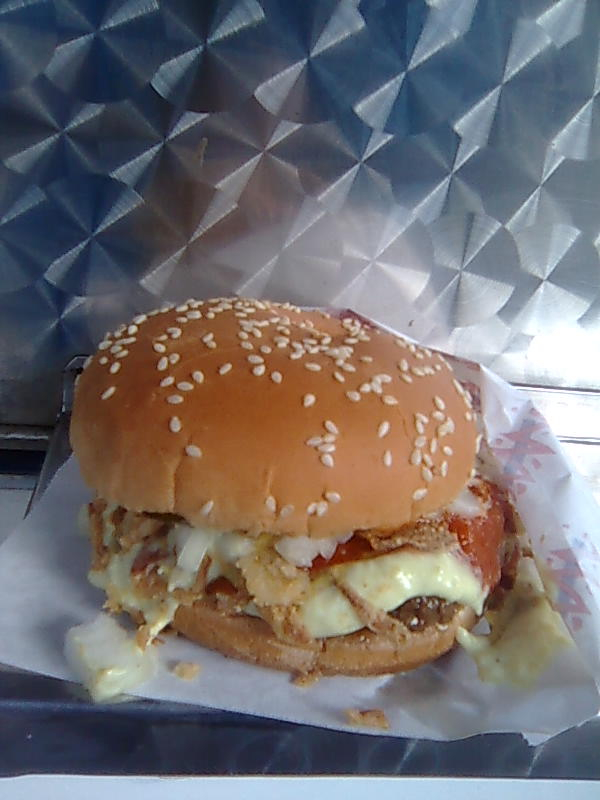
The bøfsandwich, which translates literally to "steak sandwich," is Denmark's take on the hamburger. It features a cooked ground beef patty served in a sliced bread roll. You'll typically find these at hot dog stands and traditional fast-food spots, earning a reputation as an "archetypal Danish snackbar classic." Some traditional Danish restaurants now offer gourmet versions, sometimes adding soft grilled onions. A dedicated Facebook page announces "Denmark's best bøfsandwich" each year.
Traditional toppings include ketchup, mustard, remoulade, sliced dill pickles, raw onions, and crisp fried onions. In the Jutland region, it's common to add sliced beetroots and pour brown gravy over the sandwich—a version foreigners sometimes call a "gravy burger." Other local variations may include gherkins or pickled red cabbage. Internationally, Canada's hot hamburger—a beef patty with buns and gravy—is somewhat similar.
Quick Facts
- Course
- Main course
- Country
- Denmark
- Region
- Copenhagen
- Creator
- <!-- or
- Year
- 1949
- Main Ingredient
- Ground meat, bread
- Minor Ingredient
- Pickled beetroot, pickled cucumber, onions, brown gravy (optional)
- No Recipes
- false
Facts from the source article.
Lore & Background
The bøfsandwich is a staple of Danish fast food, commonly found at hot dog stands and traditional fast food outlets. It has been called an 'archetypal Danish snackbar classic', and some traditional Danish restaurants have started serving gourmet versions with additions such as soft grilled onions. Fans maintain a Facebook page that announces 'Denmark's best bøfsandwich' each year.
Reader's Guide
The bøfsandwich holds significance as a Danish cultural food icon, representing a localized adaptation of the hamburger. Its traditional condiments—ketchup, mustard, remoulade, sliced dill pickles, raw onions, and crisp fried onions—define its standard form. Regional variations exist, notably in Jutland where sliced beetroots and brown gravy are added, sometimes called 'gravy burger' by foreigners. Other local variants may include gherkins or pickled red cabbage. Internationally, the Canadian hot hamburger, with a beef patty, buns, and gravy, somewhat resembles the bøfsandwich. The dish's ongoing popularity is evidenced by annual competitions for the best version, organized by a fan-run Facebook page. Its legacy lies in its status as a quintessential Danish snackbar classic, bridging traditional fast food and gourmet reinterpretations.
Did You Know?
- The bøfsandwich is also known as a 'steak sandwich' in literal translation.
- In the Jutland region, it is customary to serve the bøfsandwich with sliced beetroots and brown gravy poured over.
- The Canadian hot hamburger somewhat resembles the bøfsandwich.
Identity & Cultural Standing
A bøfsandwich is Denmark's own interpretation of the hamburger: a cooked ground beef patty nestled inside a sliced bread roll. Far from a minor footnote in the national food landscape, it has earned the distinction of being labelled an "archetypal Danish snackbar classic." You will find it served from the ubiquitous hot dog stands that dot Danish streets and in traditional fast food establishments where locals grab a quick, satisfying meal. In recent years the sandwich has also crossed into more elevated territory: some traditional Danish restaurants now offer gourmet interpretations, layering in extras such as soft grilled onions to refine the humble patty-and-roll combination. This trajectory—from street-corner staple to restaurant plate—speaks to the sandwich's deep roots in everyday Danish eating culture while also revealing its capacity for refinement. It is, in essence, the Danish answer to what a proper beef sandwich should be, carrying a sense of national culinary identity that few other fast foods can claim.
The Traditional Condiment Palette
The flavour profile of a classic bøfsandwich extends well beyond the patty and bread. The traditional condiment lineup is specific and layered: ketchup for sweetness, mustard for sharpness, remoulade for creamy tang, sliced dill pickles for briny crunch, raw onions for a pungent bite, and crisp fried onions for golden texture. This combination creates a sandwich that balances sweet, sour, salty, and textural contrasts in every mouthful. The inclusion of both raw and fried onions is particularly notable, offering two distinct onion experiences in a single bite—one sharp and fresh, the other golden and crunchy. Remoulade, a creamy sauce with its own identity in Scandinavian cuisine, adds a richness that distinguishes the bøfsandwich from a plain American burger. Together, these toppings form a well-established canon that defines what makes the sandwich authentically Danish rather than merely a beef patty in a roll.
Regional Twists in Jutland
While the standard bøfsandwich is recognizable across Denmark, the Jutland region has developed its own distinctive twist that sets it apart. In Jutland, it is customary to place sliced beetroots inside the sandwich and then pour brown gravy over the entire assembly. This gravy-laden version has become so characteristic of the region that foreigners visiting Denmark sometimes refer to it simply as a "gravy burger," a label that captures the visual and textural impact of the sauce-soaked bread. Beyond the Jutland specialty, other local variants across the country may swap in gherkins or pickled red cabbage, offering different acidic and textural notes to the core sandwich. These regional adaptations demonstrate that the bøfsandwich is not a monolithic item but a flexible canvas that different Danish communities have personalised over time, each adding a local signature while preserving the fundamental patty-and-roll structure that unites them all.
Community, Rivalry & International Echoes
The bøfsandwich has cultivated a devoted following that extends well beyond casual dining. A dedicated Facebook page maintained by fans of the sandwich announces "Denmark's best bøfsandwich" on an annual basis, turning a simple street food into a subject of friendly national competition and collective pride. This community-driven recognition underscores how deeply the sandwich is woven into Danish food identity and everyday conversation. Interestingly, the concept has parallels beyond Denmark's borders. In Canada, the "hot hamburger"—a beef patty served in buns with gravy poured on top—bears a striking resemblance to the Jutland-style gravy version of the bøfsandwich, suggesting that the idea of a gravy-drenched beef sandwich is a natural culinary evolution in multiple cultures. The sandwich's international echoes, combined with its domestic fan community, position it as both a local treasure and a point of cross-cultural culinary recognition.
Gallery
Frequently Asked Questions
What exactly is a Bøfsandwich?
It's Denmark's answer to the hamburger: a cooked ground beef patty served inside a sliced bread roll. The Danish name literally means 'steak sandwich.'
What toppings are traditional on a Bøfsandwich?
The classic build loads up ketchup, mustard, remoulade, sliced dill pickles, raw onions, and crisp fried onions. Some traditional restaurants now add a gourmet touch with soft grilled onions.
Where do Danes typically grab a Bøfsandwich?
You'll most often find them at hot dog stands and long-established fast-food spots, where it's regarded as an archetypal Danish snackbar staple. It's a quick, no-frills grab-and-go meal.
Is there a regional Jutland variation of the Bøfsandwich?
Yes — in Jutland the patty gets topped with sliced beetroots and a generous pour of brown gravy. This sets it apart from the standard preparation found elsewhere in Denmark.
Is there an annual Bøfsandwich award or competition?
A dedicated Facebook page crowns 'Denmark's best bøfsandwich' every year, pitting local spots against one another. It's become a lighthearted annual tradition among Danish food fans.
More in Danish cuisine 1-24
Spotted an error? Know more?
Reader corrections go straight into our review queue. Suggest an edit · How this site is sourced