Bishop-bowl
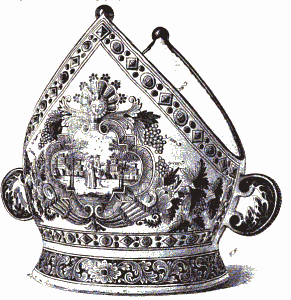
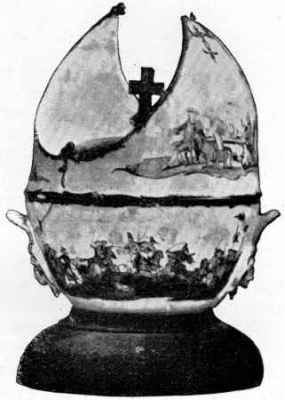
A mitre-shaped punch bowl for serving biskop.

Lewis Clarke · CC BY-SA 2.0
A bishop-bowl (Danish: *bispebolle*) is a punch bowl shaped like a bishop’s mitre. During the 1700s and 1800s, it was a common item in Denmark, Schleswig-Holstein, and Norway, used to serve a warm alcoholic punch called *biskop*. Most bowls were made of faience, and the first large-scale production came from the Store Kongensgade Faience Manufactury in Copenhagen. Later, they were also produced in Schleswig-Holstein and Norway, sometimes in porcelain as well as faience.
The drink *biskop* has German roots, where it was known as *bischof*, named for the violet color of a bishop’s robes. This hot punch became fashionable among Danish nobility in the 1700s, leading to the creation of special bowls shaped like a bishop’s hat or, later, a full bishop figure. The earliest Danish bishop-bowls came from the Store Kongensgade factory, founded in 1722, which made them its most recognizable product. They were usually decorated in blue, though a few were made in manganese violet. Popular in Denmark from the early 1700s, the bowls soon spread to Norway, where the Herrebøe Fajansefabrikk began producing them in the mid-1700s.
The basic ingredients of *biskop* are red wine, sugar, and spices, with recipes varying widely. Most call for bitter orange, orange zest, or orange juice, while some include cinnamon or ginger. By the late 1800s, recipes often added rum to improve taste and shelf life. A 1795 Danish translation of Beate Augustine Friedel’s cookbook gives a recipe using three liters of red wine, 1.5 kilos of sugar, and the zest and juice of six bitter oranges plus two to three regular oranges. Christopher Jacobsen’s 1815 recipe calls for a bottle of red wine, two bitter oranges, and sugar to taste. Anne Marie Mangor’s 1876 book includes rum: a bottle of wine, 50 milliliters of rum, 125 grams of sugar, and the zest and juice of two small bitter oranges. *Biskop* was often served warm, but unlike Danish *gløgg*, it could also be served cold or on ice. The 1935 *Old Waldorf-Astoria Bar Book* lists a “bishop” recipe served in a pitcher with sugar, lemon juice, rum, a bottle of red wine, and ice.
Early bishop-bowls from the Store Kongensgade factory are displayed at The David Collection in Copenhagen and the Museum of National History at Frederiksborg Castle in Hillerød. Bowls from a Schleswig manufacturer can be seen at St. Anne’s Museum in Lübeck.
- Type
- Punch bowl
- Origin
- Denmark
- Period
- 18th–19th centuries
- Material
- Faience (later also porcelain)
- Associated drink
- Biskop
- Notable manufacturer
- Store Kongensgade Faience Manufactury
Lore & Background
The drink biskop is of German origins, where it was known as bischof. Its name refers to the violet colour of a bishop's garments. Biskop was one of several types of hot punch which became popular among the Danish nobility in the 18th century. The popularity of the punch led to the manufacture of special punch bowls shaped in the form of a bishop's hat or later as the figure of a bishop. The first bishop-bowls in Denmark were produced at the Store Kongensgade factory, Denmark's first faience manufacturer, founded in 1722. They were typically decorated in blue, though a small number were also produced in manganese violet. The bowls grew to popularity in Denmark in the early 1700s and soon spread to Norway, where they were produced by the Herrebøe Fajansefabrikk from the mid-1700s.
Reader's Guide
The bishop-bowl is significant as a distinctive material culture artifact reflecting the social customs of 18th- and 19th-century Denmark, Schleswig-Holstein, and Norway. Its design, a punch bowl shaped like a bishop's mitre, directly ties to the drink biskop, a hot punch of German origin. The bowls were primarily produced in faience, with the Store Kongensgade Faience Manufactury in Copenhagen being the first large-scale producer. Later, they were also made in porcelain and manufactured in Schleswig-Holstein and Norway. The bowls are among the most recognizable items from the Store Kongensgade factory. Their legacy is preserved in museum collections, including The David Collection and the Museum of National History at Frederiksborg Castle in Copenhagen, as well as St. Anne's Museum in Lübeck. A Danish stamp from 1970 features a drawing of a bishop-bowl, indicating its cultural resonance.
Did You Know?
- The drink biskop is named after the violet colour of a bishop's garments.
- Bishop-bowls were first manufactured in large quantities by the Store Kongensgade Faience Manufactury in Copenhagen.
- A bishop-bowl from Kellinghusen in Holstein, circa 1770, is shaped as a seated bishop and is 34 cm high.
Gallery


Frequently Asked Questions
What exactly is a Bishop-bowl (bispebolle)?
It is a punch bowl sculpted in the shape of a bishop's mitre, popular across Denmark, Schleswig-Holstein, and Norway during the 1700s and 1800s. Its sole purpose was to hold and serve a warm, spiced alcoholic punch.
What drink do you pour into a Bishop-bowl?
The traditional companion is biskop, a warm alcoholic punch that traces its name back to the German word bischof. The drink's violet hue was said to echo the color of a bishop's ceremonial robes.
What material are Bishop-bowls made from?
The vast majority were fired in faience, the ceramic medium that gave them their characteristic glaze. In later decades, workshops in Schleswig-Holstein and Norway also produced them in porcelain.
Who first put Bishop-bowls into large-scale production?
The Store Kongensgade Faience Manufactury in Copenhagen was the pioneer, turning out the bowls in volume for the Danish market. Once the design proved popular, potters in Schleswig-Holstein and Norway began crafting their own versions.
Why is it called a 'Bishop-bowl' rather than something else?
The name is purely visual: the bowl's silhouette is modeled on the pointed mitre a bishop wears, so the shape itself carries the title. The linked drink, biskop, borrows the same ecclesiastical reference from its German ancestor word bischof.
More in Danish cuisine 1-24
Spotted an error? Know more?
Reader corrections go straight into our review queue. Suggest an edit · How this site is sourced