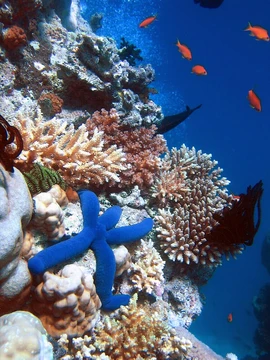
Sapodilla Cayes
Uninhabited atoll in Belize, part of a disputed maritime region.

The Sapodilla Cayes, also called Cayos Zapotillos in Spanish, are an uninhabited atoll in the Gulf of Honduras, located in Belize’s Toledo District. Belize administers the cayes, but Guatemala disputes this, claiming the maritime boundary lies to the northwest. Honduras also asserts a claim to the cayes, as stated in its 1982 constitution. Geologically, the cayes are low sandy islands forming part of the Mesoamerican Barrier Reef System. In 1996, the area was designated the Sapodilla Cayes Marine Reserve, a national protected area managed by Belize’s Fisheries Department. Additionally, a 1.2 million-hectare site off Belize’s coast, which includes the Sapodilla Cayes along with other offshore and barrier islands and marine reserves, has been recognized as an Important Bird Area by BirdLife International. This site supports significant populations of resident, passage, and breeding birds, such as white-crowned pigeons, red-footed boobies, roseate terns, Yucatan vireos, black catbirds, and golden-winged and cerulean warblers, as well as several fish spawning aggregations.
Quick Facts
- Iucn Category
- IV
- Location
- Gulf of Honduras
- Nearest City
- Punta Gorda
- Area
- 15618 ha
- Established
- 1996
- Governing Body
- Ministry of Natural Resources and the Environment / Southern Environmental Association
Facts from the source article.
Lore & Background
The Sapodilla Cayes are a system of cayes, or low sandy islands, that form part of the Mesoamerican Barrier Reef System. They are administered by Belize, but Guatemala claims that the Belize–Guatemala maritime boundary lies northwest of the cayes. Additionally, Honduras lays a claim to the Sapodilla Cayes in its 1982 constitution.
The Sapodilla Cayes Marine Reserve was established in 1996 and is administered by the Fisheries Department of Belize. The reserve is one of several marine reserves encompassed by a 1.2 million hectare Important Bird Area (IBA) off the coast of Belize, which includes offshore and barrier islands. The IBA supports significant populations of resident, passage, and breeding bird species such as white-crowned pigeons, red-footed boobies, roseate terns, Yucatan vireos, black catbirds, and golden-winged and cerulean warblers.
Reader's Guide
The Sapodilla Cayes hold significance as an uninhabited atoll within the Mesoamerican Barrier Reef System, a major reef system. Its designation as the Sapodilla Cayes Marine Reserve in 1996, administered by Belize's Fisheries Department, underscores its role in marine conservation. The cayes are also part of a larger Important Bird Area recognized by BirdLife International, which highlights their importance for bird species such as white-crowned pigeons, red-footed boobies, and roseate terns. However, the site's legacy is complicated by territorial disputes: Guatemala claims the maritime boundary lies northwest of the cayes, and Honduras asserts a claim in its 1982 constitution. This unresolved sovereignty context makes the Sapodilla Cayes a point of geopolitical interest as well as ecological value. The reserve is one of several marine reserves and islands included in the IBA, which also encompasses spawning aggregations, reflecting the broader ecological significance of the area.
Geographic Setting Within the Mesoamerican System
The Belize Barrier Reef stretches roughly 300 kilometres along the coast, sitting about 300 metres offshore in the northern reaches and extending up to 40 kilometres out in the south. It forms a 300-kilometre segment of the far larger 900-kilometre Mesoamerican Barrier Reef System, which runs continuously from Cancún at the Yucatán's north-eastern tip, through the Riviera Maya, all the way down to Honduras. This makes it the second-largest coral reef system on Earth, trailing only Australia's Great Barrier Reef. The cayes—small islands scattered across the sheltered lagoon—sit within this vast structure. Three distinct Caribbean atolls (Turneffe, Glover's Reef, and Lighthouse Reef) add further geographic variety. Lighthouse Reef is the most easterly diving area in Belize and is home to the Great Blue Hole, made famous by Jacques Cousteau in 1970. Turneffe Atoll lies directly east of Belize City, the nearest atoll to that port. Together, these features create an enormous expanse of sea offering walls, pinnacles, and reef flats for divers to explore.
A Living Laboratory of Biodiversity
The reef ecosystem supports an extraordinary array of marine life: 70 hard coral species, 36 soft coral species, 500 species of fish, and hundreds of invertebrate species. Yet scientists estimate that only about 10% of all species present have actually been identified, meaning roughly 90% of the reef still awaits proper research. This makes the area one of the most under-studied marine environments on the planet. The diversity is not confined to a single habitat; the different reef structures—barrier reef, atolls, cayes, lagoons—each harbour their own distinct communities. Charles Darwin, writing in 1842, called it 'the most remarkable reef in the West Indies,' a judgment that still resonates given the sheer scale of undiscovered biology lurking in its shallows and depths. The variety of diving terrain—walls, pinnacles, and reef flats spread across an enormous area—further underscores how much remains unexplored beneath the surface.
A Fortress of Protection
A large portion of the reef falls under the Belize Barrier Reef Reserve System, which encompasses seven marine reserves, 450 cayes, and three atolls, totalling 960 square kilometres of protected marine area. Named components include the Glover's Reef Marine Reserve, the Great Blue Hole, the South Water Caye Marine Reserve, the Half Moon Caye Natural Monument, and the Hol Chan Marine Reserve. In 1996, UNESCO designated the reserve a World Heritage Site, citing its vulnerability and its role as a critical habitat for in-situ conservation of biological diversity under criteria VII, IX, and X. Belize also made global headlines in December 2010 by becoming the first nation to impose a complete ban on bottom trawling, and in December 2015 it prohibited offshore oil drilling within one kilometre of the Barrier Reef. These layered protections reflect a national commitment to preserving the reef's ecological integrity for future generations.
Bleaching, Storms, and the Fragility of Recovery
Despite its protected status, the reef faces persistent threats from oceanic pollution, uncontrolled tourism, shipping, and fishing, compounded by hurricanes and the rising ocean temperatures driven by global warming. The first mass-bleaching event struck in 1995, killing an estimated 10% of coral colonies. Hurricane Mitch in 1998 triggered a second event, and biologists recorded a 48% reduction in live coral cover across the system. Scientists estimate that over 40% of Belize's coral reef has been damaged since 1998. Temperature measurements taken in the lagoon off Wee Wee Cay between 2004 and 2014 showed a steady warming trend, with readings climbing from roughly 22.3 °C to 32.4 °C, indicating increasing thermal stress on local coral communities. What makes the situation particularly troubling is that once corals bleach, they become highly susceptible to disease, which often kills more colonies than the thermal stress itself. With repeated bleaching events, the reef's capacity for recovery diminishes sharply, and continuous stress leaves it with little to no chance of bouncing back.
Frequently Asked Questions
What are the Sapodilla Cayes?
The Sapodilla Cayes (Cayos Zapotillos in Spanish) are a small, uninhabited atoll made up of low sandy islands sitting in the Gulf of Honduras. They form part of the larger Mesoamerican Barrier Reef System and fall within Belize's Toledo District.
Who actually controls the Sapodilla Cayes?
Belize is the country that administers the cayes day to day, but the maritime zone around them is contested. Guatemala argues the boundary should sit further northwest, and Honduras explicitly asserts its own claim in the text of its 1982 constitution.
When and how was the Sapodilla Cayes Marine Reserve created?
In 1996 the area was officially set aside as a national marine protected area. Management of the reserve falls to Belize's Fisheries Department, which oversees conservation and sustainable use of the surrounding waters.
What makes the Sapodilla Cayes ecologically important?
The atoll sits within the Mesoamerican Barrier Reef System, one of the world's major reef structures, and supports rich marine biodiversity. BirdLife International has also designated the surrounding 1.2-million-hectare zone as an Important Bird Area, underscoring its value to seabird populations.
Are the Sapodilla Cayes populated or visited by people?
The atoll itself is uninhabited, with no permanent residents or settlements. Access is limited and the area is primarily known to researchers, conservation staff, and a small number of visitors who come to observe the reef and birdlife.
More in Coral Reefs, Part 3 1-23
Spotted an error? Know more?
Reader corrections go straight into our review queue. Suggest an edit · How this site is sourced