Great Blue Hole
A flooded sinkhole off Belize, famed for diving and geological history.

The Great Blue Hole is a large marine sinkhole off the coast of Belize, near the center of Lighthouse Reef, a small atoll 70 km (43 mi) from the mainland and Belize City. It is circular, 318 m (1,043 ft) across and 124 m (407 ft) deep, with a surface area of 70,650 square metres (760,500 sq ft). The site was made famous by Jacques Cousteau, who declared it one of the top five scuba diving sites in the world, and it is part of the larger Belize Barrier Reef Reserve System, a UNESCO World Heritage Site.
Quick Facts
- Location
- Lighthouse Reef, Belize
- Depth
- 124 m
Facts from the source article.
Lore & Background
The Great Blue Hole was formed during several phases of the Quaternary glaciation when sea levels were much lower. Analysis of stalactites found in the hole shows that formation took place 153,000, 66,000, 60,000, and 15,000 years ago. As the ocean began to rise again, the cave was flooded. In 1971, Jacques Cousteau brought his ship, the Calypso, to chart its depths. Investigations confirmed the hole's origin as typical karst limestone formations, formed before rises in sea level in at least four stages, leaving ledges at depths of 21 m (69 ft), 49 m (161 ft), and 91 m (299 ft). Stalactites retrieved from submerged caves confirmed their previous formation above sea level; some were off-vertical by 5˚ in a consistent orientation, indicating past geological shift and tilting of the underlying plateau. The initial measured depth was about 125 m (410 ft), which remains the most often cited depth.
An expedition in the summer of 1997 collected core samples from the floor and documented the cave system; all divers had to be certified in cave diving and mixed gases. In December 2018, two submarines descended into the hole to map its interior using sonar scanning, nearly completing a 3-D map of the 1,000-foot-wide (300 m) hole. They discovered a layer of hydrogen sulfide at a depth of approximately 300 feet (91 m); water at that depth and below becomes dark, anoxic and devoid of life. The submarine expedition also discovered the bodies of two divers at the bottom, out of three believed to have gone missing while diving there, and reported them to Belizean authorities. Out of respect, the crew declined to bring the bodies back to land, leaving them buried at sea.
Reader's Guide
The Great Blue Hole is significant as a natural geological formation shaped by Quaternary glaciation and sea-level changes, with stalactite evidence indicating multiple formation stages and tectonic tilting. Its exploration history includes Jacques Cousteau's 1971 expedition aboard the Calypso, which confirmed its karst limestone origin and mapped ledges at specific depths. Later expeditions in 1997 and 2018 advanced scientific understanding through core sampling and sonar mapping, revealing anoxic conditions below 91 m and the presence of hydrogen sulfide. The site is part of the Belize Barrier Reef Reserve System, a UNESCO World Heritage Site. Its rim supports coral and tropical fish, including groupers, squirrelfish, angelfish, butterflyfish, midnight parrotfish, and reef sharks such as nurse sharks, Caribbean reef shark, and blacktip shark. Sea anemones, Pederson's cleaner shrimp, and neon gobies also inhabit the area. The Discovery Channel ranked it number one on its list of 'The 10 Most Amazing Places on Earth' in 2012, and featured a two-hour special in 2018 titled Discovery Live: Into the Blue Hole.
Did You Know?
- It was formed during the Quaternary glaciation in at least four stages: 153,000, 66,000, 60,000, and 15,000 years ago.
- A 2018 submarine expedition discovered a layer of hydrogen sulfide at about 91 m depth, below which water is dark, anoxic and devoid of life.
Geological Formation & Structure
The Great Blue Hole is a circular marine sinkhole situated near the center of Lighthouse Reef, a small atoll roughly 70 kilometers from the Belizean mainland and Belize City. Measuring 318 meters in diameter and plunging 124 meters to its floor, it presents a surface area of approximately 70,650 square meters. Its origins trace back to multiple phases of Quaternary glaciation, a period when global sea levels sat far below present-day marks. Stalactite analysis recovered from submerged chambers pinpoints four distinct formation episodes at roughly 153,000, 66,000, 60,000, and 15,000 years before the present. As post-glacial waters crept back upward, the limestone cave system was gradually inundated. The structure reveals internal ledges at depths of 21, 49, and 91 meters, marking each successive stage of karst development. Notably, some stalactites were found tilted five degrees from vertical in a consistent orientation, suggesting the underlying plateau experienced a geological shift and tilting event before settling into its current plane—evidence that tectonic movement, not merely rising seas, shaped the site.
Exploration & Discovery
The Blue Hole's reputation as a premier diving destination was cemented by Jacques Cousteau, who in 1971 sailed his research vessel Calypso to the site to chart its depths. His expedition confirmed the hole's karst limestone origins and documented the internal ledges, while retrieved stalactites verified that the cave had formed above sea level in at least four stages. Cousteau went on to name it one of the world's top five scuba diving locations. Decades later, a summer 1997 expedition brought cave-diving-certified teams using mixed-gas systems to collect core samples from the floor and map the cave network. The most recent major push came in December 2018, when two submarines descended into the hole and employed sonar scanning to nearly complete a three-dimensional map of the interior. That team identified a hydrogen sulfide layer at roughly 91 meters, below which the water turns dark, anoxic, and lifeless. They also located the remains of two of three divers believed lost in the site. Out of respect, the crew left the bodies at the seafloor and notified Belizean authorities.
Ecology & Marine Life
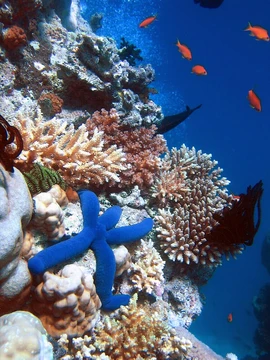
The rim surrounding the Great Blue Hole hosts a vibrant community of coral and tropical fish. The shallow reef edge begins at about five meters depth, slopes gradually to ten meters, and then plunges into a near-vertical cliff face that drops toward the hole's depths. This structural gradient supports a diverse array of marine species. Among the fish inhabiting the area are groupers, squirrelfish, angelfish, butterflyfish, and midnight parrotfish. The site also shelters several reef shark species, including nurse sharks, Caribbean reef sharks, and blacktip sharks. Smaller invertebrates and fish add further layers of biodiversity: sea anemones, Pederson's cleaner shrimp, and neon gobies all call the Blue Hole home. Below the hydrogen sulfide layer discovered at approximately 91 meters, however, conditions shift dramatically. The water becomes dark, oxygen-deprived, and entirely devoid of life, creating a stark ecological boundary between the thriving upper reef community and the sterile, sulfide-rich depths below.
Cultural Significance & Legacy
The Great Blue Hole occupies a place of distinction within the broader Belize Barrier Reef Reserve System, a designation recognized as a UNESCO World Heritage Site. Its global profile was elevated by Jacques Cousteau's declaration of it as one of the top five scuba diving sites on Earth following his 1971 expedition. In 2012, Discovery Channel placed the Blue Hole at number one on its list of "The 10 Most Amazing Places on Earth," underscoring its status as an iconic natural wonder. The site's cultural footprint continued to grow when, in 2018, Discovery aired a two-hour special titled "Discovery Live: Into the Blue Hole," featuring prominent figures including Erika Bergman, Fabien Cousteau—son of Jacques—and billionaire adventurer Richard Branson. Together, these milestones illustrate how the Blue Hole has transcended its role as a geological curiosity to become a symbol of marine exploration, scientific inquiry, and the enduring human fascination with the ocean's most dramatic formations.
Frequently Asked Questions
Who is Great Blue Hole?
It is a massive circular marine sinkhole sitting at the heart of Lighthouse Reef, a small atoll roughly 70 km off Belize's mainland coast. Measuring about 318 m across and 124 m deep, it is one of the most recognizable underwater landmarks in the Caribbean.
What are Great Blue Hole's powers/role?
It serves as one of the world's premier scuba diving destinations, a title cemented when Jacques Cousteau ranked it among his top five dive sites. Its sheer vertical drop and near-perfect circular shape make it a natural spectacle for divers exploring its walls.
Why is Great Blue Hole important?
Beyond its iconic status as a dive site, it offers a geological record spanning multiple ice-age periods, with formation events stretching back roughly 153,000 to 15,000 years. Its inclusion in a UNESCO World Heritage Site underscores its value to both science and marine conservation.
When was Great Blue Hole formed?
The sinkhole did not form in a single event; geological evidence points to distinct formation periods around 153,000, 66,000, 60,000, and 15,000 years ago. Each phase likely corresponds to shifts in sea level during successive ice ages that carved and reshaped the underlying limestone.
More in Coral Reefs, Part 3 1-23
Spotted an error? Know more?
Reader corrections go straight into our review queue. Suggest an edit · How this site is sourced