Gladden Spit and Silk Cayes Marine Reserve
A Belizean marine reserve protecting whale shark feeding and spawning aggregations.

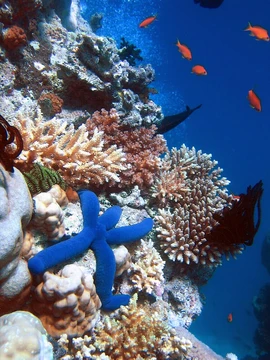
Gladden Spit and Silk Cayes Marine Reserve (GSSCMR) is a protected marine reserve in the central part of Belize's Barrier Reef, covering approximately 25,980 acres (10,510 ha) and lying 36 kilometres (22 mi) off the coast of Placencia. Established in 2003, the reserve comes under the authority of the government's Fisheries Department but is managed by the Southern Environmental Association, a community-based organisation. It is notable as the only place worldwide where whale sharks are known to feed on the eggs of spawning reef fish.
Quick Facts
- Iucn Category
- IV
- Location
- Gulf of Honduras
- Nearest City
- Placencia, Stann Creek
- Area
- 10,510 ha
- Established
- 18 May 2000
- Governing Body
- Ministry of Forestry, Fisheries & Sustainable Development / Southern Environmental Association
Facts from the source article.
Lore & Background
The reserve was declared on 18 May 2000 (Gazette No. 68/2000). In 2001, the feeding site of the whale sharks was declared a special protected zone, and tourism regulations were drafted to regulate the increasing number of whale shark tours. Since 2003, the reserve has been divided into a general use zone, a no-take zone around the Silk Cayes, a conch restoration zone, and a whale shark and reef-fish spawning aggregation conservation zone.
Gladden Spit is a promontory forming the southernmost tip of the sunken atoll, with a short sloping shelf that drops off steeply at about 40–2000 metres in depth within 10 kilometres of the reef. Three small cayes—North Silk, Middle Silk, and South Silk—lie south of Gladden entrance just inside Queen Caye. A nesting colony of terns has been recorded on North Silk Caye. The reserve contains some of the healthiest parts of the reef system due to its elevation and good water quality, and Gladden Spit itself hosts over 25 species of reef fish.
Since the 1920s, fishermen have congregated here to harvest mutton snapper and grouper during their ten-day spawning aggregation period that occurs between March and June. Historically, fishermen recorded substantial catches, and whale sharks—who come to feed on the eggs—were sighted in large numbers. It is the only place worldwide where this activity is known to occur.
Reader's Guide
The significance of Gladden Spit and Silk Cayes Marine Reserve lies in its unique ecological phenomenon: the only known location globally where whale sharks feed on the eggs of spawning reef fish. This event, tied to the ten-day spawning aggregation of mutton snapper and grouper between March and June, has drawn fishermen since the 1920s and later whale shark tours. The reserve's zoning system, established since 2003, reflects a management approach that balances conservation with regulated use, including a special protected zone for whale shark feeding declared in 2001. The reserve also contributes to the broader 1.2 million hectare Important Bird Area off Belize's coast, supporting species such as white-crowned pigeons, red-footed boobies, and roseate terns. Its healthy reef sections, attributed to elevation and good water quality, underscore its role in preserving part of Belize's Barrier Reef system.
From Dispute to Protected Waters
In the early 1980s, the waters surrounding Ambergris Caye and Caye Caulker faced a growing tension between two competing interests. Fish stocks were visibly declining, while tourism to the Cayes was climbing. At the heart of the conflict lay the Hol Chan cut, a natural break in the reef that served as both a productive fishing ground and a magnet for snorkelers and divers. When proposed fishing bans were turned down, the situation stalled until public consultations on a marine protected area began in the mid-1980s. International bodies, including the New York Zoological Society and the Peace Corps, lent their voices to the cause, pointing to the channel's unique geology, its rich conch and lobster populations, and the rare opportunity to protect an interconnected system of reef, seagrass, and mangrove habitats. Between 1985 and 1987, environmentalist Janet Gibson campaigned tirelessly among citizens, businesses, fishermen, and the Belizean government, and in 1986 she authored the Draft Management Plan that laid out the project's feasibility. The reserve was formally established in July 1987, backed by funding from WWF and USAID, with active enforcement of its rules beginning in 1989 and visitor fees for Zone A introduced the following year.
A Landscape of Four Zones
Spanning roughly 18 square kilometres of coral reef, seagrass beds, and mangrove forest, Hol Chan is organized into four distinct management zones. Zone A centres on the Hol Chan Cut itself, a natural gap in the barrier reef measuring about 23 metres wide and 9 metres deep. The name Hol Chan translates from Mayan as "little channel," a fitting description for this passage where the sea can drop to just 1.5 metres around the edges before sloping outward into the Caribbean. Zone B encompasses the seagrass beds within the reef and contains Boca Ciega Blue Hole, a sinkhole that opens into a larger underwater cavern, though its danger to inexperienced divers keeps most visitors away. Zone C covers the mangrove swamps along southern Ambergris Caye, where commercial fishing is prohibited but licensed sport fishing is allowed. In 1999, Zone D was added: Shark Ray Alley, a shallow sandy-bottomed stretch inside the reef that became a gathering ground for sharks and stingrays, originally drawn by the food scraps left when fishermen cleaned their nets nearby.
A Living Corridor of Species
Because the Hol Chan Cut opens directly to the sea beyond the reef, it functions as a living corridor through which marine creatures move freely between the lagoon and the open Caribbean. More than 160 species of fish have been documented within the reserve, alongside forty varieties of coral, five sponge species, two types of seagrass, three species of sea turtle, and three marine mammals: the short-beaked common dolphin, the pantropical spotted dolphin, and the West Indian manatee. The rocky outcrops shelter lobsters, moray eels, and sea anemones, while brain coral, elkhorn coral, and finger coral form the structural backbone of the reef. Jacks, groupers, snappers, and barracuda are regular sights, and spotted eagle rays and southern stingrays glide along the channel floor. The mangrove forests serve as critical nurseries, harbouring juvenile and adult blue striped grunts, French grunts, white grunts, gray snappers, French and gray angelfish, and seahorses. In Shark Ray Alley, nurse sharks and rays congregate in the clear shallow water, making the area a prime snorkelling destination.
Sustaining the Reserve: Goals and Pressures
When the reserve was created in 1987, its charter set four core objectives: preserving the coral reef ecosystem, balancing recreational and tourist use with the area's continued value to fisheries, creating a space for education and scientific research, and conserving genetic resources. Day-to-day oversight now falls to the Hol Chan Marine Reserve Trust Fund Committee, which took over from an informal advisory body in 1994. The committee's primary revenue stream is not direct ticket sales but a yearly licensing scheme applied to the boats of tour guides who access Zones A and D. After WWF funding ended in 1995, this model became essential. The results have been mixed. Fish stocks within the reserve have rebounded, yet the broader fishing industry in the region has continued to shrink. Adjacent mangrove clearance, over which the committee has no jurisdiction, still degrades connected habitats. Meanwhile, the very success of Hol Chan as a tourist draw is creating new pressures: rising visitor numbers strain facilities in San Pedro and Caye Caulker, and the growing foot traffic on the reef poses a tangible threat to coral health.
Frequently Asked Questions
What is the Gladden Spit and Silk Cayes Marine Reserve?
It is a protected marine area in the middle section of Belize's Barrier Reef, sitting roughly 36 kilometres offshore from the Placencia peninsula. The reserve was created to safeguard critical spawning aggregations and the unique feeding habitat of whale sharks.
What makes the Gladden Spit and Silk Cayes Marine Reserve unique?
It is the only site on Earth where whale sharks have been observed gathering to feed on the eggs released by spawning reef fish. This singular ecological interaction has made the area a global focal point for marine conservation and research.
Who manages the Gladden Spit and Silk Cayes Marine Reserve?
While the reserve falls under the jurisdiction of Belize's Fisheries Department, day-to-day management is handled by the Southern Environmental Association, a community-based organisation. This arrangement gives local residents a direct stake in protecting the reef ecosystem.
How large is the Gladden Spit and Silk Cayes Marine Reserve?
The protected zone spans approximately 25,980 acres (about 10,510 hectares) of ocean. It sits in the central stretch of the Belize Barrier Reef, roughly 22 miles off the Placencia coast.
When was the Gladden Spit and Silk Cayes Marine Reserve officially established?
The area was formally declared through gazette notice 68/2000 on 18 May 2000, with full operational status as a marine reserve taking effect in 2003. This two-step process allowed time for management frameworks to be put in place before the protection became active.
More in Coral Reefs, Part 3 1-23
Spotted an error? Know more?
Reader corrections go straight into our review queue. Suggest an edit · How this site is sourced