Bahamas Reef Environmental Educational Foundation
Bahamas marine conservation and education non-profit.

The Bahamas Reef Environmental Educational Foundation (BREEF) is a nonprofit, nongovernmental organization in the Bahamas focused on protecting marine life. Based in Nassau, it works to safeguard coral reef ecosystems, local fishing areas, and runs educational programs. Sir Nicholas Nuttall, 3rd Baronet, founded it as a volunteer group in 1993, and the group hired its first executive director in 2002.
BREEF originally concentrated on teaching Bahamians about the nation’s natural resources. Over time, it became more active as a watchdog and political advocate, shifting from a volunteer effort to a formal NGO. Its main work includes community outreach, partnerships with government and civil society, and educational initiatives.
The organization raises awareness about the value of coral reefs, seagrass beds, mangroves, and other marine ecosystems through projects like the Coral Reef Sculpture Garden. It also trains marine science teachers. BREEF runs the Young Reporters for the Environment program in the Bahamas and hosts the Extreme Hangout Bahamas, an annual two-day youth climate action summit.
Quick Facts
- Founded
- 1993
- Founder
- Sir Nicholas Nuttall
- Location
- Nassau, Bahamas
- Methods
- Education, advocacy
- Fields
- Marine conservation
Facts from the source article.
Lore & Background
BREEF was founded in 1993 by Sir Nicholas Nuttall, 3rd Baronet, as a voluntary organisation based in Nassau. Its first executive director was hired in 2002. Initially focused on educating Bahamians about the country's natural resources, BREEF later took on an active role as a watchdog and political advocacy group, transitioning from a voluntary organisation to a more formalised non-government organisation. Its primary activities are community outreach, government and civil society partnerships, and educational programmes. The organisation raises awareness about the importance of coral reefs, seagrass beds, mangroves and other marine ecosystems through initiatives like the Coral Reef Sculpture Garden. BREEF also trains marine science teachers.
Reader's Guide
BREEF is notable as a non-government, not-for-profit organisation that campaigns to preserve coral reef ecosystems in the seas around the Bahamas and protect local fishing grounds. Its significance lies in its evolution from a voluntary organisation founded in 1993 by Sir Nicholas Nuttall, 3rd Baronet, to a formalised non-government organisation with a watchdog and political advocacy role. The organisation's legacy includes its educational focus, training marine science teachers and raising awareness through initiatives like the Coral Reef Sculpture Garden. BREEF also serves as the national operator for the Young Reporters for the Environment programme for the Bahamas and organises the Extreme Hangout Bahamas, an annual two-day youth climate action summit. Its primary activities—community outreach, government and civil society partnerships, and educational programmes—underscore its role in marine conservation and public engagement in the Bahamas.
The Living Architecture of the Reef
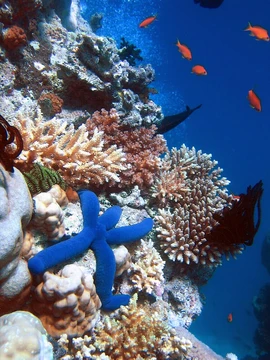
Coral reefs are among the most architecturally complex structures on Earth, yet they are built by animals. Each reef is a colony of tiny polyps belonging to the class Anthozoa, a group within the phylum Cnidaria that also includes sea anemones and jellyfish. What sets corals apart from their anemone relatives is their ability to secrete rigid calcium carbonate exoskeletons, creating a living scaffold that both supports and shields the polyp. These stony corals cluster in dense groups, and as other elements in the water become incorporated into the carbonate deposits, the mineral aragonite forms the reef's structural backbone. Shell fragments and the remains of coralline algae, including the green-segmented genus Halimeda, further reinforce the framework against storm damage. Growth is slow but steady: healthy tropical reefs expand horizontally by one to three centimeters per year and vertically by one to twenty-five centimeters, though they can only thrive at depths shallower than roughly 150 meters where sufficient sunlight reaches the symbiotic zooxanthellae that power their metabolism.
How Reefs Rise from the Deep
The story of how coral reefs came to be is inseparable from the story of sea-level change. Most of the world's reefs are younger than ten thousand years, having taken shape after the Last Glacial Period melted ice sheets and flooded continental shelves. As water levels climbed, coral communities grew upward in lockstep, building on foundations of older dead coral to stay within their narrow photic zone. Charles Darwin, drawing on observations from the Beagle voyage, proposed a three-stage sequence for atoll formation: a fringing reef encircles a volcanic island, transforms into a barrier reef as the island subsides, and eventually becomes a ring-shaped atoll once the volcano sinks below the waves. He predicted a bedrock base beneath each lagoon, a prediction later confirmed by research. The Great Barrier Reef, roughly twenty thousand years old, illustrates the same principles on a continental shelf, where rising waters gradually overtopped coastal hills, allowing corals to overgrow them into cays and reefs stretching two thousand kilometers.
A Fragile Paradise Under Siege
Despite their apparent robustness, shallow tropical coral reefs have lost roughly half their extent since 1950, a decline driven by their sensitivity to even modest shifts in water conditions. Excess nutrients from nitrogen and phosphorus runoff, rising ocean heat content, and progressive acidification all stress the delicate polyp-algae partnership. Human fishing practices compound the damage: blast fishing, cyanide harvesting, and spearfishing on scuba deplete the fish populations that help maintain reef balance. Sunscreen chemicals and harmful land-use practices, including seepage from injection wells and cesspools, introduce additional pollutants. The result is a cascading loss of habitat for the vast array of organisms that depend on the reef. Corals that rely on zooxanthellae are particularly vulnerable when water becomes too deep or too turbid for their symbionts to photosynthesize effectively, a phenomenon sometimes called coral drowning. The combination of these pressures makes reef conservation one of the most urgent challenges in marine science.
The Ocean's Most Valuable Real Estate
Often called the rainforests of the sea, coral reefs punch far above their geographic weight. They occupy less than one-tenth of one percent of the world's ocean area—roughly half the size of France—yet they shelter at least a quarter of all known marine species, from fish and mollusks to crustaceans, echinoderms, sponges, tunicates, and other cnidarians. This extraordinary concentration of life underpins critical ecosystem services: tourism revenue, sustainable fisheries, and natural shoreline protection against storm surges. The economic stakes are staggering. Estimates of the annual global value of coral reefs have ranged from thirty to three hundred seventy-five billion dollars in late-twentieth- and early-twenty-first-century assessments, climbing to two point seven trillion dollars in a 2020 analysis and as high as nine point nine trillion dollars in a 2014 study. These figures reflect not just direct commercial use but the irreplaceable biological infrastructure that supports coastal communities worldwide.
Frequently Asked Questions
What is the Bahamas Reef Environmental Educational Foundation (BREEF)?
BREEF is a nonprofit, nongovernmental organization headquartered in Nassau, Bahamas, dedicated to protecting the nation's marine ecosystems. It was established in 1993 by Sir Nicholas Nuttall, 3rd Baronet, as a volunteer-driven group focused on coral reef and fishing-area conservation.
What are BREEF's main activities and role?
The organization works to safeguard coral reef habitats and local fishing grounds while also running educational programs for Bahamians about their natural resources. Over time, BREEF expanded its mission to include watchdog and political advocacy work in marine conservation.
Who founded BREEF and when was it established?
Sir Nicholas Nuttall, 3rd Baronet, created the foundation in 1993 as a volunteer group. The organization did not hire its first executive director until 2002, meaning it operated as a grassroots effort for nearly a decade before formalizing its leadership structure.
Where is BREEF headquartered?
The foundation is based in Nassau, the capital of the Bahamas, where it coordinates its conservation, education, and advocacy efforts for the country's marine environments.
Why is BREEF important to coral reef conservation?
BREEF fills a critical gap by combining hands-on reef protection with public education and political advocacy, all while operating as an independent, non-governmental body. Its evolution from a small volunteer teaching group into an active environmental watchdog has made it a key voice for marine preservation in the Bahamas.
More in Coral Reefs, Part 3 1-23
Spotted an error? Know more?
Reader corrections go straight into our review queue. Suggest an edit · How this site is sourced