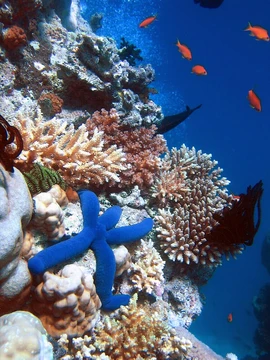
Coral Reef Conservation Program
NOAA partnership managing and restoring U.S. coral reef ecosystems.

The Coral Reef Conservation Program (CRCP) is a partnership of agencies within the National Oceanic and Atmospheric Administration (NOAA), created in 2000. It represents a multidisciplinary effort by NOAA to study and manage coral reef ecosystems through research and the sharing of data, supporting partners who work on reef restoration. The program was established under the Coral Reef Conservation Act of 2000 and Presidential Executive Order 13089, meeting NOAA’s legal duties under those laws.
The CRCP’s main job is to collect and share scientific information that coastal and marine resource managers and other decision-makers need to address threats to coral reef ecosystems in U.S. waters and nearby areas. The program focuses on three priority threats: climate change, unsustainable fishing, and pollution. Its primary responsibility is monitoring how these threats affect the condition of U.S. coral reefs. Each year, NOAA divers survey nearly 1,600 reef sites to track these effects. All research and data collected are publicly available through the Coral Reef Information System. Beyond monitoring, the CRCP also maps coral reef habitats, forecasts ocean conditions, and handles communications and data management.
In addition to conducting research, the CRCP provides financial support to partners such as universities and nonprofit organizations by awarding grants for projects in coral reef ecosystem management and restoration. The program aims to fund at least $8 million in grants each year for conservation management projects. In fiscal year 2018, it contributed over $26 million to coral reef projects across the U.S. through grants and agreements. Funding for the CRCP comes from NOAA and the U.S. Fish and Wildlife Service.
The CRCP includes several NOAA line offices: the National Ocean Service, the National Marine Fisheries Service, the Office of Oceanic and Atmospheric Research, and the National Environmental Satellite, Data and Information Service. The National Ocean Service oversees the CRCP’s budget and conducts partnered activities like mapping and monitoring reefs. The National Marine Fisheries Service works to reduce overfishing and collaborates with the CRCP to manage its effects on coral reefs.
Quick Facts
- Abbreviation
- CRCP
- Formation
- 2000
- Tax Id
- <!-- or
- Vat Id
- (for European organizations) -->
- Headquarters
- Silver Spring, Maryland
- Key People
- Jennifer Koss (director)
- Parent Organization
- National Oceanic and Atmospheric Administration
Facts from the source article.
Lore & Background
The CRCP was established by the Coral Reef Conservation Act 2000 and Presidential Executive Order 13089, in order to fulfill the NOAA's obligations under these statutes. The main role of the CRCP is to gather and present scientific information that coastal and marine resource managers and other decision-makers require, to address the various threats facing coral reef ecosystems in U.S. and surrounding waters. The CRCP's priority threats are climate change, unsustainable fishing practices and pollution. Monitoring the effects of these threats on the condition of U.S. coral reef ecosystems is the primary responsibility of the CRCP. Each year NOAA divers survey coral reefs at nearly 1600 sites to monitor these effects. All research and data collected by the CRCP is publicly available on the Coral Reef Information System. Other tasks conducted by the CRCP include mapping of coral reef habitats, forecasting oceanographic conditions, and communications and data management.
The CRCP is made up of several NOAA Line Offices including the National Ocean Service, the National Marine Fisheries Service, the Office of Oceanic and Atmospheric Research, and the National Environmental Satellite, Data and Information Service. The National Ocean Service is responsible for overseeing budget activities for the CRCP and conducts partnered activities including mapping and monitoring. The National Marine Fisheries Service works closely with the CRCP to manage the effects of overfishing. The National Environmental Satellite, Data and Information Service monitors coral reef indices through sensors, sharing data with the CRCP. NOAA's Oceanic and Atmospheric Research body coordinates data collection on atmospheric and oceanic parameters. The CRCP also works closely with external partners including state and territorial governments, academic institutions and non-government and intergovernmental organisations.
Reader's Guide
The CRCP's mission is to 'protect, conserve and restore coral reef resources by maintaining healthy ecosystem functioning,' as outlined in the Coral Reef Conservation Act. Its objectives are consolidated into four key pillars: increasing resilience to climate change, reducing land-based sources of pollution, improving fisheries' sustainability, and restoring viable coral populations. Under the resilience pillar, the CRCP developed precise climate and bleaching thermal stress prediction tools in 2014, enabling proactive management. The program aims for at least seven partners to apply climate resilience data by 2025. For pollution reduction, the CRCP supports watershed management initiatives and partners with the U.S. Coral Reef Task Force. In fisheries, it provides data to managers under the Magnuson-Stevens Fishery Conservation and Management Act and aims for 50 percent of relevant partners to adopt cooperatively developed management tools. Restoration efforts include resilience interventions such as assisted genetic adaptation and larval propagation. The CRCP also produces periodic national-level status reports on U.S. coral reef condition, developed with the Integration and Application Network at the University of Maryland Centre for Environmental Science. Funding for the CRCP is provided by the NOAA and the U.S. Fish and Wildlife Service.
The Symbiotic Engine of Reef Life
Coral reefs are built on a partnership so fundamental that its collapse unravels the entire structure. Each coral polyp hosts single-celled zooxanthellae algae within its tissues. The algae perform photosynthesis, converting sunlight into sugars that feed the coral, while the coral offers the algae a protected home. This mutualism is also the source of the vivid colors that make reefs so visually stunning—different species of zooxanthellae produce different pigments. When environmental conditions shift, particularly when water temperatures rise, the stressed coral expels its algal symbionts. The result is coral bleaching: the polyp turns pale as it loses both its color and its primary sugar-based food supply. Without the zooxanthellae, corals effectively starve. This single biological relationship underpins the productivity and diversity that make reefs among Earth's richest ecosystems, and its vulnerability to even modest temperature changes makes it a focal point of every conservation effort.
A Tiny Fraction, an Enormous Return
Coral reefs occupy a mere 0.2 percent of the world's marine ecosystems, yet the services they deliver are staggering in scale. They shelter more than nine million species—roughly a quarter of all marine life—ranging from tiny invertebrates to sharks, sea turtles, and marine mammals. Over a billion people worldwide rely on reef-associated fish as a critical food source, and in the United States alone, half of all commercial and recreational fisheries draw over $100 million annually from reef-dependent stocks. Globally, reef fisheries generate $5.7 billion in net income. Beyond food, reefs act as natural breakwaters, buffering coastlines from storms and erosion; approximately 500 million people live within 100 kilometers of a reef and depend on that protection. Local economies channel roughly $9.6 billion through diving tours, fishing trips, hotels, and restaurants. In medicine, compounds from reef organisms have been explored for treating cancer, arthritis, asthma, and viral infections, while coral limestone has shown promise as a biocompatible material for human bone grafts.
Managing the Human Footprint
Effective coral reef protection centers on reshaping how people interact with these fragile systems. Key strategies include setting measurable conservation goals, introducing active management, and weaving local communities into the decision-making process. One of the most direct tools is the establishment of Marine Protected Areas, which impose concrete limits on activities like fishing within designated zones. Recreational scuba diving, however, presents a subtler but measurable threat. The most common form of damage occurs when a diver's fins, hands, knees, or equipment gauges strike brittle branched stony corals. Research has shown that a 45-minute briefing on coral biology and protected-area rules, paired with a short in-water demonstration of proper buoyancy and trim, significantly reduces the damage divers inflict during their dive. Education and skill-building, rather than outright bans, can therefore shift diver behavior in ways that let the reef recover. These approaches illustrate a broader principle: reducing human stressors is as important as protecting what remains.
Deep Time Against Rising Threats
The sheer timescale of reef formation underscores how vulnerable these structures are to modern pressures. It takes roughly ten thousand years for coral polyps to build a reef, and between 100,000 and 30 million years for a fully mature reef to develop. Against that geological patience, the stressors now acting on reefs operate with alarming speed. On a global scale, climate change drives warming waters, shifts in ocean pH, and sea-level rise. At the local level, residential and industrial runoff, agricultural discharge, sedimentation from land clearing, sewage, and toxic waste compound the damage. Acute threats include unsustainable fishing practices such as bottom trawling, as well as boat anchors and accidental groundings that physically shatter reef structures. The effects of these combined stressors can range from negligible to catastrophic, and because a single damaged section of reef may take millennia to rebuild, the margin for error is vanishingly small. Conservation, in this light, is not merely preservation—it is an attempt to buy time that deep time once provided for free.
Frequently Asked Questions
What is the Coral Reef Conservation Program?
The Coral Reef Conservation Program is a collaborative initiative housed within NOAA that coordinates the study and management of U.S. coral reef ecosystems. Launched in 2000, it brings multiple federal agencies together as a multidisciplinary partnership to pool research and data for reef restoration efforts.
What laws established the Coral Reef Conservation Program?
The program was created in response to two key legal mandates: the Coral Reef Conservation Act of 2000 and Presidential Executive Order 13089. Both gave NOAA a formal obligation to oversee and protect coral reef resources, and the CRCP was the mechanism built to fulfill those duties.
What does the Coral Reef Conservation Program do on a day-to-day basis?
Its core function is gathering and distributing scientific information about coral reefs to coastal and marine resource managers. It also funds research partners and supports restoration work, surveying nearly 1,600 reef sites each year to track ecosystem health.
How much money does the Coral Reef Conservation Program put toward reef work?
The program targets a minimum of $8 million in annual grants, though actual disbursements have exceeded that figure—for instance, more than $26 million was allocated in fiscal year 2018. This funding flows to partner organizations conducting reef research and restoration.
Why does the Coral Reef Conservation Program matter?
It serves as the central federal coordination point for understanding and protecting U.S. coral reefs, bridging the gap between scientific research and on-the-ground management. By 2025, the program aims to have at least seven partners formally adopt climate-resilience strategies, cementing its role in long-term reef survival.
More in Coral Reefs, Part 3 1-23
Spotted an error? Know more?
Reader corrections go straight into our review queue. Suggest an edit · How this site is sourced