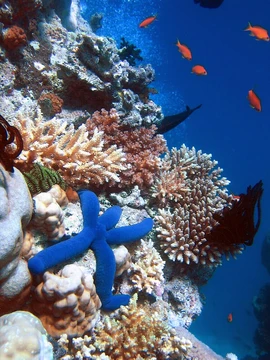
Arrecifes de Cozumel National Park
Part of the second largest coral reef system in the world.

Arrecifes de Cozumel National Park is a marine protected area located off the island of Cozumel, in Quintana Roo, Mexico. The reef system here belongs to the Mesoamerican Barrier Reef System, which is the second-largest coral reef system on Earth. Although coral reefs surround nearly the entire island, the park only protects those on the southern side. Its boundaries start just south of the International Pier, run down and around Punta Sur, and extend a short distance up the island’s east coast. The park includes both shallow and mesophotic coral reefs, reaching out to the 100-meter depth isobar.
This park is safeguarded under the Ramsar Convention, together with Manglares y Humedales del Norte de Isla Cozumel, and both are part of the UNESCO-protected Isla Cozumel Biosphere Reserve.
**Location** The park lies in the municipality of Cozumel, Quintana Roo, Mexico, roughly 20 kilometers (12 miles) off the eastern coast of the Yucatán Peninsula in the Caribbean Sea.
**History** Arrecifes de Cozumel was declared a National Marine Park on July 19, 1996, under President Ernesto Zedillo Ponce de León. The park covers an area of 120 square kilometers (46 square miles).
**Biodiversity** The park is part of a rich coral reef ecosystem that supports more than 1,000 marine species. Most reefs grow on underwater cliffs, though some are found in coastal lagoons and on sand bars at the island’s northern tip. Cozumel’s deeper reefs were once famous for black corals, but overharvesting from the 1960s to the mid-1990s caused their numbers to drop, and by 2016 they had not recovered. The reefs consist of both hard and soft corals. Marine life includes zoanthids, polychaetes, actinarians, hydroids, sponges, crustaceans, mollusks, echinoderms, and many types of Caribbean fish. The park also provides habitat for several endangered species, such as loggerhead and hawksbill sea turtles, queen triggerfish, and the endemic splendid toadfish. Because of its abundant marine life, coral reefs, and clear, warm Caribbean water, Cozumel is considered one of the world’s top scuba-diving destinations.
The Cozumel splendid toadfish (*Sanopus splendidus*), listed as vulnerable by the IUCN, is entirely endemic to the reefs around the island. Other protected species in the park include green turtles, loggerhead sea turtles, hawksbill sea turtles, queen conch, and black coral.
Quick Facts
- Iucn Category
- II
- Location
- Cozumel, Quintana Roo, Mexico
- Nearest City
- San Miguel de Cozumel, Quintana Roo, Mexico
- Area
- 120 km2
- Established
- July 19, 1996
- Governing Body
- Secretariat of the Environment and Natural Resources
Facts from the source article.
Lore & Background
The park was declared a National Marine Park on July 19, 1996, under the direction of President Ernesto Zedillo Ponce de León. It covers 120 square kilometres (46 sq mi) and includes both shallow and mesophotic coral reefs, extending to the 100 m depth isobar. The park is protected under the Ramsar Convention along with Manglares y Humedales del Norte de Isla Cozumel, and both are included in the UNESCO protected area called Isla Cozumel Biosphere Reserve, Mexico.
The reefs are primarily found on underwater cliffs, with some in coastal lagoons and on sand bars at the north tip of the island. Cozumel's deeper coral reefs were historically famed for their black corals, but black coral populations declined from the 1960s to the mid-1990s due to overharvesting and had not recovered by 2016. The reefs are made up of hard coral and soft coral, and host a diverse array of marine life including zoanthids, polychaets, actinarians, hydroids, sponges, crustaceans, mollusks, echinoderms, and many varieties of Caribbean fish.
Reader's Guide
Arrecifes de Cozumel National Park is notable as part of the Mesoamerican Barrier Reef System, the second largest coral reef system in the world. The park's biodiversity includes more than 1,000 marine species, and it is a habitat for several endangered species such as the loggerhead and hawksbill sea turtles, queen triggerfish, and the endemic splendid toadfish. The Cozumel splendid toadfish (Sanopus splendidus) is listed as vulnerable by IUCN and is entirely endemic to the reefs surrounding the island. Other protected species include the green turtle, queen conch, and black coral. The clear, warm Caribbean water and abundant marine life have made Cozumel considered one of the best scuba-diving destinations in the world. The park's protection under the Ramsar Convention and its inclusion in the UNESCO Isla Cozumel Biosphere Reserve underscore its conservation significance. The historical decline of black coral from overharvesting between the 1960s and mid-1990s, with no recovery by 2016, highlights ongoing ecological challenges within the park.
Did You Know?
- The park covers 120 square kilometres (46 sq mi) and extends to the 100 m depth isobar.
- The Cozumel splendid toadfish (Sanopus splendidus) is entirely endemic to the reefs surrounding the island and is listed as vulnerable by IUCN.
Geography and Spatial Scope
Nestled roughly twenty kilometers off the eastern shore of the Yucatán Peninsula, Arrecifes de Cozumel National Park occupies a stretch of the Caribbean Sea adjacent to the island of Cozumel in Quintana Roo, Mexico. Though coral formations ring nearly the entire island, the protected park deliberately focuses on the southern and southeastern reefs. Its boundaries begin just below the International Pier, sweep around the dramatic headland of Punta Sur, and extend a short distance up the island's eastern flank. The park covers approximately 120 square kilometers of marine territory and is a constituent element of the Mesoamerican Barrier Reef System, the second-largest coral reef structure on the planet. Within those waters, divers encounter both shallow reef communities and mesophotic coral gardens, with the protected zone reaching down to the 100-meter depth isobar. This vertical range means the park shelters ecosystems that exist in bright, sunlit shallows as well as the dim, cooler depths where light-dependent corals give way to different assemblages of marine life.
Designation and Administrative History
The formal creation of Arrecifes de Cozumel as a National Marine Park traces back to a single decisive act on July 19, 1996. Under the direction of Mexican president Ernesto Zedillo Ponce de León, the government issued the declaration that carved out 120 square kilometers—roughly 46 square miles—of Caribbean waters for dedicated marine protection. This designation was not merely a local conservation measure; it anchored the park within a broader web of international and national protections. Together with the wetland and mangrove area known as Manglares y Humedales del Norte de Isla Cozumel, the reef park falls under the Ramsar Convention, the global treaty for wetland preservation. Both sites are also encompassed within the UNESCO-recognized Isla Cozumel Biosphere Reserve, a designation that signals the island's ecological importance on a world stage. The 1996 declaration thus represented a convergence of federal authority, international wetland policy, and UNESCO biosphere criteria, all converging on the same stretch of reef off Cozumel's southern coast.
Marine Biodiversity and Signature Species
The waters within Arrecifes de Cozumel support an ecosystem that shelters more than one thousand distinct marine species, a richness that has earned Cozumel a reputation as one of the premier scuba-diving destinations on the planet. Coral formations here are built from both hard and soft coral, growing primarily along steep underwater cliffs, with additional patches found in coastal lagoons and on sand bars near the island's northern tip. The reef communities teem with zoanthids, polychaetes, actinarians, hydroids, sponges, crustaceans, mollusks, echinoderms, and a wide array of Caribbean fish. Among the most remarkable residents is the Cozumel splendid toadfish, Sanopus splendidus, a species entirely endemic to these island reefs and currently listed as vulnerable by the IUCN. The park also serves as critical habitat for endangered loggerhead and hawksbill sea turtles, the queen triggerfish, and the queen conch. The clear, warm Caribbean water and the sheer density of life make every dive a window into one of the most biologically rich reef environments in the western Atlantic.
Conservation Pressures and Protected Status
Despite its layered protections, the reefs of Arrecifes de Cozumel have faced serious ecological setbacks. The most stark example is the black coral: once a celebrated feature of Cozumel's deeper reefs, black coral populations suffered severe declines between the 1960s and the mid-1990s as a direct result of overharvesting. By 2016, those populations still had not recovered to their former levels, underscoring how slowly deep-water coral communities can rebound once depleted. To counter such threats, the park benefits from multiple overlapping conservation frameworks. It is protected under the Ramsar Convention alongside the northern mangrove and wetland area of the island, and both sites sit within the UNESCO Isla Cozumel Biosphere Reserve. Specific species receive targeted protection as well: the green, loggerhead, and hawksbill sea turtles, the queen conch, and black coral all carry some degree of legal safeguard. The IUCN's vulnerable listing for the endemic splendid toadfish further highlights the urgency of preserving these waters against both historical exploitation and ongoing environmental pressures.
Frequently Asked Questions
What is Arrecifes de Cozumel National Park?
It is a marine protected zone in the Caribbean Sea, situated roughly 20 kilometers off the eastern shore of the Yucatán Peninsula near the island of Cozumel in Quintana Roo, Mexico. The park safeguards coral habitats on the southern and eastern edges of the island, including both shallow reefs and deeper mesophotic communities extending to the 100-meter depth line.
How big is Arrecifes de Cozumel National Park?
The protected area covers approximately 120 square kilometers (46 square miles) of marine territory. Its boundaries begin just south of the International Pier, trace around Punta Sur, and stretch a short distance up the island's east coast.
What larger reef system does Arrecifes de Cozumel National Park belong to?
The coral formations within the park are a component of the Mesoamerican Barrier Reef System, which ranks as the second-largest coral reef structure on the planet. This connection gives the park a significant ecological role within one of the world's most extensive reef networks.
When and by whom was Arrecifes de Cozumel National Park officially declared?
President Ernesto Zedillo Ponce de León formally designated the area as a national park on July 19, 1996. This act placed the southern and eastern coral habitats of Cozumel under federal protection.
Why is Arrecifes de Cozumel National Park important to coral reef enthusiasts?
It shelters both shallow and mesophotic reef communities down to the 100-meter isobath, offering a cross-section of depth zones within a single protected zone. As part of the Mesoamerican Barrier Reef, it represents a critical fragment of the second-largest reef system on Earth and a key habitat for Caribbean marine biodiversity.
More in Coral Reefs, Part 3 1-23
Spotted an error? Know more?
Reader corrections go straight into our review queue. Suggest an edit · How this site is sourced