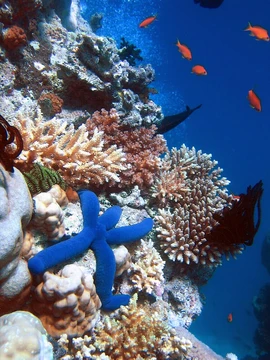
Coral Reef Initiative for the South Pacific
A French inter-ministerial project for Pacific coral reef protection.

The Coral Reef Initiative for the South Pacific (CRISP) is a French inter-ministerial project launched in 2002. Its goal is to shape a long-term vision for coral reef ecosystems and the communities relying on them, spanning French overseas territories and developing Pacific Island nations. The program is coordinated by a dedicated unit and a program manager, supported by scientific advisors, and is hosted by the Secretariat of the Pacific Community in Nouméa, New Caledonia. Institutional oversight comes from the Pacific Community and the South Pacific Regional Environment Programme, making CRISP a regional effort to promote the protection and sustainable management of Pacific island coral reefs. The initiative traces its origins to the 2003 French-Oceania Summit, where French President Jacques Chirac proposed uniting Oceania participants around sustainable development of Pacific coral reefs. Its launch was announced in September 2004 at a South Pacific Regional Environment Programme (SPREP) meeting in Papeete, French Polynesia. Initially valued at €10 million over three years, the project involved fifteen Pacific Island countries and three French Pacific territories—New Caledonia, French Polynesia, and Wallis and Futuna—envisioned as a "driving belt" connecting these areas. The programme's implementation was facilitated by the United Nations Environment Programme (UNEP), and the initiative reflected a political push for local oversight in the region. CRISP’s components include integrated coastal and watershed management and coral ecosystem development. The ReefBase Pacific project is a collaborative effort with SPREP, and International Coral Reef Action Network (IRCAN) projects have also been folded into CRISP. Educational activities include a 2008 workshop on economic evaluation of marine protected areas. In partnership with SPREP, CRISP supports groups like the Aiga Folau o Samoa (Samoa Voyaging Society), which raises regional environmental awareness. The initiative also helps organizations develop case studies, such as the 2009 Navakavu Locally Managed Marine Area in Viti Levu, Fiji, where CRISP provided biological monitoring and fish larvae research. The 2009 Pacific COREMO (Coral Reef Monitoring) database training, run through the Institute of Marine Resources at the University of the South Pacific, included CRISP representatives. Additionally, CRISP’
- Founded
- 2002
- Initial value
- €10 million
- Initial duration
- three years
- Initial participants
- fifteen Pacific Island countries and three French Pacific Territories
- French territories involved
- New Caledonia, French Polynesia, Wallis and Futuna
- Host organization
- Secretariat of the Pacific Community
- Location of host
- Nouméa, New Caledonia
Lore & Background
During the French-Oceania Summit of 2003, French President Jacques Chirac promoted the idea of bringing together Oceania participants to work towards sustainable development of the Pacific Ocean coral reefs. Its launch was announced in September 2004 during the South Pacific Regional Environment Programme (SPREP) meeting held in Papeete, French Polynesia. At the initial launch, the project was valued at €10 million over three years, involving fifteen Pacific Island countries and three French Pacific Territories, envisioned as a 'driving belt' between these locales. The programme's implementation was facilitated by the United Nations Environment Programme (UNEP), and its establishment included a political desire for local oversight in the Pacific region. Some of CRISP's components include integrated coastal and watershed management, and development of coral ecosystems. The ReefBase Pacific project is a collaborative programme with SPREP, and International Coral Reef Action Network (IRCAN) projects have also been incorporated into CRISP. An additional component is educational, such as the Workshop on Economic Evaluation of MPAs sponsored by CRISP in 2008. In partnership with SPREP, CRISP supports activities of various societies such as the Aiga Folau o Samoa (Samoa Voyaging Society), which promotes regional awareness in protecting the environment. CRISP provides support to organizations in developing case studies, of which Navakavu Locally Managed Marine Area, Viti Levu, Fiji (2009) is one example. For that study, CRISP provided biological monitoring test and comparison, as well as fish larvae research. Pacific COREMO (Coral Reef Monitoring) database training of 2009 through the Institute of Marine Resources at the University of the South Pacific included representatives from CRISP. Supporting Kanak traditions, CRISP's partnership with Conservation International provided recommendations and underwater species guides to the Kanak people.
Reader's Guide
The Coral Reef Initiative for the South Pacific is notable as a regional initiative that promotes the protection and sustainable management of the coral reefs of the Pacific island states. Its significance lies in its collaborative structure, bringing together French overseas territories and Pacific Island developing countries under a single programme coordinated by the CRISP Coordination Unit and a programme manager supported by scientific counselors. The initiative's legacy includes its role in facilitating projects such as ReefBase Pacific with SPREP, incorporating International Coral Reef Action Network projects, and sponsoring educational workshops like the 2008 Workshop on Economic Evaluation of MPAs. It also contributed to case studies such as the Navakavu Locally Managed Marine Area in Fiji, providing biological monitoring and fish larvae research. Through partnerships with organizations like Conservation International, CRISP supported Kanak traditions by providing recommendations and underwater species guides. The programme's establishment was facilitated by UNEP and reflected a political desire for local oversight in the Pacific region. Its initial funding of €10 million over three years and involvement of fifteen Pacific Island countries and three French territories underscore its broad regional scope.
Did You Know?
- CRISP was founded in 2002 as a French inter-ministerial project.
- Its launch was announced in September 2004 during a SPREP meeting in Papeete, French Polynesia.
- CRISP provided biological monitoring and fish larvae research for the Navakavu Locally Managed Marine Area case study in Fiji (2009).
A Living Treasury of Marine Life
The Coral Triangle, spanning tropical waters across Indonesia, Malaysia, Papua New Guinea, the Philippines, the Solomon Islands, and Timor-Leste, stands as the planet's most extraordinary marine ecosystem. Despite covering only 1.6 percent of the world's oceanic area, it shelters 76 percent of all known shallow-water reef-building coral species and 37 percent of the world's reef fish species. More than 3,000 species of bony fish roam its waters, including the whale shark, the coelacanth, and chimaeras. Beyond corals and fish, the region harbors roughly 950 mollusc species, 458 crustacean species, and six of the seven sea turtle species found globally. The Bird's Head Seascape in Indonesian Papua represents the absolute peak of this diversity, hosting 574 coral species alone. The region also contains the world's largest mangrove forest and supports between 10 and 21 seagrass species across nearly 58,550 square kilometres. Thirteen percent of the Triangle has been flagged as high-biodiversity hotspots, while the 6 percent of area with the highest species counts stretches from the northern Philippines through Sabah, Sulawesi, the Banda Sea, the Raja Ampat Archipelago, and into Papua New Guinea and the Solomon Islands.
Economic Lifeline for Millions
The marine ecosystem of the Coral Triangle is not merely an ecological treasure; it is an economic engine of staggering scale. In 2014, the Asian Development Bank estimated that the region's marine GDP reaches approximately $1.2 trillion annually, while simultaneously providing food security to more than 120 million people. The Coral Triangle Knowledge Network further reported that fisheries exports generate roughly $3 billion in foreign exchange income each year, matched by another $3 billion flowing in from coastal tourism. These figures underscore how deeply the livelihoods of coastal communities across six nations depend on healthy reefs, productive fisheries, and thriving mangrove systems. The region's biological resources—spanning 500 or more reef-building coral species per ecoregion, vast populations of razor clams, and abundant fish stocks—form the foundation of this economic output. For the governments of Indonesia, Malaysia, Papua New Guinea, the Philippines, the Solomon Islands, and Timor-Leste, the Triangle represents both a source of national revenue and a critical food supply, making its preservation an economic imperative as much as an ecological one.
Global Conservation Priorities
Recognized as one of the eight major coral reef zones on Earth and a global priority for conservation, the Coral Triangle has attracted sustained international attention. The World Wide Fund for Nature designates the region a top marine conservation priority and has addressed ecological threats through its Coral Triangle Program, launched in 2007. Two of the Triangle's reef systems have earned the highest international recognition: the Tubbataha Reef Natural Park in the Philippines and the Raja Ampat UNESCO Global Geopark in Indonesia, both designated UNESCO World Heritage Sites. The Verde Island Passage in the Philippines is likewise celebrated as a center of biodiversity within the Triangle. Despite these protections, Indonesia's Minister of Research and Technology, Bambang Permadi Soemantri Brodjonegoro, has emphasized that the region urgently needs more taxonomists and oceanographers to catalogue its biodiversity and apply that knowledge to protecting coastal and marine life from extinction. The challenge of documenting and safeguarding a region that spans 5.7 million square kilometres of ocean across six sovereign nations remains one of the most complex conservation endeavors in the world.
Mysteries of the Deep and the Why of Diversity
Scientists continue to debate why the Coral Triangle harbors such extraordinary species richness, and three competing models offer different explanations. The 'centre of origin' model suggests that the archipelago's populations are part of a central origin of diversification. The 'centre of overlap' model proposes that multiple biogeographic ranges converge in the region, while the 'centre of accumulation' model argues that species from surrounding areas accumulate here over time. The Triangle indeed straddles two biogeographic regions—the Indonesian-Philippines Region and the Far Southwestern Pacific Region—sitting between the Pacific and Indian Oceans. Beyond shallow reefs, a joint Indonesian–U.S. marine survey in 2008 revealed that the Triangle's diversity extends into the deep ocean. At depths of 3,800 meters along the western ridge, researchers discovered active underwater volcanoes and roughly 40 newly identified deep-sea coral species, most of them whitish due to the absence of shallow-water algae. At 4,000 meters, hydrothermal vents and coral formations sustain communities of niche shrimps, crabs, barnacles, and sea cucumbers, revealing that the Triangle's biological richness reaches far beyond the sunlit shallows.
Frequently Asked Questions
What is the Coral Reef Initiative for the South Pacific (CRISP)?
CRISP is a French inter-ministerial program created to develop a shared, long-term strategy for protecting coral reef ecosystems and the coastal communities that depend on them. It operates across French Pacific territories and neighboring developing Pacific Island nations.
When was CRISP launched and how was it initially funded?
The initiative was set up in 2002 with a starting budget of ten million euros. Its original three-year phase brought together fifteen Pacific Island countries and three French Pacific Territories.
Which French territories are part of CRISP?
The three French Pacific territories involved are New Caledonia, French Polynesia, and Wallis and Futuna. They participate alongside fifteen independent Pacific Island nations in the program's collaborative framework.
Where is CRISP headquartered and who provides institutional oversight?
The program is hosted by the Secretariat of the Pacific Community in Nouméa, New Caledonia. Day-to-day coordination runs through a dedicated unit and program manager backed by scientific advisors, while the Pacific Community and the South Pacific Regional Environment Programme supply the broader institutional oversight.
Why does CRISP matter for the South Pacific region?
It gives a formal, multi-year platform for French and Pacific Island stakeholders to align their reef-management policies rather than working in isolation. By pooling scientific expertise and political commitment, it aims to shape a durable vision for reef health and the livelihoods tied to those ecosystems.
More in Coral Reefs, Part 3 1-23
Spotted an error? Know more?
Reader corrections go straight into our review queue. Suggest an edit · How this site is sourced