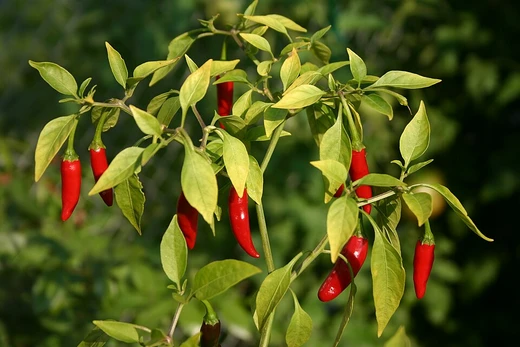
Guajillo chili
The guajillo chili is a landrace variety of Capsicum annuum, with the fresh form called mirasol and the dried form called guajillo.[1] It is the second-most common dried chili in Mexican cuisine, with a Scoville rating of 2,500 to 5,000 units.[1][2] The guajillo has a glossy, dark reddish-brown skin, a long shape of four to six inches, and a sweet, tangy flavor with hints of cranberry and tea.[2]
Quick Facts
- Species
- Capsicum annuum
- Origin
- Central America and Mexico
Facts from the source article.
Key facts and history
There are two main varieties distinguished by size and heat: the smaller, hotter guajillo puya and the larger, milder guajillo with richer flavor.[3] The guajillo’s heat is considered mild to medium, ranging from 2,500 to 5,000 Scoville heat units.[3][2] The fresh mirasol peppers are picked when red and then dried to become guajillos.[2][4] The dried guajillo has a raisin-like wrinkled texture due to the drying process and the age at which the chilies are picked.[2]
Guajillo is one of the “Holy Trinity” of dried Mexican chilies, along with ancho and pasilla, commonly used in authentic mole sauces.[2][5] The guajillo is the spiciest of these three, with ancho ranging from 1,000 to 1,500 SHU and pasilla from 1,000 to 2,500 SHU.[2] Zacatecas is a significant growing region for guajillo chilies.[1] The guajillo's flavor is described as having green tea and blackberry notes.[5]
What the cited sources add
The source “Guajillo pepper: The sweet side of spice” states that guajillo peppers share the same heat range as Tabasco Original Red Sauce (2,500 to 5,000 SHU).[2] The same source notes that guajillos are often ground into powder or rehydrated and pureed for cooking.[2] It also lists common pairings: tomatoes balance the heat, garlic pairs with the sweet heat, and cumin complements the mild heat.[2] The source “Mirasol (Guajillo) Chili Pepper – Parks Brothers Farm, Inc” describes the flavor as fruity with a berry hint.[4]
The Marata Specialities source explains that the guajillo has a thin, dark red flesh and a taste of green tea with high notes of blackberry.[5] It adds that the green, immature guajillo chili can also be harvested and used in cooking.[5] The same source states that guajillo is excellent in pastes, butters, or spreads to flavor any type of meat, especially chicken.[5]
References
- Wikipedia, "Guajillo chili" (CC BY-SA 4.0), which cites: "Mirasol (Guajillo) Chili Pepper – Parks Brothers Farm, Inc", parksbrothers.com; "Guajillo pepper: The sweet side of spice", 22 November 2014; "Guajillo Peppers", WorldCrops for Northern United States; Kraft, "Multiple lines of evidence for the origin of domesticated chili pepper, Capsicum annuum, in Mexico", Proceedings of the National Academy of Sciences, 21 April 2014, p. 6165–6170 (we also read that source) en.wikipedia.org
- "Guajillo pepper: The sweet side of spice", 22 November 2014. pepperscale.com
- Wikipedia, "Guajillo chili" (CC BY-SA 4.0), which cites: "Guajillo pepper: The sweet side of spice", 22 November 2014 (we also read that source) en.wikipedia.org
- "Mirasol (Guajillo) Chili Pepper – Parks Brothers Farm, Inc", parksbrothers.com. parksbrothers.com
- "Guajillo", Marata Specialities, 19 August 2016. marataonline.com
Each numbered sentence above was checked against the source it cites before publication. Sentences citing Wikipedia adapt text from the English Wikipedia article Guajillo chili (contributors), used under CC BY-SA 4.0; this entry is available under the same licence. Other sources were used for facts only.
More in Chili Pepper Varieties
Spotted an error? Know more?
Reader corrections go straight into our review queue. Suggest an edit · How this site is sourced