
Canada's Food Guide
A nutrition guide produced by Health Canada since 1942.

Arthur Farrell (1877–1909) · Public domain
Canada’s Food Guide is a nutrition resource created by Health Canada. It first appeared in 1942 under the name Official Food Rules, aimed at helping Canadians eat well during wartime rationing. Over the years, it has been updated many times and remains one of the government’s most requested publications.
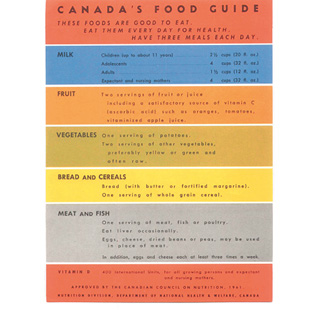
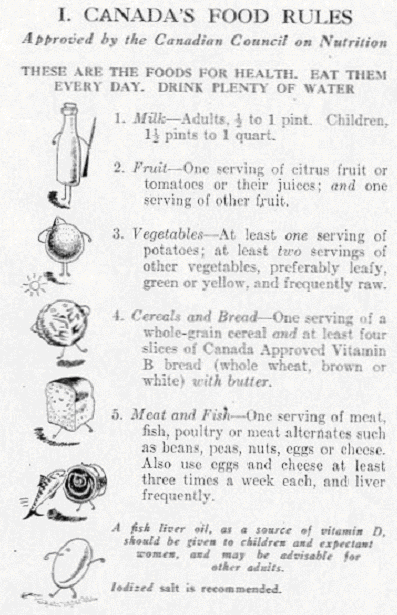
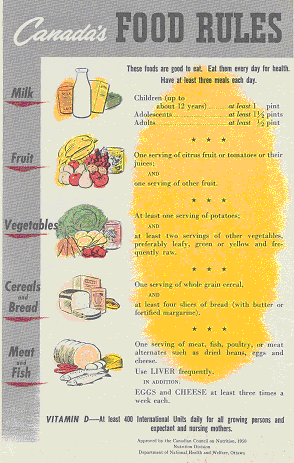
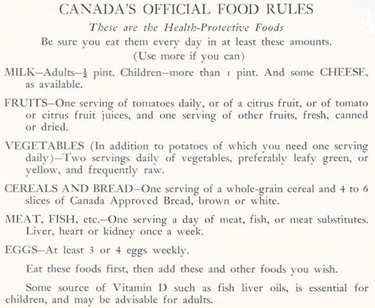
The original 1942 version listed six food groups: Milk; Fruit; Vegetables; Cereals and Breads; Meat, Fish, etc.; and Eggs. In 1944, it was renamed Canada’s Food Rules, and the Meat and Fish group was broadened to include cheese and eggs—wait, actually, cheese was already in the Milk group, and eggs were moved out of the Meat group into a separate group. The revision also recommended iodized salt. By 1949, the guide was updated again: the five food groups stayed, but the butter reference (which had been part of the Breads and Cereals section since 1944) was expanded to include “or fortified margarine”—a change driven by nutrition policy and dairy lobbying, not wartime shortages (the war had ended in 1945). Vitamin D supplements, like cod liver oil, were recommended for the first time.
In 1961, the guide was renamed Canada’s Food Guide, dropping “Rules.” Whole grains remained a focus, milk needs for pregnant and nursing mothers were highlighted, and citrus fruit—already recommended in the 1944 and 1949 guides—continued to be included. The 1977 version reduced food groups from five to four, merging fruits and vegetables into one. Potatoes were no longer recommended daily, the metric system was introduced, and a companion handbook debuted.
The 1982 edition warned Canadians about the link between diet and heart disease, following the Report of the Committee on Diet and Cardiovascular Disease. In 1992, the guide became Canada’s Food Guide to Healthy Eating, swapping the circular pie-chart for a rainbow graphic. The four groups were renamed: Meat and Alternatives, Grain Products, Vegetables and Fruit, and Milk Products. A fifth “Other Foods” category appeared on the back. The philosophy shifted from a “foundation diet” (minimum requirements) to a “total diet” approach, accommodating different ages, body sizes, activity levels, genders, and conditions like pregnancy, while noting that energy needs vary. The rainbow graphic subtly encouraged more grain products and less meat.
- First introduced
- 1942
- Original name
- Official Food Rules
- Produced by
- Health Canada
- Country
- Canada
- Known for
- Nutrition guide for Canadians
- Latest revision
- 2019
Lore & Background
Canada's Food Guide originated in 1942 as the Official Food Rules, identifying six food groups: Milk; Fruit; Vegetables; Cereals and Breads; Meat, Fish, etc.; and Eggs. It was revised in 1944 and renamed Canada's Food Rules. Contrary to some accounts, the Meat and Fish group was not broadened to include cheese and eggs; cheese was already in the Milk group, and eggs were moved into a separate group. The revision did recommend iodized salt. In 1949, the guide added a reference to fortified margarine—not due to teacher feedback about wartime shortages (the war had ended in 1945), but as a result of nutrition policy and dairy lobbying. Vitamin D supplements from sources such as cod liver oil were also recommended.
The guide was renamed Canada's Food Guide in 1961, shifting from 'Rules' to 'Guide'. Citrus fruit, already recommended in the 1944 and 1949 guides, continued to be included. The 1977 version reduced food groups from five to four, combining fruits and vegetables, and introduced the metric system. The 1992 edition adopted a rainbow graphic and a 'total diet' approach, and was made available via the internet for the first time. The 2007 guide included an ethnoculturally sensitive approach and addressed obesity—though obesity had already been recognized as a dietary problem in earlier guides.
Reader's Guide
Canada's Food Guide has served as a foundational nutrition education tool for Canadians for over eight decades. Its evolution reflects changing scientific understanding, dietary concerns, and societal needs—from wartime rationing to modern issues like obesity and heart disease. The 2019 revision marked a significant shift from specific serving sizes to a proportional plate model, emphasizing plant-based proteins and limiting highly processed foods. The guide's influence extends beyond individual dietary choices to public health policy, food labeling, and educational curricula. Its consultative process has grown from a hierarchical approach to include expert committees, stakeholder consultations, and scientific reviews. The guide's availability in both official languages and online has broadened its reach, while the 2007 ethnoculturally specific version addressed the needs of Indigenous populations. As a government publication second only to Income Tax Forms in requests, it remains a key reference for healthy eating in Canada.
Did You Know?
- In 2007, it was reported to be the second most requested Canadian government publication, behind the Income Tax Forms.
- The 1942 version was called the Official Food Rules and identified six food groups.
- The 1992 guide introduced a 'rainbow graphic' to replace the circular pie-chart graphic used since 1977.
- The 2019 guide recommends choosing protein foods that come from plants more often.
Wartime Origins and the Shaping of an Early Framework
Canada's Food Guide traces its roots to a very specific historical moment: the wartime rationing of the early 1940s. In 1942, the federal government issued what was then called the Official Food Rules, a practical document meant to steer Canadians toward adequate nutrition when supplies were constrained. It organized food into six categories—milk, fruit, vegetables, cereals and breads, meat and fish, and eggs. Just two years later, in 1944, the document was revised and rebranded as Canada's Food Rules. The meat-and-fish category broadened to encompass cheese and eggs, and a new directive urged households to use iodized salt. By 1949, the guide had been refined again, this time informed by feedback from primary-school teachers who relied on it as a classroom resource. The five-group structure held, but the breads-and-cereals section now acknowledged fortified margarine, a vegetable-oil spread born from wartime shortages of animal fats. Vitamin D supplementation, sourced from cod liver oil, also entered the recommendations for the first time.
The 1992 Philosophical Reimagining
The 1992 revision marked a genuine turning point in how Health Canada conceived of dietary guidance. The document was renamed Canada's Food Guide to Healthy Eating, and the familiar circular pie chart that had anchored the guide since 1977 gave way to a rainbow graphic. Four food groups were redefined—Meat and Alternatives, Grain Products, Vegetables and Fruit, and Milk Products—while a fifth category, Other Foods, appeared for the first time. More importantly, the underlying philosophy shifted from a foundation-diet model, which set minimum requirements and told those with higher needs to simply eat more, to a total-diet framework that acknowledged variation across ages, body sizes, activity levels, genders, and conditions like pregnancy. The development process itself was novel: rather than relying on a top-down hierarchy, Health Canada assembled input from experts, consumers, literature reviews, food-consumption surveys, and commissioned scientific reviews. The guide was produced in both official languages and, for the first time, made accessible online. A sixteen-page booklet supplemented the traditional poster, and a separate resource was crafted to help educators plan lessons.
Cultural Broadening and the 2007 Expansion
The 2007 update represented one of the most expansive revisions in the guide's history. For the first time, Health Canada produced an ethnoculturally specific document—the Food Guide for First Nations, Inuit and Métis people—acknowledging the distinct dietary traditions of Indigenous communities. The main guide was retitled Eating Well with Canada's Food Guide and expanded into a six-page fold-out pamphlet that spoke to Canada's increasingly multicultural population. Obesity was formally recognized as a dietary concern. The Milk Products category was renamed Milk and Alternatives to include fortified soy beverage, accommodating those who did not drink dairy. New guidance urged Canadians to cut back on trans fats and swap saturated fats for unsaturated ones. Vitamin D supplementation, once sourced from cod liver oil, was now recommended for adults over fifty. The guide linked healthy food choices to nutrition labels, identified nine distinct age-and-sex groups for tailored recommendations, and incorporated the Dietary Reference Intake framework from the American Institute of Medicine. Three advisory bodies guided the revision throughout the process.
The 2019 Simplification and Plant-Forward Turn
When Health Canada released the updated guide to the public in January 2019, it deliberately departed from the food-group-and-serving structure that had defined the document for decades. The new edition's core message was strikingly concise: eat plenty of vegetables, fruits, whole grain foods, and protein foods, and choose protein sources that come from plants more often. It also advised limiting highly processed foods. The guide's preparation process reflected a heightened awareness of scientific integrity; Health Canada stated that it relied on scientific reports on food and health while explicitly excluding industry-commissioned studies, citing the potential for conflicts of interest. This represented a philosophical reset from the earlier era of prescriptive groupings and portion counts toward a more flexible, principle-based approach. The 2019 guide thus stood in contrast to its predecessors, which had organized nutrition around defined categories and recommended servings, and instead placed the emphasis on food quality, plant-based choices, and the reduction of ultra-processed items in the daily diet.
Gallery
Frequently Asked Questions
What is Canada's Food Guide?
It is a government-published nutrition reference produced by Health Canada to help everyday Canadians build balanced, healthy meals. Think of it as the country's long-standing dietary playbook rather than a single recipe or dish.
When did Canada's Food Guide first appear, and what was its original name?
It debuted in 1942 under the title "Official Food Rules," designed to steer households through wartime rationing. The name shifted to "Canada's Food Rules" in 1944 before eventually settling on its current title.
What food groups does Canada's Food Guide recommend?
The original 1942 edition sorted foods into six categories: Milk, Fruit, Vegetables, Cereals and Breads, Meat and Fish, and Eggs. The 2019 revision moved to a plate-based model emphasizing vegetables, fruits, whole-grain grains, and protein sources.
How often has Canada's Food Guide been updated?
It has been revised numerous times since its 1942 debut, with the most recent major overhaul landing in 2019. Despite all those changes, it consistently ranks among Health Canada's most requested publications.
Why is Canada's Food Guide considered important in Canadian food culture?
It has served as the baseline dietary reference for Canadian households for over eight decades. Its longevity and repeated revisions make it one of the most recognizable and widely referenced nutrition documents in the country.
More in Canadian cuisine 1-24
Spotted an error? Know more?
Reader corrections go straight into our review queue. Suggest an edit · How this site is sourced