
Atlantic cod
A heavily fished apex predator of the North Atlantic.

Wilhelm Thomas Fiege · CC BY-SA 4.0
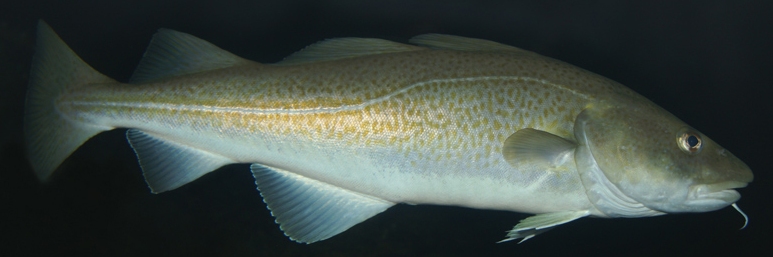
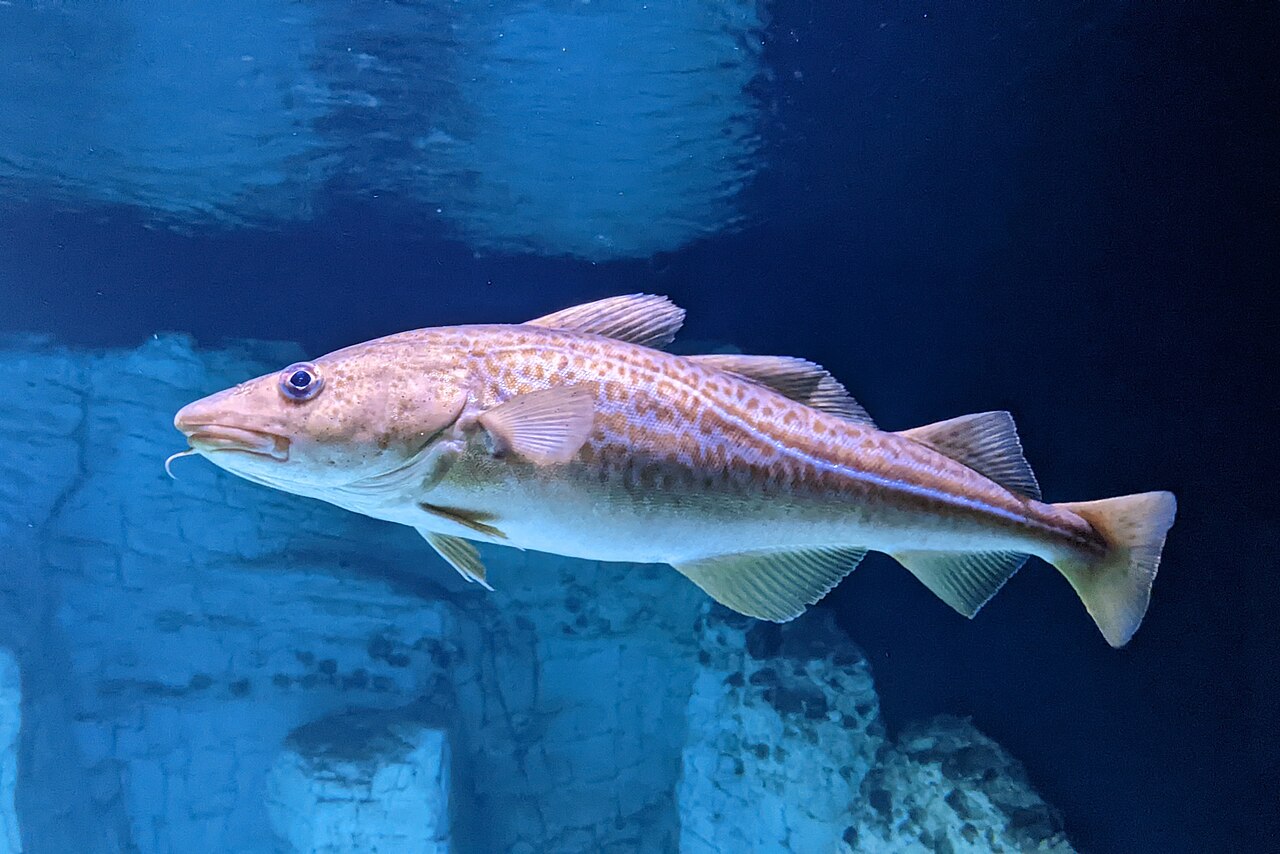
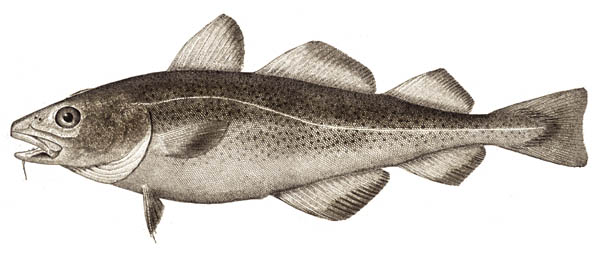
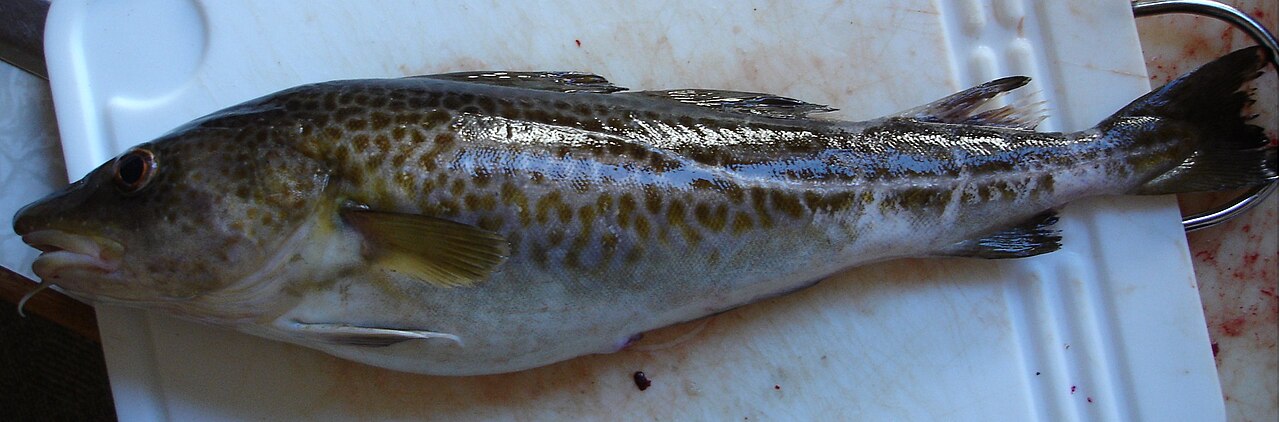
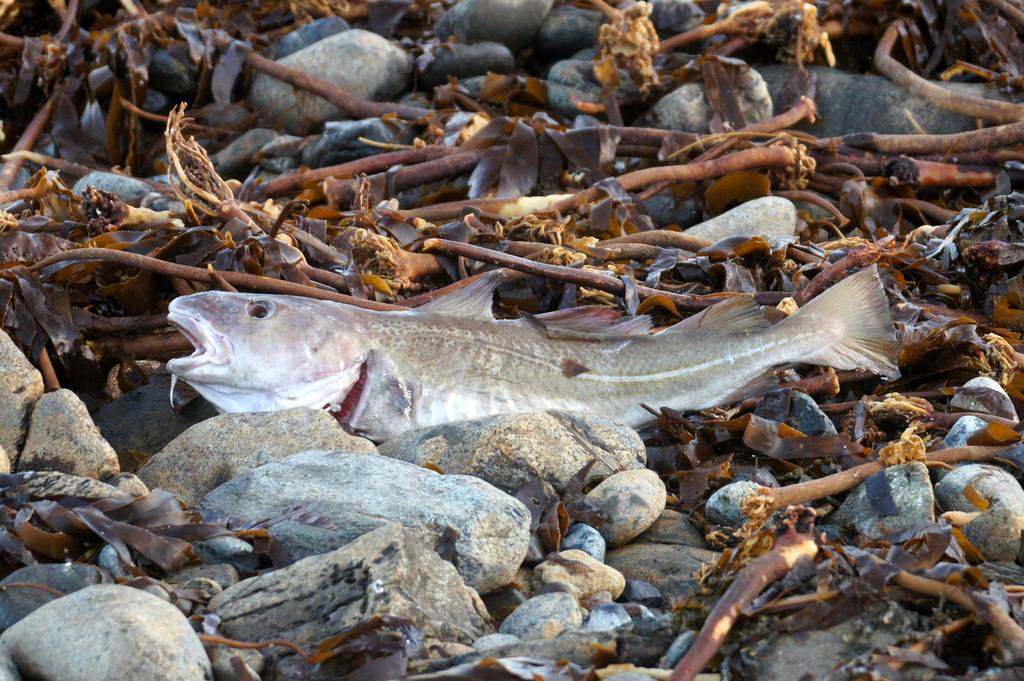
The Atlantic cod (Gadus morhua) belongs to the Gadidae family and is a popular food fish, often sold simply as cod or codling. In the western Atlantic, it ranges north of Cape Hatteras, North Carolina, and around both Greenland coasts and the Labrador Sea; in the eastern Atlantic, it appears from the Bay of Biscay up to the Arctic Ocean, including the Baltic, North, and Hebrides seas, plus waters near Iceland and the Barents Sea. It can reach 25 years old, typically grows to 100–140 cm (40–55 in), though specimens over 180 cm (70 in) and 50 kg (110 lb) have been recorded. Sexual maturity occurs between ages 2 and 8, varying by population and over time. Its coloring is brown or green with spots on the back, fading to silver underneath, and a clear stripe runs along its lateral line, which detects vibrations. It lives from the coast down to 300 m (1,000 ft) on the continental shelf.
This species has been heavily fished for a thousand years, with northern European fishers following it across the North Atlantic to North America. It sustained US and Canadian fishing economies until Canada banned cod fishing in 1992. Several cod stocks collapsed in the 1990s—declining by over 95% of their historical maximum biomass—and have not fully recovered even after fishing stopped. The loss of this apex predator triggered trophic cascades in many areas, and many other stocks remain at risk. The IUCN lists Atlantic cod as vulnerable (based on a 1996 assessment needing update), but a 2013 European assessment found it rebounding there, relabeling it least concern. Dry cod can be made into unsalted stockfish or cured salt cod (clipfish).
Taxonomically, Atlantic cod is one of three Gadus species, alongside Pacific cod and Alaska pollock. Many fish called “cod” are not in the genus Gadus, though some belong to the same family, Gadidae.
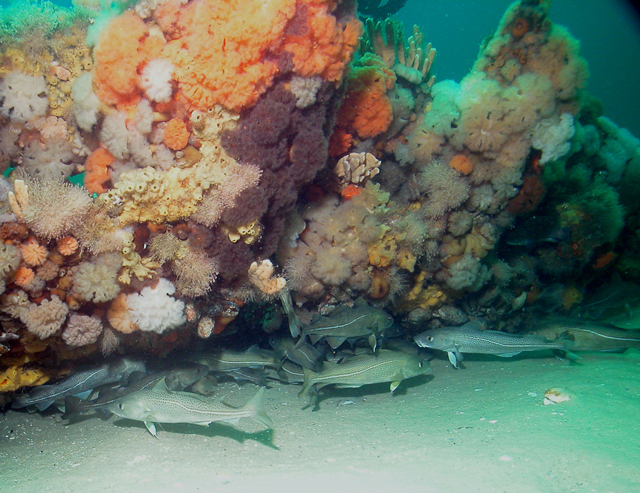
Atlantic cod are shoaling fish, forming large, size-structured groups. Larger individuals act as scouts, leading the shoal’s direction, especially during post-spawning migrations inshore to feed. They feed actively while migrating, and shoal structure changes when food is found. Shoals are generally leaderless, with equal status and resource distribution, though some studies suggest leading fish gain feeding benefits.
Quick Facts
- Taxon
- Gadus morhua
Facts from the source article.
Lore & Background
Atlantic cod are a shoaling species, moving in large, size-structured aggregations. Larger fish act as scouts and lead the shoal's direction, particularly during post-spawning migrations. Shoals are generally leaderless, but studies show leading fish gain feeding benefits. Juvenile cod serve as prey for adult cod, which practice cannibalism; in the southern North Sea, 1–2% of stomach contents for cod larger than 10 cm consisted of juvenile cod, rising to 10% in the northern North Sea.
Their diet includes fish such as herring, capelin, and sand eels, as well as squid, mussels, clams, and crustaceans. Small cod feed primarily on crustaceans, while large cod feed primarily on fish. Cod practice cannibalism, with some reports estimating up to 56% of the diet consists of juvenile cod. They attain sexual maturity between ages 2 and 8, varying between populations and over time. Spawning occurs from January to May, often requiring migration to different grounds.
Reader's Guide
The Atlantic cod is significant as one of the most heavily fished species in history, fished for a thousand years by north European fishers who followed it across the North Atlantic to North America. It supported the US and Canadian fishing economy until 1992, when the Canadian Government implemented a fishing ban. Several cod stocks collapsed in the 1990s, declining by more than 95% of maximum historical biomass, and have failed to fully recover even with cessation of fishing. This absence of the apex predator led to trophic cascades, increasing populations of species such as American lobsters, crabs, and shrimp. Many cod stocks remain at risk. The Atlantic cod is labelled vulnerable on the IUCN Red List, though a 2013 assessment covering only Europe shows it has rebounded there and been relabelled least concern. Its legacy includes the collapse of major fisheries and ongoing ecological shifts in the North Atlantic.
Did You Know?
- Atlantic cod can live up to 25 years and grow over 180 cm (70 in) and 50 kg (110 lb).
- Juvenile cod prefer cobble substrate to hide from predators, significantly reducing predation risk.
- A decrease of only 2.5 °C (5 °F) in water temperature caused a 15–30% increase in metabolic rate.
- In the northern North Sea, cannibalism accounted for 10% of stomach contents for cod larger than 10 cm.
Range, Form & Life History
The Atlantic cod belongs to the genus Gadus, sharing that name with Pacific cod and Alaska pollock, though many unrelated species are colloquially called cod. Its range stretches impressively: in the western Atlantic it occupies waters north of Cape Hatteras, wraps around both Greenland coasts, and fills the Labrador Sea, while in the eastern Atlantic it spans from the Bay of Biscay all the way to the Arctic, threading through the Baltic, North Sea, Sea of the Hebrides, Icelandic waters, and the Barents Sea. Physically, the fish displays a mottled brown or green back dotted with spots that fade to a silvery belly, with a distinct stripe tracing the lateral line that serves as a vibration-detecting organ. It inhabits depths from the shoreline down to roughly 300 metres along the continental shelf. Most individuals reach 100 to 140 centimetres in length and live up to a quarter century, though specimens exceeding 180 centimetres and 50 kilograms have been hauled from the sea. Sexual maturity arrives anywhere between two and eight years of age, a window that shifts between populations and across decades.
Shoal Dynamics & Feeding Hierarchy
Atlantic cod travel in large, size-structured shoals, and the social architecture of these groups reveals a subtle hierarchy that challenges the old assumption of perfect equality. During post-spawning migrations inshore for feeding, the largest fish tend to take the lead, scouting ahead and setting the group's heading. While shoals are generally described as leaderless, with every member enjoying equal access to resources, research on migrating groups tells a more nuanced story. Larger scouts at the front consumed a more varied and greater quantity of food, whereas smaller trailing fish ate less and with less dietary diversity. The distribution of individuals within the shoal appears governed primarily by body size. Yet the smaller, lagging members are not simply losers in this arrangement. Social facilitation means they feed more successfully in the shoal than they would if migrating alone, gaining a collective advantage that individual foraging could not provide. Shoal structure also shifts dynamically whenever a food source is encountered, indicating that the group reorganises in real time to exploit new opportunities.
The Collapse & Ecological Aftermath
For roughly a millennium, north European fishers tracked Atlantic cod across the North Atlantic, eventually following it to the shores of North America, where it became the backbone of the American and Canadian fishing economy. The species was among the most heavily exploited in the world, prepared as unsalted stockfish, cured salt cod, or clipfish for markets far from the fishing grounds. Then, in the 1990s, several stocks suffered catastrophic collapses, losing more than 95 percent of their maximum historical biomass. The Canadian government imposed a fishing ban in 1992, yet the depleted populations have failed to fully rebound even after decades of cessation. The removal of this apex predator triggered trophic cascades: American lobsters, crabs, and shrimp, previously kept in check by cod predation, surged in abundance and expanded their ranges. The IUCN listed the species as vulnerable in a 1996 assessment it now flags as outdated, while a 2013 European-only review found a recovery sufficient to downgrade the status to least concern. Many stocks, however, remain at risk.
Predation, Temperature & Survival Instincts
Adult Atlantic cod sit at the top of the food web in the Baltic, largely free from predation, yet the species practices cannibalism, with adults preying on juveniles. Young cod make critical habitat choices shaped by the threat of being eaten. In the absence of a visible predator, they favour fine-grained substrates like sand and gravel-pebble. When a predator appears, their preference shifts sharply toward cobble, where the gaps between stones offer refuge; without cobble available, their only option is to flee. Their response also calibrates to the predator's behaviour: a passive, non-foraging threat elicits little change, while an actively hunting predator triggers intense avoidance, driving juveniles into cobble or, failing that, into kelp. Temperature adds another layer. Respirometry experiments reveal that heart rates swing dramatically with shifts of only a few degrees. Warmer water spikes swimming activity, and cod actively avoid unfamiliar thermal conditions, preferring deeper, colder layers by day and shallower, warmer ones at night. These finely tuned adjustments are driven by the need to maintain homeostasis and conserve energy, with even a 2.5-degree drop provoking measurable physiological responses.
Gallery
Frequently Asked Questions
What is Atlantic cod in the context of Canadian cuisine?
Atlantic cod (Gadus morhua) is a Gadidae-family fish that has long served as a staple table fish in Canadian coastal communities, typically marketed under the simple names "cod" or "codling." It sits at the top of the North Atlantic food web and is one of the most commercially harvested species in Canadian waters.
Where does Atlantic cod live?
In the western Atlantic, its habitat stretches north of Cape Hatteras through the Labrador Sea and along both Greenland coasts. In the eastern Atlantic, it ranges from the Bay of Biscay all the way to the Arctic Ocean, covering the Baltic, North, Hebrides, and Barents seas as well as waters around Iceland.
How big and long-lived is Atlantic cod?
Most specimens grow to roughly 100–140 cm, although rare individuals over 180 cm and 50 kg have been documented. The species can reach an age of about 25 years under favorable conditions.
What is the conservation status of Atlantic cod?
The IUCN classifies Atlantic cod as Vulnerable, based on a 1996 assessment that is noted as overdue for revision. As a top-level predator under intense commercial fishing pressure, its populations remain a major concern for Canadian and international fisheries management.
Why is Atlantic cod culturally important to Canada?
It is one of the most recognizable and widely eaten fish in the North Atlantic, anchoring many traditional dishes along the Canadian east coast. Its role as a heavily harvested apex predator also makes it a recurring subject in debates over sustainable Canadian fishing practices.
More in Canadian cuisine 1-24
Spotted an error? Know more?
Reader corrections go straight into our review queue. Suggest an edit · How this site is sourced