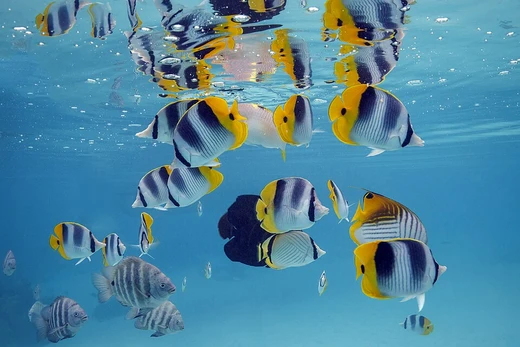
Spotband butterflyfish
A western Pacific butterflyfish with vertical bands and orange caudal peduncle.

The spotband butterflyfish (Chaetodon punctatofasciatus) is a marine ray-finned fish in the family Chaetodontidae, native to the western Pacific Ocean. Its range spans the Indo-West Pacific region, from Christmas Island in the eastern Indian Ocean to the Line Islands, north to the Ryukyu Islands, south to the Rowley Shoals and the northern Great Barrier Reef, and across Micronesia. In the Indian Ocean, it is replaced by its close relative, the peppered butterflyfish (C. guttatissimus); the two species overlap from Christmas Island to Bali.
This fish belongs to the subgenus Exornator, alongside the peppered, pebbled (C. multicinctus), and sunset (C. pelewensis) butterflyfish. These four are thought capable of producing fertile hybrids. If the genus Chaetodon is divided, Exornator may become a subgenus of Lepidochaetodon. The spotband butterflyfish is the type species of Exornator, first formally described in 1831 by French anatomist Georges Cuvier.
Reaching a maximum length of 12 cm, its body is pale grey with close-set grey spots arranged in vertical bands on the upper sides, interspersed with yellow, and horizontal rows on the lower sides. The dorsal fin has a yellow margin, and a bright orange patch runs through the caudal peduncle. It inhabits coral-rich areas and clear waters of seaward and lagoon reefs, feeding on filamentous algae, coral polyps, and other benthic invertebrates.
Quick Facts
- Genus
- Chaetodon
- Parent
- Chaetodon (Exornator)
- Species
- punctatofasciatus
Facts from the source article.
Lore & Background
The spot-banded butterflyfish is found in the Indo-West Pacific region from Christmas Island in the eastern Indian Ocean to the Line Islands, north to the Ryukyu Islands, south to the Rowley Shoals and the northern Great Barrier Reef, and throughout Micronesia. It is replaced by its close relative the Peppered butterflyfish (C. guttatissimus) in the Indian Ocean, and these two species are sympatric from Christmas Island to Bali. This species is one of the members of the subgenus Exornator. With the Peppered butterflyfish it is part of a close-knit group which also includes the Pebbled butterflyfish (C. multicinctus) and the Sunset butterflyfish (C. pelewensis). It is suspected that these four are able to produce fertile hybrids. If the genus Chaetodon is split up, Exornator might become a subgenus of Lepidochaetodon. C. punctatofasciatus is the type species of the subgenus Exornator and was first formally described in 1831 by the French anatomist Georges Cuvier (1769–1832). Its body is pale grey with close-set grey spots which are aligned in vertical bands, interspersed with yellow, on the upper sides and form horizontal rows on the lower sides. The dorsal fin has a yellow margin and there is a bright orange patch running through the caudal peduncle. It is found in coral-rich areas and clear waters of seaward and lagoon reefs. This fish feeds on filamentous algae and coral polyps and other benthic invertebrates.
Reader's Guide
The spot-banded butterflyfish is notable as the type species of the subgenus Exornator within the genus Chaetodon, a position that underscores its taxonomic significance. Its close relationship with the Peppered, Pebbled, and Sunset butterflyfishes, including the suspected ability to produce fertile hybrids, highlights the complex evolutionary dynamics within this group. The species' distribution across the western Pacific, from Christmas Island to the Line Islands and Micronesia, and its sympatry with the Peppered butterflyfish from Christmas Island to Bali, illustrate a biogeographic boundary between the Indian and Pacific Oceans. Its description by the prominent French anatomist Georges Cuvier in 1831 adds historical depth to its scientific record. Ecologically, the spot-banded butterflyfish occupies coral-rich areas and clear waters of seaward and lagoon reefs, feeding on filamentous algae, coral polyps, and other benthic invertebrates, which positions it as a component of reef trophic networks. The species' maximum length of 12 cm and distinctive coloration—pale grey with vertical bands of spots and a bright orange patch on the caudal peduncle—make it recognizable among butterflyfishes.
More in Butterflyfish, Part 2 1-24
Spotted an error? Know more?
Reader corrections go straight into our review queue. Suggest an edit · How this site is sourced