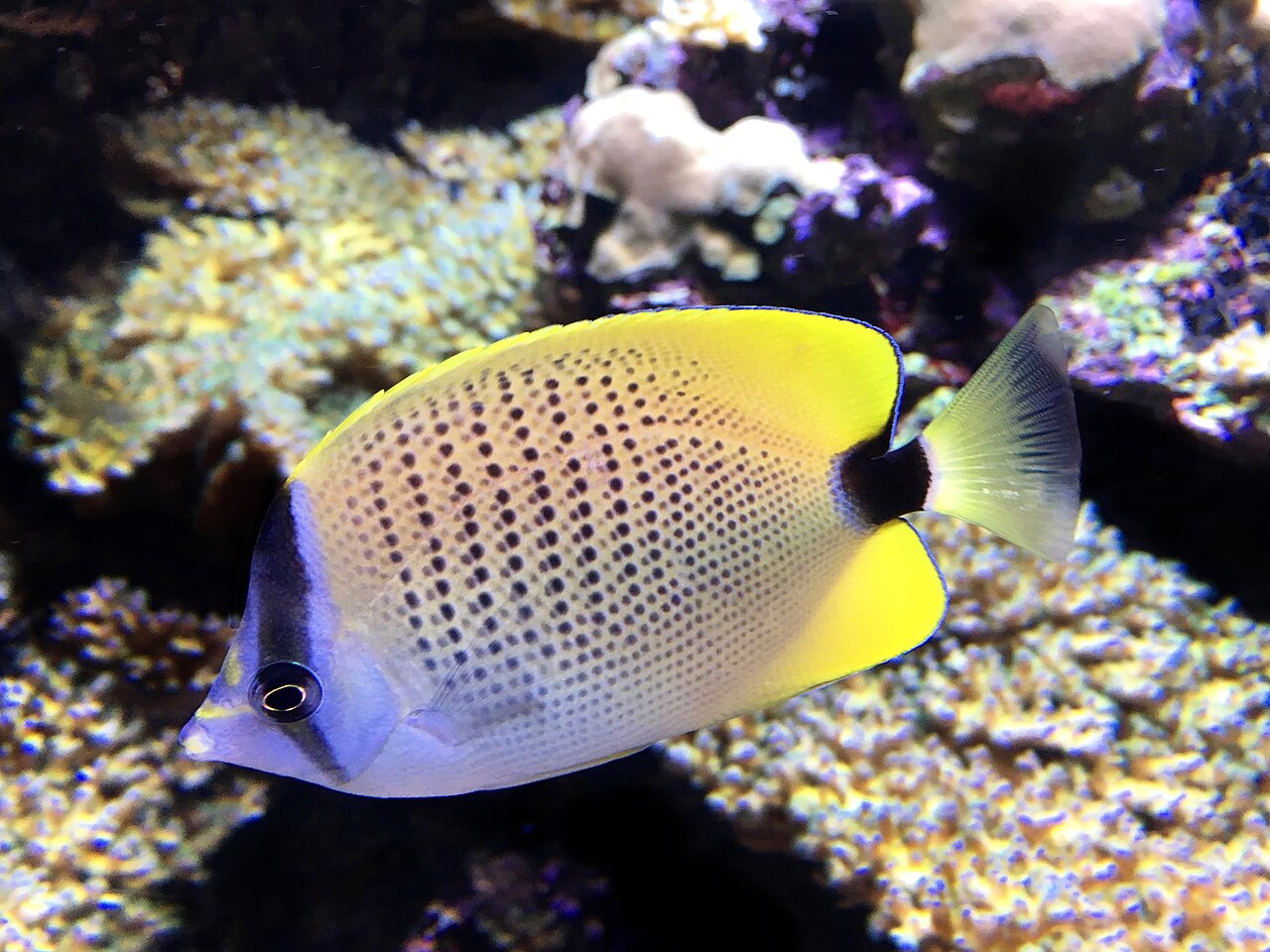
Millet butterflyfish
Endemic to Hawaii and Johnston Atoll, common in its range.

Krinkle · CC BY 4.0
The millet butterflyfish (Chaetodon miliaris) is a species of butterflyfish in the family Chaetodontidae, also known as the lemon butterflyfish or millet-seed butterflyfish. It is endemic to the Hawaiian Islands and the Johnston Atoll, where it is found at depths down to 250 m (820 ft). Despite its limited range, it is common around Hawaii and is listed by the International Union for Conservation of Nature as being of 'least concern'.
Quick Facts
- Parent
- Chaetodon (Exornator)
- Genus
- Chaetodon
- Species
- miliaris
Facts from the source article.
Lore & Background
The millet butterflyfish belongs to the subgenus Exornator, and probably shares a group with the African butterflyfish (C. dolosus), the crochet butterflyfish (C. guentheri), and the reef butterflyfish (C. sedentarius). The crochet butterflyfish might be its closest living relative. If the genus Chaetodon is split up, Exornator might become a subgenus of Lepidochaetodon.
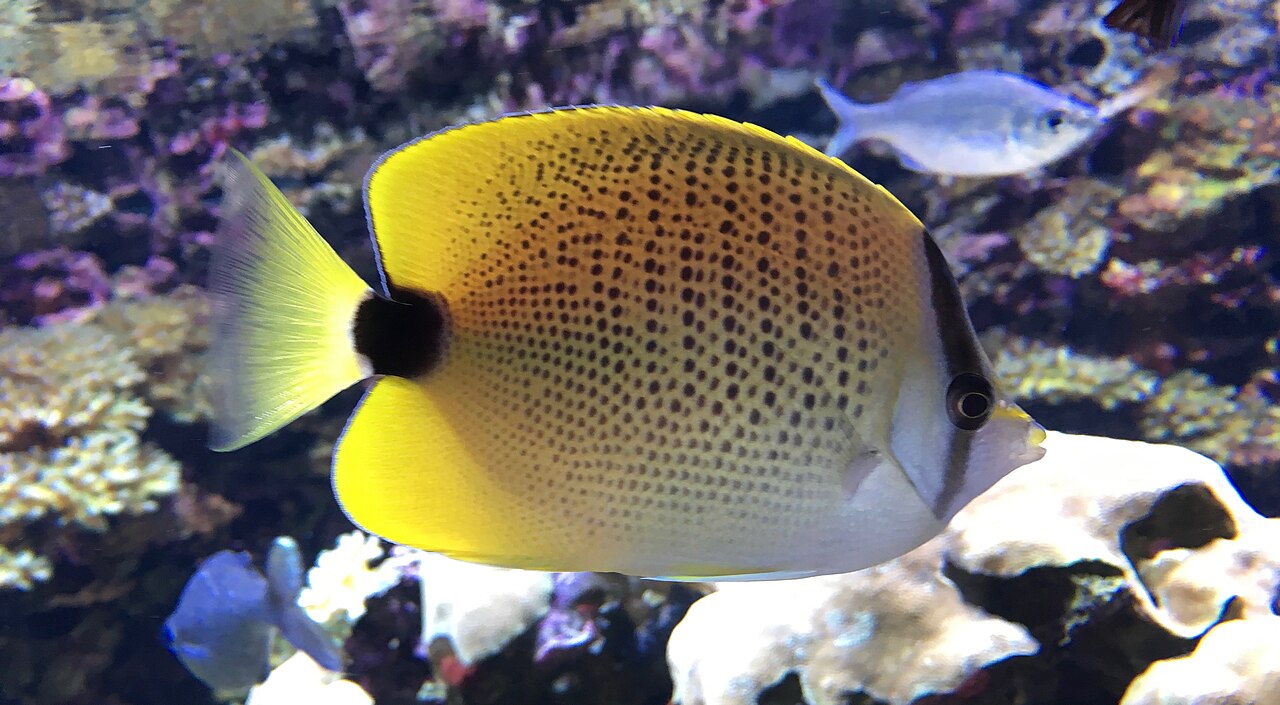
It grows to a maximum length of 13 cm (5 in) and has a deep-bodied, laterally flattened shape. The general body color is whitish or yellow, with vertical rows of dark spots on the flanks. A broad black stripe runs from above the eye to the base of the operculum, and there is a large black patch on the caudal peduncle.
This fish is found in coastal fringing reefs, outer reefs, and lagoons. It is a schooling species that feeds on zooplankton in mid-water, and also opportunistically on polychaete worms and other small invertebrates on the seabed. It does not seem territorial but forms aggregations to feed at particular reef sites. Breeding takes place between January and May, with newly settled juveniles found in inner reef areas between April and June.
Reader's Guide
The millet butterflyfish is notable for its endemic distribution to the Hawaiian Islands and Johnston Atoll, where it is common despite its limited range. Its conservation status is assessed as 'least concern' by the International Union for Conservation of Nature, which believes the population is stable and that collection for the aquarium trade has little impact. The species is sometimes collected from the wild for aquariums; its feeding habits make it more suitable for reef aquariums than more specialist butterflyfish that feed on scleractinian corals. Although rare at Johnston Atoll, it is plentiful around the Hawaiian Islands. Its breeding habits are unknown, but the gonads are large relative to body size, suggesting a promiscuous mating system. The species is a mid-water schooling fish that feeds by rapid suction, and it does not appear to be territorial.
Gallery
Frequently Asked Questions
What is the Millet butterflyfish?
The Millet butterflyfish (Chaetodon miliaris) is a small marine fish belonging to the butterflyfish family Chaetodontidae. It goes by a few alternate names, including lemon butterflyfish and millet-seed butterflyfish, but all refer to the same single species.
Where can you find the Millet butterflyfish in the wild?
This species is strictly endemic to the Hawaiian Islands and Johnston Atoll, meaning it occurs nowhere else on Earth. Within that range, it has been recorded at depths reaching as far down as 250 metres (about 820 feet).
How large does the Millet butterflyfish get?
Adults top out at roughly 13 centimetres (5 inches) in total length, making it a modestly sized member of the butterflyfish family.
What does the Millet butterflyfish's fin structure look like?
Its dorsal fin carries 13 to 14 spines followed by 20 to 23 soft rays, while the anal fin has 2 to 3 spines paired with 17 to 20 soft rays. These counts are key identifiers used to separate it from visually similar chaetodontids.
Is the Millet butterflyfish threatened or hard to spot?
Despite its range being limited to just Hawaii and Johnston Atoll, the species is actually common wherever it occurs. The IUCN currently lists it as 'Least Concern,' so it poses no immediate conservation worry.
More in Butterflyfish, Part 2 1-24
Spotted an error? Know more?
Reader corrections go straight into our review queue. Suggest an edit · How this site is sourced