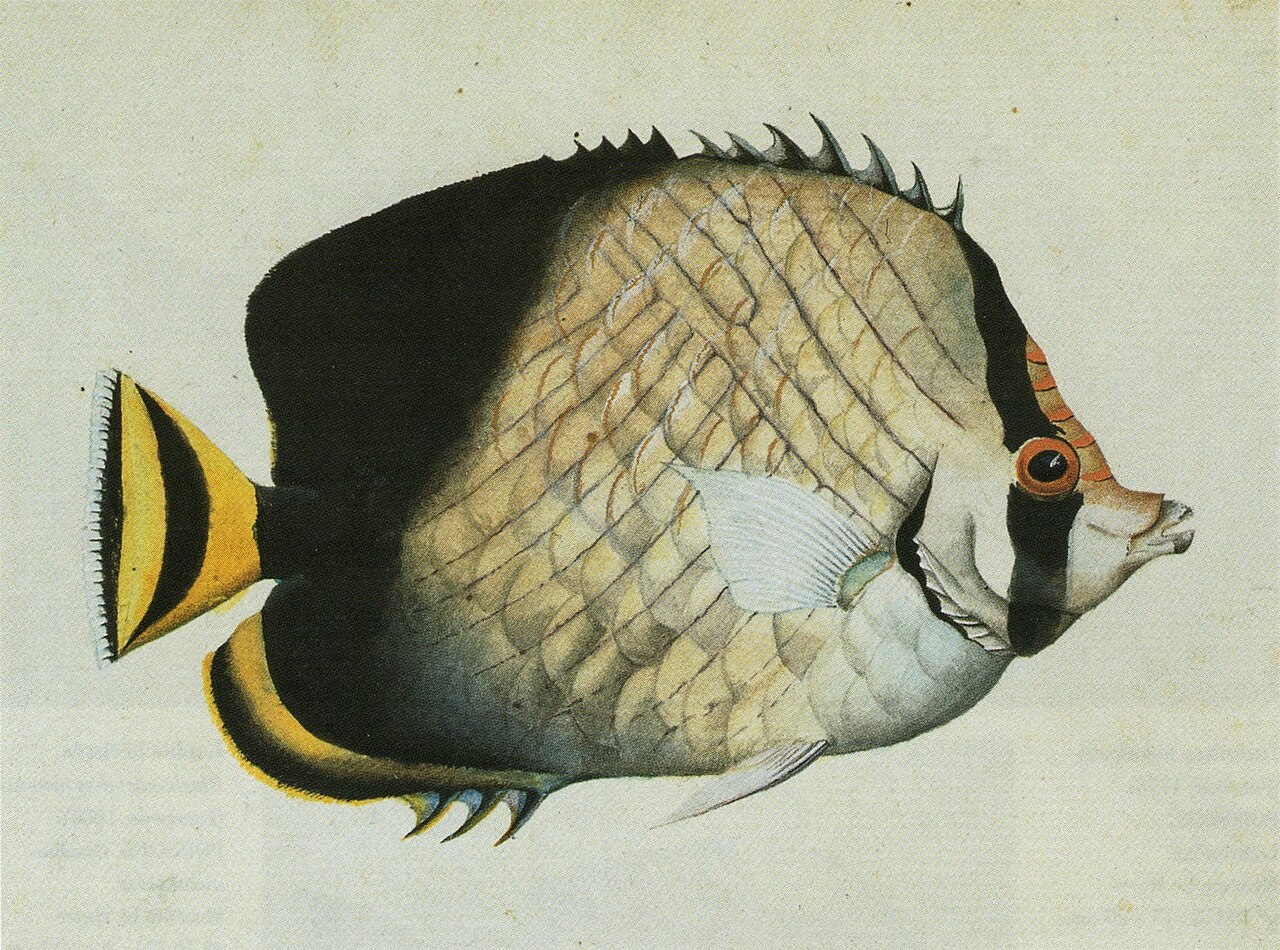
Indian vagabond butterflyfish
A monogamous butterflyfish with black eye band and yellow fins.

Charles Alexandre Lesueur · Public domain
The Indian vagabond butterflyfish, also called the blackened butterflyfish or black-finned vagabond, is a marine ray-finned fish in the Chaetodontidae family. Its range spans the Indo-West Pacific, stretching from the Maldives through India, Sri Lanka, and the Andaman Sea, reaching the western edge of the Indonesian archipelago. This species has a silvery-white body marked with diagonal grey lines, a broad black vertical band across its eyes, and a largely black posterior lower section. Yellow markings appear on the tail and anal fins. It grows up to 20 cm (nearly 8 inches) long and inhabits rich coral reefs, as well as rubble and rocky areas. Adults are monogamous, swim in pairs, and can be territorial and aggressive toward other Chaetodon species, while juveniles are solitary. Its diet consists mainly of algae and coral polyps, and it reproduces by laying eggs (oviparous). French anatomist Georges Cuvier first formally described it in 1829, with the type locality given as "India." It belongs to the large subgenus Rabdophorus, which may warrant recognition as a distinct genus. Within this group, it is likely closely related to the threadfin butterflyfish (C. auriga) and the vagabond butterflyfish (C. vagabundus). However, C. decussatus might be closer to the threadfin butterflyfish than to the common vagabond butterflyfish, though abnormal DNA sequence data from C. vagabundus makes this uncertain. The C. auriga species group shares a characteristic pattern of two areas of ascending and descending oblique lines, with species differing notably in hindpart coloration.
Quick Facts
- Genus
- Chaetodon
- Parent
- Chaetodon (Rabdophorus)
- Species
- decussatus
Facts from the source article.
Lore & Background
The Indian vagabond butterflyfish was first formally described in 1829 by the French anatomist Georges Cuvier, with the type locality given as 'India'. It belongs to the large subgenus Rabdophorus, which might warrant recognition as a distinct genus. In this group, it is almost certainly a rather close relative of the threadfin butterflyfish (C. auriga) and the vagabond butterflyfish (C. vagabundus). C. decussatus might be closer to the threadfin butterflyfish than to the common Vagabond Butterflyfish; as C. vagabundus has yielded abnormal DNA sequence data this is hard to say. The C. auriga species group shares the characteristic pattern of two areas of ascending and descending oblique lines; species differ conspicuously in hindpart coloration.
Reader's Guide
The Indian vagabond butterflyfish is notable for its distinctive coloration and behavior. Its silvery-white body is marked with diagonal grey lines and a broad black vertical band through the eyes, with the posterior lower part of the body largely black and yellow markings on the tail and anal fins. Growing to a maximum of 20 cm, it inhabits rich coral reefs as well as rubble and rocky areas. The monogamous adults swim in pairs and may be territorial and aggressive to other Chaetodon, while juveniles are solitary. Its diet consists largely of algae and coral polyps, and it is oviparous. The species' uncertain phylogenetic position within the Rabdophorus subgenus, due to abnormal DNA data from the vagabond butterflyfish, highlights ongoing taxonomic questions in butterflyfish research.
Did You Know?
- The Indian vagabond butterflyfish is also known as the blackened butterflyfish or black-finned vagabond.
- It was first formally described in 1829 by French anatomist Georges Cuvier.
- Adults are monogamous and swim in pairs, while juveniles are solitary.
- It feeds largely on algae and coral polyps.
Physical Form and Striking Coloration
Butterflyfish are compact, deep-bodied marine fish whose lateral compression gives them a distinctive disc-like silhouette against the busy backdrop of coral reefs. Most species measure between 12 and 22 centimeters, though the lined butterflyfish and the saddle butterflyfish push the upper limit to roughly 30 centimeters. Their most arresting feature is coloration: many display vivid combinations of black, white, blue, red, orange, and yellow, while others remain comparatively drab. Several species bear eyespots on their flanks and bold dark stripes running through the eyes, patterns that echo the markings on lepidopteran wings and likely serve as a visual language between species. The dorsal fin runs as a single unbroken arc along the back, and the caudal fin is either rounded or squared off but never forked. Unlike the superficially similar angelfish, butterflyfish lack the spiny preopercle at the gill covers, a key anatomical distinction. A handful of Heniochus species even mimic the Moorish idol, a fish that belongs to an entirely separate, single-species family.
Daily Rhythms, Feeding, and Reproduction
Butterflyfish are predominantly daytime active, patrolling reef waters typically shallower than 18 meters, although a few species venture as deep as 180 meters. Their social structure splits along dietary lines: corallivorous species are fiercely territorial, pairing up and defending a particular coral head, while zooplankton-feeding species gather in large groups of their own kind. When darkness falls, these fish retreat into crevices in the reef and shift to a noticeably different color scheme. Reproduction follows a pelagic strategy: adults release clouds of buoyant eggs that drift with ocean currents as part of the plankton until they hatch. The resulting larvae pass through a remarkable tholichthys stage, during which their bodies are encased in large bony plates extending from the head; these plates are shed as the fish matures. Only one other fish family, the scats, shares this temporary armored phase. In the aquarium trade, butterflyfish are prized for their beauty, yet most species rely on coral polyps and sea anemones for food, making long-term captive care challenging and pushing hobbyists toward the rarer generalist or zooplankton-feeding species.
Evolutionary Origins and Fossil Evidence
Molecular phylogenetic studies indicate that butterflyfish shared a common ancestor with the scats and angelfish during the Early Eocene, roughly 54 million years ago. The fossil record, however, is frustratingly sparse. Because butterflyfish live on coral reefs, their remains are vulnerable to dispersal by scavengers, overgrowth by living coral, and erosion, leaving very few specimens in the geological record. Several Eocene fish, including Pygaeus, have been tentatively assigned to Chaetodontidae in the past, but these identifications cannot be confirmed with confidence. The earliest reliably identified butterflyfish fossils come from the Early Oligocene: an indeterminate larva from Frauenweiler in Germany, two tholichthys-stage specimens from the Menilite Formation in Poland, and the extinct species Chaetodon (Blumchaetodon) wattsi from Italy. Before the advent of DNA sequencing, taxonomists struggled to determine whether many of the roughly 129 recognized species represented true species or merely subspecies, and numerous subgenera have been proposed to subdivide the enormous genus Chaetodon.
Taxonomic Placement and Global Distribution
The family Chaetodontidae, described by Rafinesque in 1815, encompasses approximately 129 species spread across 12 genera, with the vast majority inhabiting coral reefs in the Atlantic, Indian, and Pacific Oceans. Several species pairs occur in both the Indian and Pacific basins, particularly within the large genus Chaetodon. The family divides into two principal lineages: one centered on the typical butterflyfish of Chaetodon and Prognathodes, and the other uniting the bannerfish and coralfish genera, which include Heniochus, Chelmon, Forcipiger, and others. Systematic placement has been contentious. The 5th edition of Fishes of the World assigns the family to the suborder Percoidei, yet it actually sits in an unnamed clade outside the superfamily Percoidea, alongside seven other families with loose ties to Acanthuroidei, Monodactylidae, and Priacanthidae. Some authorities have erected a separate order Chaetodontiformes pairing the family with Leiognathidae. Current consensus, following Eschmeyer's Catalog of Fishes, places Chaetodontidae within the broad order Acanthuriformes, which also includes the angelfish and the Moorish idol, all three sharing a similar reef habitat.
Gallery
Frequently Asked Questions
What is the Indian vagabond butterflyfish?
It is a small reef-dwelling butterflyfish in the Chaetodontidae family, also known as the blackened butterflyfish or black-finned vagabond. The species sits within the subgenus Rabdophorus and was formally described by Georges Cuvier in 1829, with India designated as its type locality.
What does the Indian vagabond butterflyfish look like?
Its body is silvery-white with diagonal grey stripes, a bold black vertical bar across the eyes, and a predominantly black rear-lower section. The tail and anal fins carry noticeable yellow markings that help distinguish it from other reef butterflyfish.
Where can you find the Indian vagabond butterflyfish in the wild?
Its natural range spans the Indo-West Pacific, running from the Maldives along the coasts of India and Sri Lanka, through the Andaman Sea, and to the western edge of the Indonesian archipelago. Within that stretch it is typically associated with coral reef habitats.
How big does the Indian vagabond butterflyfish get?
Adults top out at roughly 20 centimetres (about eight inches) in total length, keeping it a relatively modest-sized member of the butterflyfish family.
What is the Indian vagabond butterflyfish's mating behavior?
This species is monogamous, so a bonded pair of adults tends to stay together rather than seeking multiple partners. That committed pairing is a notable behavioral trait among reef-dwelling butterflyfish.
More in Butterflyfish, Part 2 1-24
Spotted an error? Know more?
Reader corrections go straight into our review queue. Suggest an edit · How this site is sourced