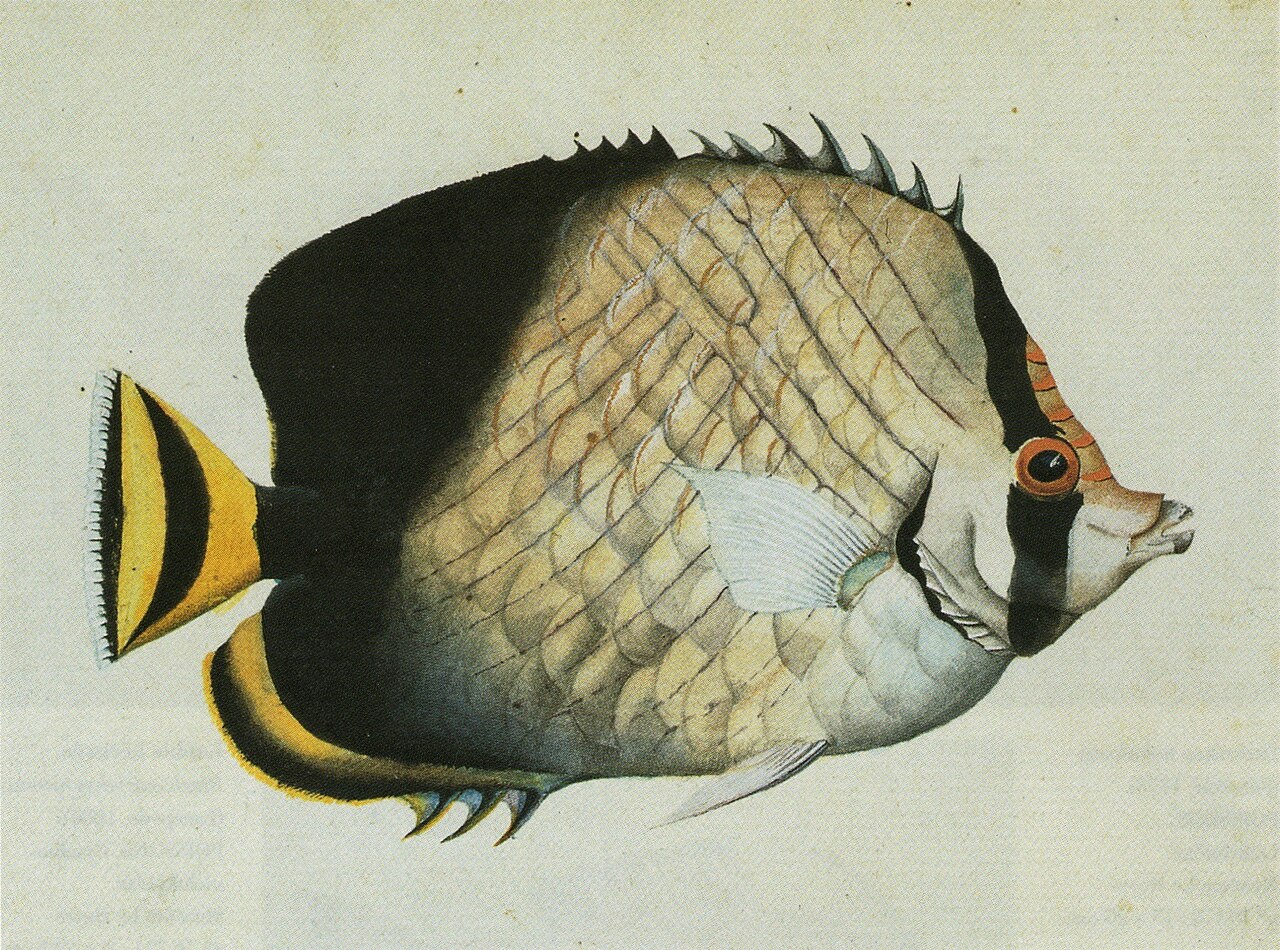
Indian butterflyfish
A deep-water butterflyfish with a scattered Indian Ocean distribution.

Charles Alexandre Lesueur · Public domain
The Indian butterflyfish (Chaetodon mitratus), also called the headband butterflyfish, is a marine ray-finned fish belonging to the family Chaetodontidae. It inhabits the Indian Ocean.
This fish has a yellow body marked by two broad, black diagonal bands across its sides. A black band runs through the eye, fading to orange below it. The pelvic, dorsal, anal, and caudal fins are yellow. The dorsal fin has 8 spines and 18–20 soft rays, while the anal fin has 3 spines and 14–15 soft rays. The maximum standard length reaches 14 cm (5.5 in).
Its distribution across the Indian Ocean is scattered. Recorded locations include the Cocos (Keeling) Islands and Christmas Island (Australia), the Maldives, Mauritius, Réunion, the Amirante Islands and Cosmoledo Island (Seychelles), and the Chagos Archipelago (British Indian Ocean Territory).
A relatively deep-water species, it lives at depths of 22 to 80 m (72–262 ft), most often between 50 and 68 m (164–223 ft). Small groups of up to five individuals are found on steep outer reef drop-offs, in rubble zones, and among black coral and sea fans. It is oviparous and forms pairs to breed. Its diet consists of zooplankton and benthic invertebrates.
The species was first formally described in 1860 by the German-born British zoologist Albert Günther, with the type locality given as Mauritius.
Because it lives in deep water and is rarely collected, the Indian butterflyfish fetches a high price in the aquarium trade.
Quick Facts
- Genus
- Chaetodon
- Parent
- Chaetodon (Rhombochaetodon)
- Species
- mitratus
Facts from the source article.
Lore & Background
The Indian butterflyfish has a yellow body marked with two broad, black oblique bands across the flanks, and a black eye band that shades to orange below the eye. Its pelvic, dorsal, anal, and caudal fins are yellow. The dorsal fin contains 8 spines and 18–20 soft rays, while the anal fin has 3 spines and 14–15 soft rays. This species attains a maximum standard length of 14 centimetres (5.5 in).
It has a scattered distribution across the Indian Ocean, recorded from the Cocos (Keeling) Islands and Christmas Island in Australia, the Maldives Islands, Mauritius, Réunion, the Amirante Islands and Cosmoledo Island in the Seychelles, and the Chagos Archipelago in the British Indian Ocean Territory. It is a relatively deep-water species, living at depths between 22 and 80 metres (72 and 262 ft), commonly at 50 to 68 metres (164 to 223 ft). It has been encountered in small groups of up to 5 individuals on steep outer drop-offs of reefs, in rubble areas, and among areas where black coral and sea fans grow.
The Indian butterflyfish was first formally described in 1860 by the German-born British zoologist Albert Günther, with the type locality given as Mauritius. It is an oviparous species that forms pairs to breed, and feeds on zooplankton and benthic invertebrates.
Reader's Guide
The Indian butterflyfish commands a high price in the aquarium trade because this deep-water species is infrequently collected. Its scattered distribution across the Indian Ocean—from the Cocos (Keeling) Islands and Christmas Island to the Maldives, Mauritius, Réunion, the Seychelles, and the Chagos Archipelago—contributes to its rarity in the trade. The species inhabits relatively deep waters, typically between 50 and 68 metres, on steep outer reef drop-offs, rubble areas, and among black coral and sea fans. It is encountered in small groups of up to five individuals and forms pairs for breeding. Its diet consists of zooplankton and benthic invertebrates. First described in 1860 by Albert Günther from a specimen collected at Mauritius, the Indian butterflyfish remains a sought-after but infrequently available species for marine aquarists.
Did You Know?
- The Indian butterflyfish is also known as the headband butterflyfish.
- This species is found at depths between 22 and 80 metres.
Appearance & Coloration
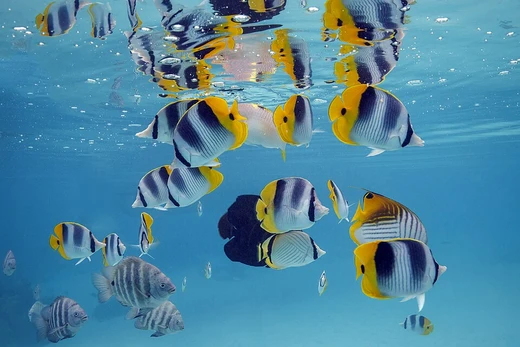
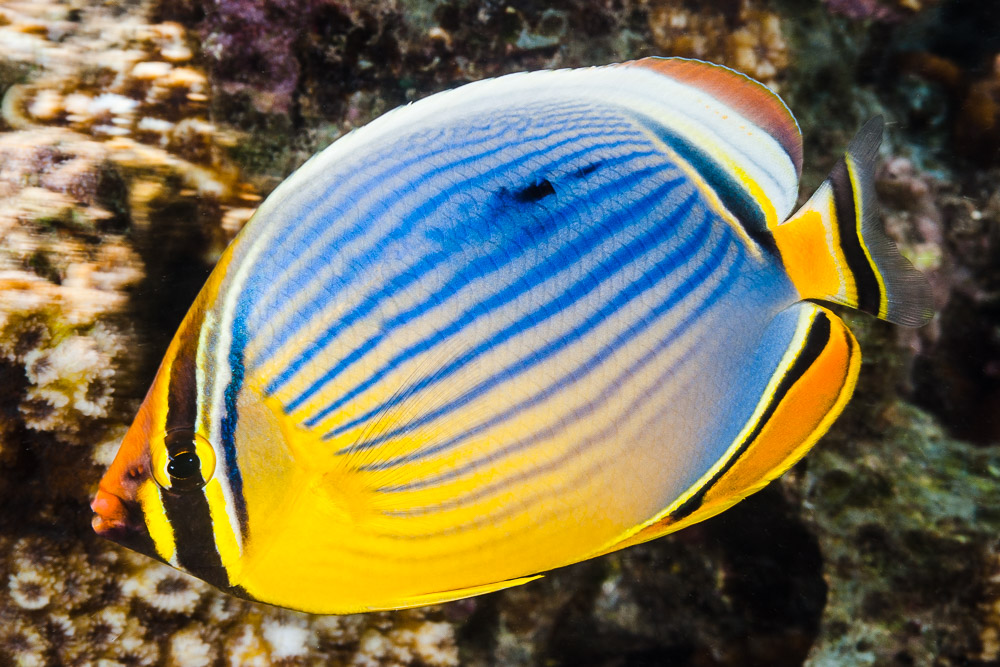
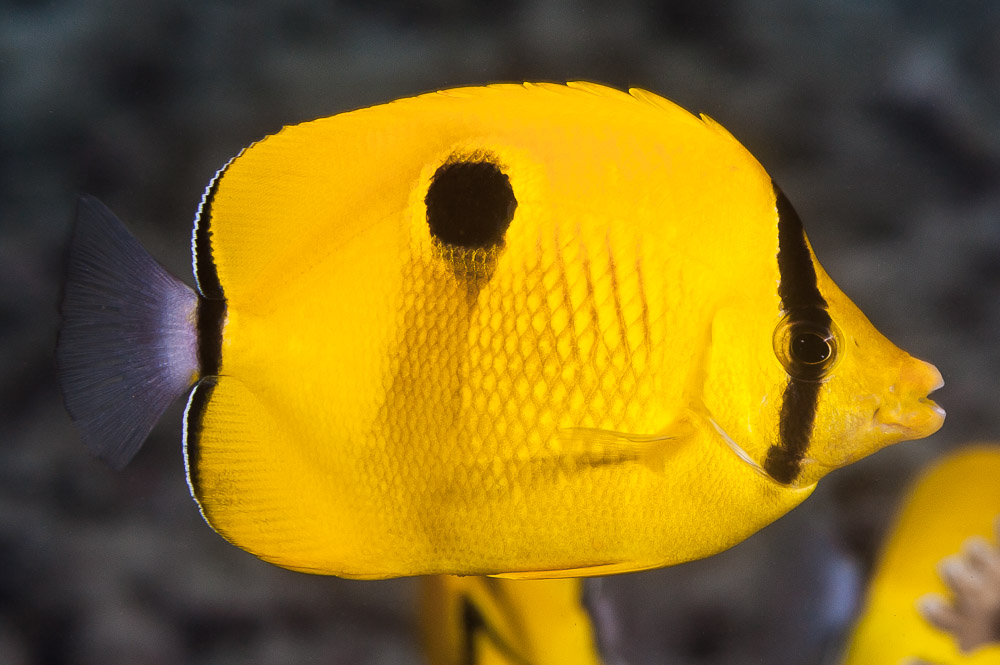
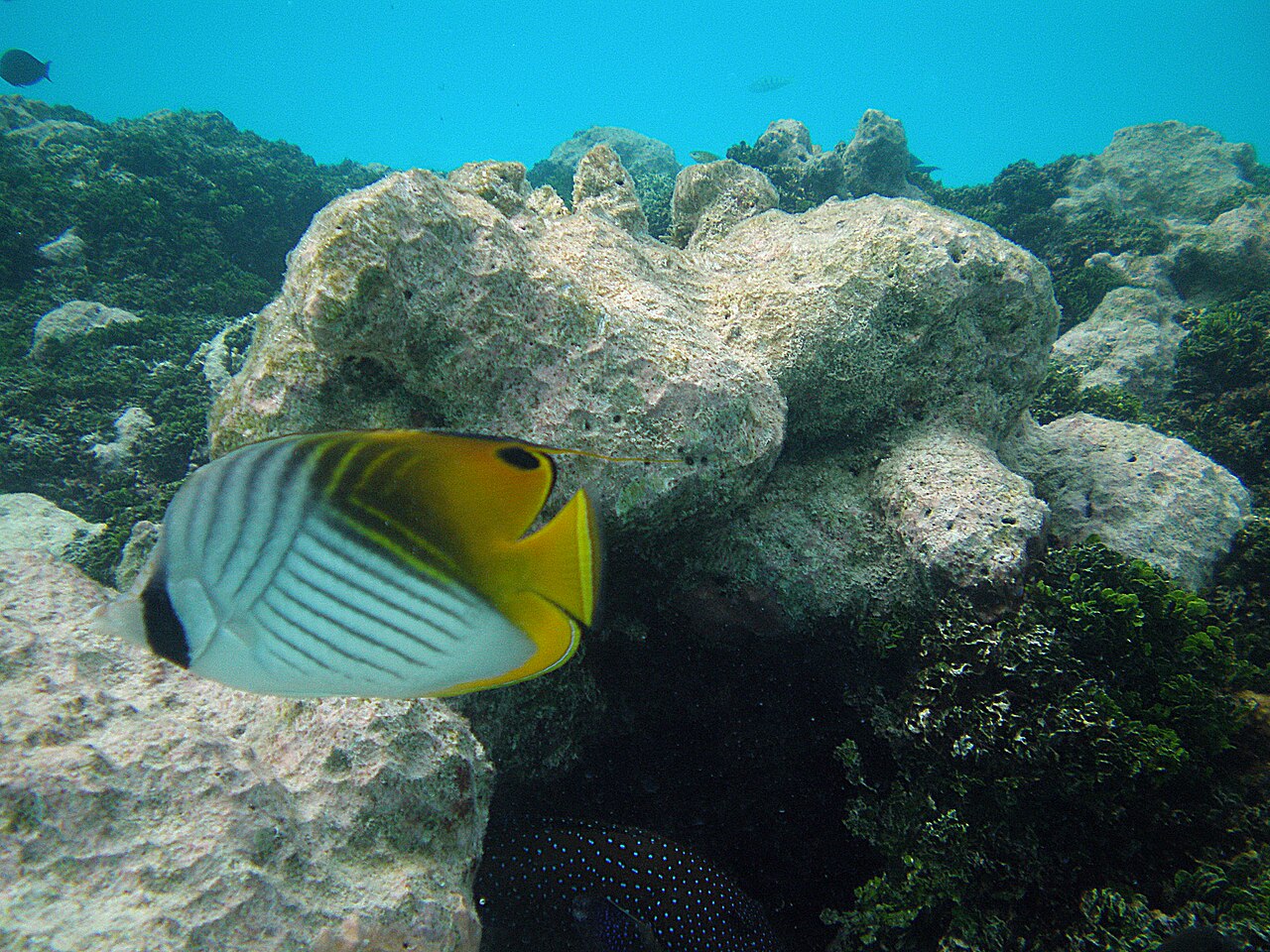
Butterflyfish are among the most visually arresting marine fish, with bodies that evoke the vivid wings of their terrestrial namesakes. Most species measure between 12 and 22 centimeters, though the lined butterflyfish and the saddle butterflyfish (C. ephippium) push the boundary to a remarkable 30 centimeters. Their deep, laterally compressed silhouettes cut through the dense clutter of reef life with ease. Many display bold eyespots on their flanks and dark bands sweeping across their eyes—patterns that mirror the markings found on butterfly wings. The palette spans black, white, blue, red, orange, and yellow, though some species remain comparatively muted. Their dorsal fins are uninterrupted, and their tail fins are either rounded or truncated but never forked. At night, these same fish tuck into reef crevices and shift to markedly different coloration, a transformation that underscores how central visual signaling is to their daily lives. The conspicuous coloration likely serves as a channel for interspecies communication within the reef community.
Ecology & Behavior
Butterflyfish are predominantly diurnal, patrolling waters shallower than 18 meters, though certain species venture as deep as 180 meters. They are notably territorial, and the corallivorous species form tight pairs that stake out a specific coral head as their domain. In contrast, those that feed on zooplankton gather into large groups of their own kind. At nightfall, they retreat into crevices in the reef, where their coloration shifts dramatically. Reproduction follows a pelagic strategy: adults release clouds of buoyant eggs into the open water, where the embryos drift with currents as part of the plankton until they hatch. The resulting fry pass through a distinctive tholichthys stage, during which their bodies are armored with large bony plates extending from the head—a trait shared only by the scats (Scatophagidae). These plates are shed as the fish mature. In the aquarium hobby, their beauty is matched by dietary difficulty; most species rely on coral polyps and sea anemones, so keepers gravitate toward the few generalist or zooplankton-feeding species.
Taxonomy & Classification
The family Chaetodontidae, named by Rafinesque in 1815, encompasses approximately 129 species distributed across 12 genera, with the vast majority inhabiting coral reefs in the Atlantic, Indian, and Pacific Oceans. The family splits into two principal lineages: the typical butterflyfish centered on the enormous genus Chaetodon, and the bannerfish–coralfish group. Eschmeyer's Catalog of Fishes recognizes these as distinct subfamilies—Chaetodontinae and Heniochinae—though the former name is a vestige of an older classification that lumped butterflyfish and angelfish together. Placement within the broader tree of life has been contentious. Because Perciformes proved highly paraphyletic, the family's exact relationships remain poorly resolved. Some authorities have placed Chaetodontidae in an order of its own, Chaetodontiformes, alongside Leiognathidae. Current phylogenetic analyses, however, situate the family within the large and diverse order Acanthuriformes, alongside the angelfish (Pomacanthidae) and the Moorish idol (Zanclidae), all three sharing similar reef habitats.
Evolution & Fossil Record
Tracing the deep history of butterflyfish is complicated by the very environments that shaped them. Because they are restricted to coral reefs, their carcasses are easily scattered by scavengers, overgrown by living corals, or eroded away before they can fossilize. The fossil record is therefore thin and debated. Several Eocene-aged genera, including Pygaeus, have been variously assigned to Chaetodontidae in the past, but these cannot be reliably placed within the family. The earliest confirmed butterflyfish fossils are an indeterminate larval specimen from Frauenweiler, Germany, two tholichthys-stage specimens from the Menilite Formation in Poland, and the extinct species Chaetodon (Blumchaetodon) wattsi from Italy—all dating to the Early Oligocene. Molecular phylogenies corroborate this timeline, suggesting the family arose during the Late Eocene and that most living genera were already distinct by the end of the Paleogene, roughly 23 million years ago. A shared common ancestor with the scats and angelfish is estimated to have lived around 54 million years ago, in the Early Eocene.
Gallery
Frequently Asked Questions
What is the Indian butterflyfish?
The Indian butterflyfish (Chaetodon mitratus), nicknamed the headband butterflyfish, is a marine ray-finned fish in the family Chaetodontidae. It is native to the Indian Ocean and is recognized as a deep-water species with a patchy, scattered range.
What does the Indian butterflyfish look like?
It has a yellow body crossed by two broad black diagonal bands, plus a black stripe through the eye that fades to orange beneath it. All of its fins—pelvic, dorsal, anal, and caudal—are yellow, giving it a striking banded-and-bright appearance.
Where and how deep does the Indian butterflyfish live?
This species occurs at scattered sites throughout the Indian Ocean, generally between 22 and 80 meters, with most sightings around 50 to 68 meters. Its distribution is notably fragmented rather than continuous across the basin.
How big does the Indian butterflyfish get?
It reaches a maximum standard length of 14 centimeters (about 5.5 inches). Its dorsal fin carries 8 spines and 18–20 soft rays, while the anal fin has 3 spines and 14–15 soft rays.
What sets the Indian butterflyfish apart from other butterflyfish?
Unlike many butterflyfish that patrol shallow coral reefs, this one is a deep-water species with a scattered Indian Ocean distribution. The pairing of two wide diagonal black bands with an eye-stripe that fades into orange gives it a distinctive headband-like look that separates it from most Chaetodon relatives.
More in Butterflyfish, Part 2 1-24
Spotted an error? Know more?
Reader corrections go straight into our review queue. Suggest an edit · How this site is sourced