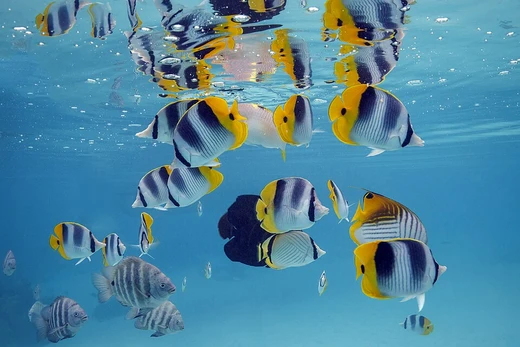
Melon butterflyfish
A coral-feeding butterflyfish of the Indian Ocean.

National Marine Sanctuaries · Public domain
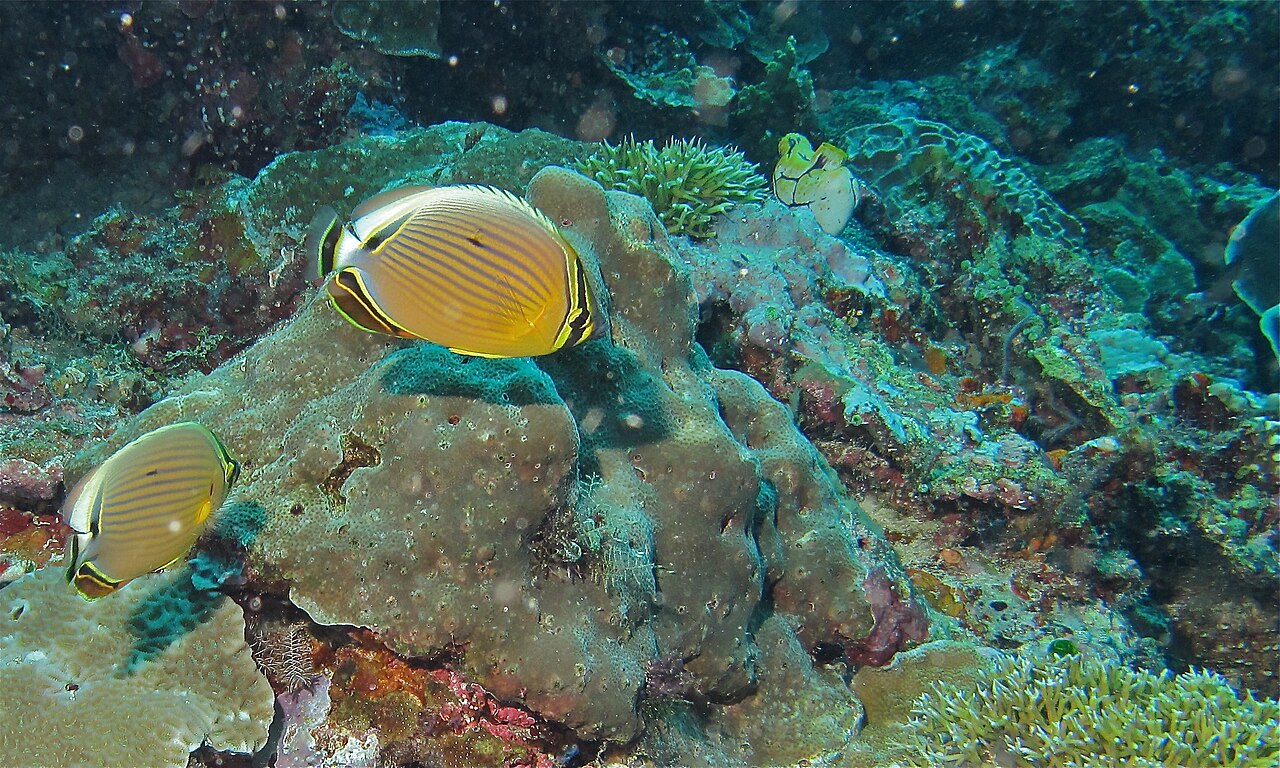
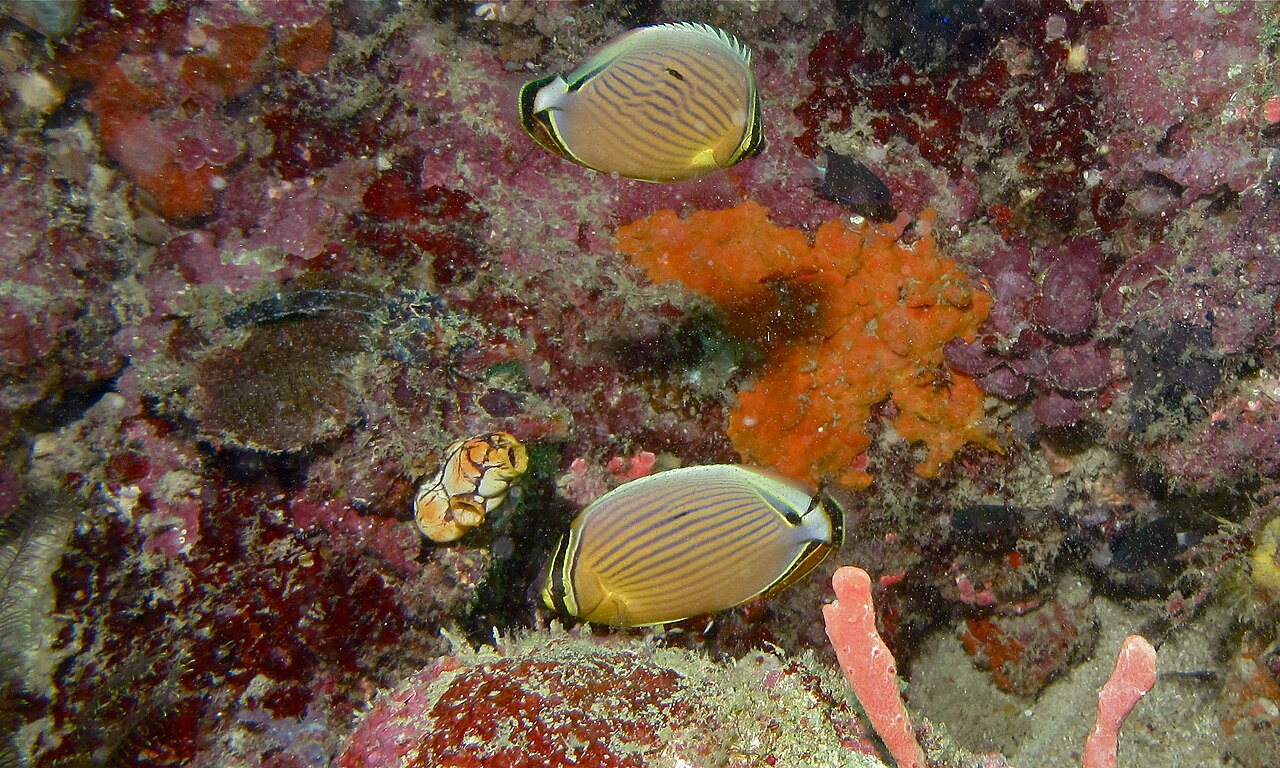
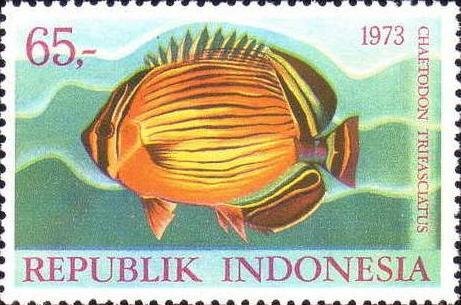
The melon butterflyfish (Chaetodon trifasciatus) is a marine ray-finned fish in the family Chaetodontidae, also called the Indian redfin butterflyfish. It belongs to the subgenus Corallochaetodon, for which it is the type species; this group also includes the blacktail butterflyfish and the oval butterflyfish, as well as the somewhat different Arabian butterflyfish. These species are likely closely related to the subgenus sometimes called "Citharoedus," which includes the scrawled butterflyfish, and both groups might be placed in the genus Megaprotodon if Chaetodon is split.
This fish should not be confused with the chevron butterflyfish, three-striped butterflyfish, or three-banded butterflyfish. In coloration, the oval butterflyfish and blacktail butterflyfish resemble the melon butterflyfish, but the oval has a less noticeable back patch below the dorsal fin and a mostly dark anal fin, while the blacktail has black caudal and anal fins.
The melon butterflyfish lives in the Indian Ocean, from East Africa to western Java, at depths of 2 to 20 meters. It inhabits coral-rich lagoons and semi-protected seaward reefs. Small juveniles are secretive and hide among corals.
Adults grow to a maximum length of 15 centimeters. They are monogamous, swimming in pairs, and can be territorial and aggressive toward other Chaetodon species. Their diet consists exclusively of coral polyps, particularly those of Pocillopora. They are oviparous.
Quick Facts
- Genus
- Chaetodon
- Parent
- Chaetodon (Corallochaetodon)
- Species
- trifasciatus
Facts from the source article.
Lore & Background
The melon butterflyfish is one species of a closely related group that includes the blacktail butterflyfish (C. austriacus) of the Red Sea and Gulf of Aden and the oval butterflyfish (C. lunulatus) of the western Pacific. It should not be confused with the chevron butterflyfish (C. trifascialis), three-striped butterflyfish (C. tricinctus), or three-banded butterflyfish (C. robustus).
In coloration, the oval butterflyfish and blacktail butterflyfish resemble C. trifasciatus. The oval butterflyfish has a less conspicuous back patch below the dorsal fin and a mainly dark anal fin, while the blacktail butterflyfish has black caudal and anal fins. The melon, black-tailed, and oval butterflyfishes, and probably also the somewhat aberrant Arabian butterflyfish (C. melapterus), make up the subgenus Corallochaetodon, of which C. trifasciatus is the type species. They are probably quite close to the subgenus called 'Citharoedus' (a junior homonym of a mollusc genus), which contains for example the scrawled butterflyfish (C. meyeri). Like that group, they might be separated in Megaprotodon if the genus Chaetodon is split up.
Found in coral-rich lagoons and semi-protected seaward reefs at depths between 2 and 20 m, small juveniles are secretive and hide in corals. Adults feed exclusively on coral polyps, particularly of Pocillopora, and are monogamous, swimming in pairs, and may be territorial and aggressive to other Chaetodon.
Reader's Guide
The melon butterflyfish is significant as the type species of the subgenus Corallochaetodon, a grouping that includes the blacktail butterflyfish and oval butterflyfish, and probably the Arabian butterflyfish. This subgenus is considered closely related to the subgenus 'Citharoedus' (a name that is a junior homonym of a mollusc genus), which includes the scrawled butterflyfish. The article notes that if the genus Chaetodon is split up, these groups might be placed in the genus Megaprotodon. This taxonomic context highlights the melon butterflyfish's role in understanding evolutionary relationships among butterflyfishes.
Its ecological role is specialized: it feeds exclusively on coral polyps, particularly those of Pocillopora, making it dependent on healthy coral reefs. The species is found in the Indian Ocean from East Africa to Western Java, inhabiting coral-rich lagoons and semi-protected seaward reefs at depths of 2 to 20 m. Its monogamous pair-bonding and territorial behavior toward other Chaetodon species are notable aspects of its ecology. The article also clarifies that it should not be confused with similarly named species such as the chevron butterflyfish, three-striped butterflyfish, or three-banded butterflyfish, which helps prevent misidentification in scientific and aquarium contexts.
Physical Form and Coloration
The scrawled butterflyfish presents a striking visual profile against the backdrop of tropical reefs. Its body takes on a pale whitish or bluish-white tone, serving as a canvas for a series of bold black markings. These bars run diagonally across the flanks, each one curving gently toward the rear of the fish, giving the pattern a distinctive swept-back appearance. A prominent black bar, bordered in yellow, passes directly through the eye, while a matching bar encircles the snout and mouth region, lending the face a mask-like character. Structurally, the species carries between twelve and thirteen spines alongside twenty-three to twenty-five soft rays in its dorsal fin, while the anal fin holds three spines and eighteen to twenty soft rays. At its largest, an individual reaches a total length of roughly twenty centimetres, or about eight inches, making it a modestly sized member of the butterflyfish family.
Indo-Pacific Reach and Vagrant Records
The scrawled butterflyfish commands one of the broadest distributions among marine butterflyfishes, stretching across the entire Indo-Pacific realm. Along the eastern African coastline, its range begins in the waters off Somalia and extends southward to the shores near Durban. From there, the species spreads eastward through the Indian Ocean and across the Pacific, reaching as far as the remote Line Islands and the Hawaiian archipelago. To the north, populations are documented in the waters surrounding the Ryukyu Islands off southern Japan, while to the south the range encompasses the Great Barrier Reef, New Caledonia, and the Tongan island chain. Remarkably, occasional vagrant individuals have been recorded far outside this core area, turning up in the eastern Pacific at the Galápagos Islands off Ecuador and at the Revillagigedo Islands near Mexico. These isolated sightings underscore just how vast and interconnected the tropical marine environments are, even for a species whose primary habitat spans thousands of kilometres of reef and lagoon.
Reef Life: Social Structure and Feeding
In its native habitats, the scrawled butterflyfish occupies the shallow, sunlit zones of coral-rich environments, typically ranging from just two metres down to about twenty-five metres in depth. It favours clear lagoons and seaward reefs where living coral provides both shelter and sustenance. The social life of this species shifts noticeably with age. Young fish tend to be solitary, weaving through the intricate branches of branching corals where they can hide from predators. As they mature, however, a pair-bonding behaviour emerges: adults generally form lasting pairs and maintain a defined home range within the reef. Reproduction follows this social pattern, with the species laying eggs in pairs. Dietarily, the scrawled butterflyfish is an obligate corallivore, meaning coral is its sole food source. Yet researchers believe it does not consume the coral tissue itself; instead, it feeds on the mucus that the coral produces, a subtle but important distinction in reef ecology.
Naming, Classification, and Taxonomic Neighbours
The formal scientific description of the scrawled butterflyfish dates back to 1801, when two German naturalists, Marcus Elieser Bloch and Johann Gottlob Theaenus Schneider, published their account with the type locality set at Ambon Island in present-day Indonesia. The specific epithet honours an individual whose identity Bloch and Schneider never explicitly stated, though the type specimen resided in Meyer's Museum in Leiden, Netherlands. One plausible candidate is Johan Frederik Meijer, a bookkeeper stationed at Ambon who maintained a modest natural-history collection in the Netherlands during the eighteenth century. Taxonomically, the species sits alongside the mailed butterflyfish and the ornate butterflyfish within a group once called the subgenus Citharoedus, a name that proved invalid because it had already been assigned to a mollusc genus. The scrawled butterflyfish is also considered a close relative of the melon butterflyfish, found in the subgenus Corallochaetodon. Should the large genus Chaetodon ever be subdivided, both groups might be reclassified under the name Megaprotodon.
Gallery
Frequently Asked Questions
What is the melon butterflyfish?
The melon butterflyfish (Chaetodon trifasciatus), also called the Indian redfin butterflyfish, is a small marine ray-finned fish in the butterflyfish family that grows to about 15 cm. It is a dedicated coral feeder native to the Indian Ocean.
What does the melon butterflyfish eat?
This species feeds almost exclusively on coral polyps, showing a strong preference for those of the genus Pocillopora. It is classified as a specialist coral-feeding butterflyfish rather than a generalist.
Where can you find the melon butterflyfish in the wild?
Its natural range stretches across the Indian Ocean from the coast of East Africa to Western Java. It typically occupies shallow waters between roughly 2 and 20 meters depth.
How does the melon butterflyfish behave socially?
It is a monogamous, pair-swimming species that defends its territory aggressively against other Chaetodon. Reproduction is oviparous, with the pair laying free-floating eggs.
What is the melon butterflyfish's taxonomic significance?
It is the type species of the subgenus Corallochaetodon, a small group that also includes the blacktail and oval butterflyfishes. Should Chaetodon be split, this subgenus and the related Citharoedus group may both be moved into the genus Megaprotodon.
More in Butterflyfish, Part 2 1-24
Spotted an error? Know more?
Reader corrections go straight into our review queue. Suggest an edit · How this site is sourced