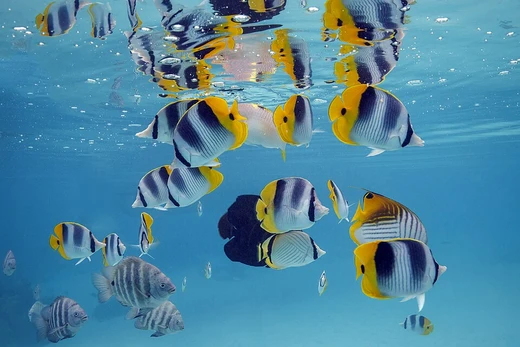
Mailed butterflyfish
A dull-colored corallivore of Pacific reefs, often seen in pairs.

Krinkle · CC BY 4.0
The mailed butterflyfish (Chaetodon reticulatus), also known as the reticulated butterflyfish or black butterflyfish, is a species of marine ray-finned fish in the family Chaetodontidae. It is found on reefs in the central and western Pacific Ocean and occasionally appears in the aquarium trade.
Quick Facts
- Genus
- Chaetodon
- Parent
- Chaetodon (Citharoedus)
- Species
- reticulatus
Facts from the source article.
Lore & Background
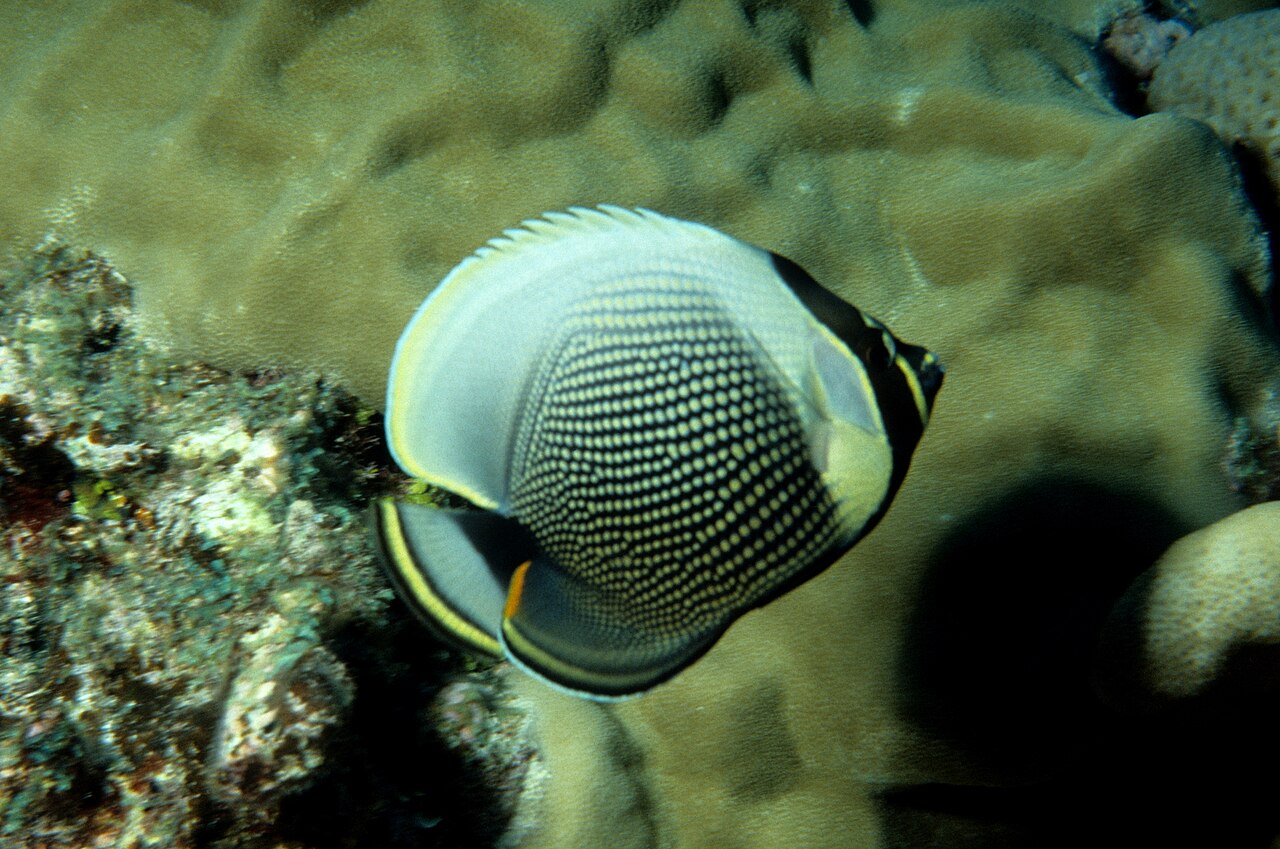
The mailed butterflyfish has a mainly blackish body with light grey centers to the scales and a pale back. It features a broad vertical band with yellow edges through the eye and a broad white vertical band behind that. The dorsal fin is white, the anal fin is white, the caudal peduncle is black, and the caudal fin is whitish blue with a yellow marginal band that has a black submargin. Juveniles have a transparent tail. This species attains a maximum total length of 18 centimeters.
Its distribution spans from Taiwan and the Philippines through Polynesia to Hawaii, the Marquesas Islands, and the Pitcairn Islands, extending north to the Ryukyu Islands and south to New Caledonia. In Australia, it is found on the Great Barrier Reef, with juveniles as far south as the Solitary Islands.
The mailed butterflyfish is relatively common on exposed seaward reefs and also in sheltered lagoon areas with rich coral growth and clear water. Juveniles prefer more protected waters than adults. It is normally encountered in pairs, though schools have been recorded. It is an obligate corallivore that feeds mainly on Acropora corals. This species is oviparous and breeds in monogamous pairs.
Reader's Guide
The mailed butterflyfish is notable for its specialized diet as an obligate corallivore, feeding mainly on Acropora corals. This dietary specificity makes it challenging to keep in captivity, as captive specimens frequently starve to death despite its occasional appearance in the aquarium trade. The species is a close relative of the ornate butterflyfish (C. ornatissimus) and the scrawled butterflyfish (C. meyeri), together forming the subgenus 'Citharoedus' (an invalid name due to prior use for a mollusc genus). They are probably close to the subgenus Corallochaetodon, which contains the Melon Butterflyfish (C. trifasciatus). If the genus Chaetodon is split up, these might be separated into Megaprotodon. The mailed butterflyfish was first formally described in 1831 by French anatomist Georges Cuvier, with the type locality given as Tahiti. Its presence across a wide Pacific range, from Taiwan to the Pitcairn Islands, and its occurrence on the Great Barrier Reef, underscore its ecological role in coral reef systems. The species' monogamous breeding and preference for clear, coral-rich waters further highlight its dependence on healthy reef environments.
Distinctive Markings and Body Structure
The scrawled butterflyfish presents a striking visual profile against the backdrop of tropical reefs. Its body takes on a pale whitish or bluish-white tone, across which a series of curved and diagonal black bars are painted along the flanks. What makes these markings distinctive is their direction of curvature, which bends toward the rear of the fish. A bold black bar, trimmed with a thin yellow edge, sweeps through the eye, while a matching bar encircles the snout and mouth region. In terms of fin structure, the dorsal fin carries between twelve and thirteen spines alongside twenty-three to twenty-five soft rays, and the anal fin features three spines paired with eighteen to twenty soft rays. The species reaches a maximum total length of roughly twenty centimetres, or about seven and a half inches, placing it among the moderate-sized members of the butterflyfish family. As a ray-finned marine species within the family Chaetodontidae, it shares the broad body plan and vivid patterning that characterise this well-known group of reef fish.
Vast Indo-Pacific Range
The scrawled butterflyfish enjoys one of the broadest distributions among its reef-dwelling relatives, spanning the full expanse of the Indo-Pacific region. Along the eastern African coastline, its range stretches from the waters off Somalia all the way south to Durban. From there, the species extends eastward across both the Indian and Pacific Oceans, reaching as far as the Line Islands and the Hawaiian archipelago. To the north, populations have been recorded as far as the Ryukyu Islands off the coast of Japan, while to the south the range encompasses the Great Barrier Reef, the waters around New Caledonia, and the Tongan archipelago. Remarkably, occasional vagrant individuals have turned up well outside this core range, with records from the Galapagos Islands off Ecuador in the eastern Pacific and from the Revillagigedo Islands near Mexico. These isolated sightings suggest that, while firmly an Indo-Pacific species, the scrawled butterflyfish occasionally appears in distant waters, perhaps swept along by ocean currents or carrying out brief forays beyond its established territory.
Coral-Dwelling Lifestyle and Feeding
In its natural habitat, the scrawled butterflyfish occupies a narrow band of depth, typically between two and twenty-five metres below the surface. It favours areas where coral is abundant, settling into clear lagoons as well as seaward reef slopes. The social structure of this species shifts noticeably with age. Young fish tend to be solitary, weaving through the intricate branches of coral formations where they find shelter. As they mature, however, the behavioural pattern changes: adults typically form pairs and establish a defined home range within the reef. Reproduction follows this paired structure, with the species being oviparous and breeding as a couple. Perhaps the most ecologically notable aspect of the scrawled butterflyfish is its strict dietary specialisation. It is an obligate corallivore, meaning coral is its sole food source. Yet research suggests it does not consume the living coral tissue itself; instead, it feeds on the mucus that the coral produces. This subtle distinction places the fish in a delicate relationship with its host organism, drawing nutrition without directly destroying the polyps.
Taxonomic Origins and Classification
The formal scientific description of the scrawled butterflyfish dates back to 1801, when the German naturalists Marcus Elieser Bloch and Johann Gottlob Theaenus Schneider published their account. They designated Ambon Island in present-day Indonesia as the type locality. The specific epithet honours an individual whose identity Bloch and Schneider did not explicitly name, but the type specimen was housed in the Museo Meyeri Lugduni Batavorum, commonly known as Meyer's Museum in Leiden, Netherlands. The person in question may have been Johan Frederik Meijer, a bookkeeper stationed at Ambon who maintained a modest natural-history collection in the Netherlands during the eighteenth century. In modern taxonomy, the scrawled butterflyfish is grouped as a close relative of both the mailed butterflyfish and the ornate butterflyfish. Together, these three species were once placed in a subgenus called Citharoedus, though that name is not valid because it had already been assigned to a mollusc genus. They are also thought to be near the subgenus Corallochaetodon, which includes the melon butterflyfish. Should the large genus Chaetodon ever be split, these species might be reassigned to a group called Megaprotodon.
Gallery
Frequently Asked Questions
Who is Mailed butterflyfish?
The mailed butterflyfish (Chaetodon reticulatus), sometimes called the reticulated or black butterflyfish, is a small reef-dwelling member of the family Chaetodontidae. It is native to coral reefs throughout the central and western Pacific Ocean.
What is Mailed butterflyfish's role in the reef?
This species is a dedicated corallivore, feeding on coral polyps as its primary food source. It is most often encountered in pairs, foraging side by side along the reef face.
How big does Mailed butterflyfish get and where does it live?
It tops out at roughly 18 centimetres (about 7 inches) in total length and occupies a depth band from just 1 metre down to around 30 metres. Its muted, dull coloration helps it stay low-key against the reef backdrop.
What are Mailed butterflyfish's fin counts?
The dorsal fin carries 12 to 13 spines followed by 23–29 soft rays, while the anal fin has 3 spines backed by 20–22 soft rays. These counts are a key way to separate it from look-alike species in the same family.
Why do hobbyists care about Mailed butterflyfish?
Although it is a fairly plain-looking fish, it does occasionally turn up in the aquarium trade, giving reef-keeping enthusiasts a chance to keep a genuine Pacific corallivore. Its pair-bonding behavior also makes it a small but interesting subject for observation.
More in Butterflyfish, Part 2 1-24
Spotted an error? Know more?
Reader corrections go straight into our review queue. Suggest an edit · How this site is sourced