Mirror butterflyfish
A solitary Indo-Pacific butterflyfish with a distinctive black blotch.

Rickard Zerpe · CC BY 2.0
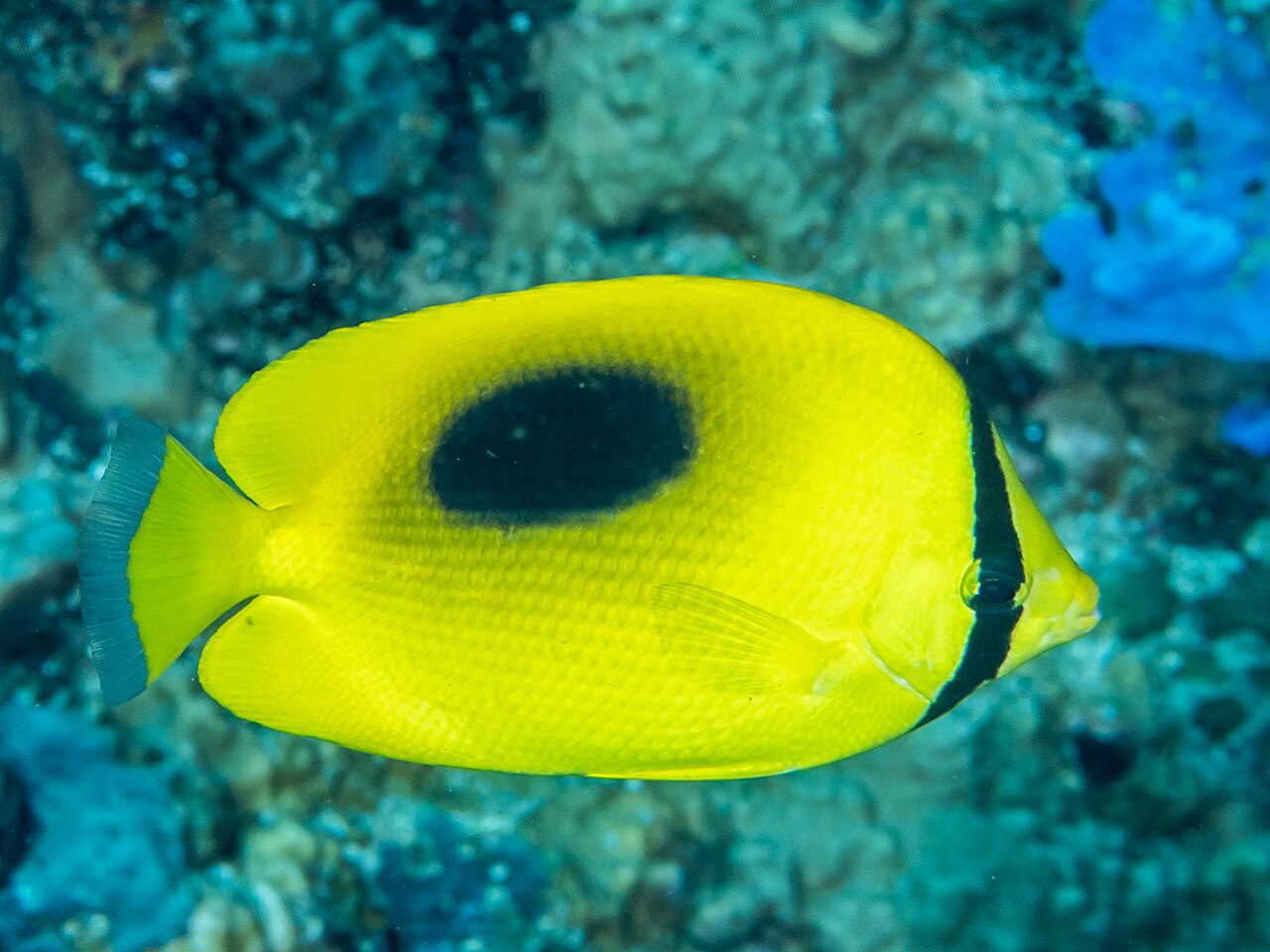
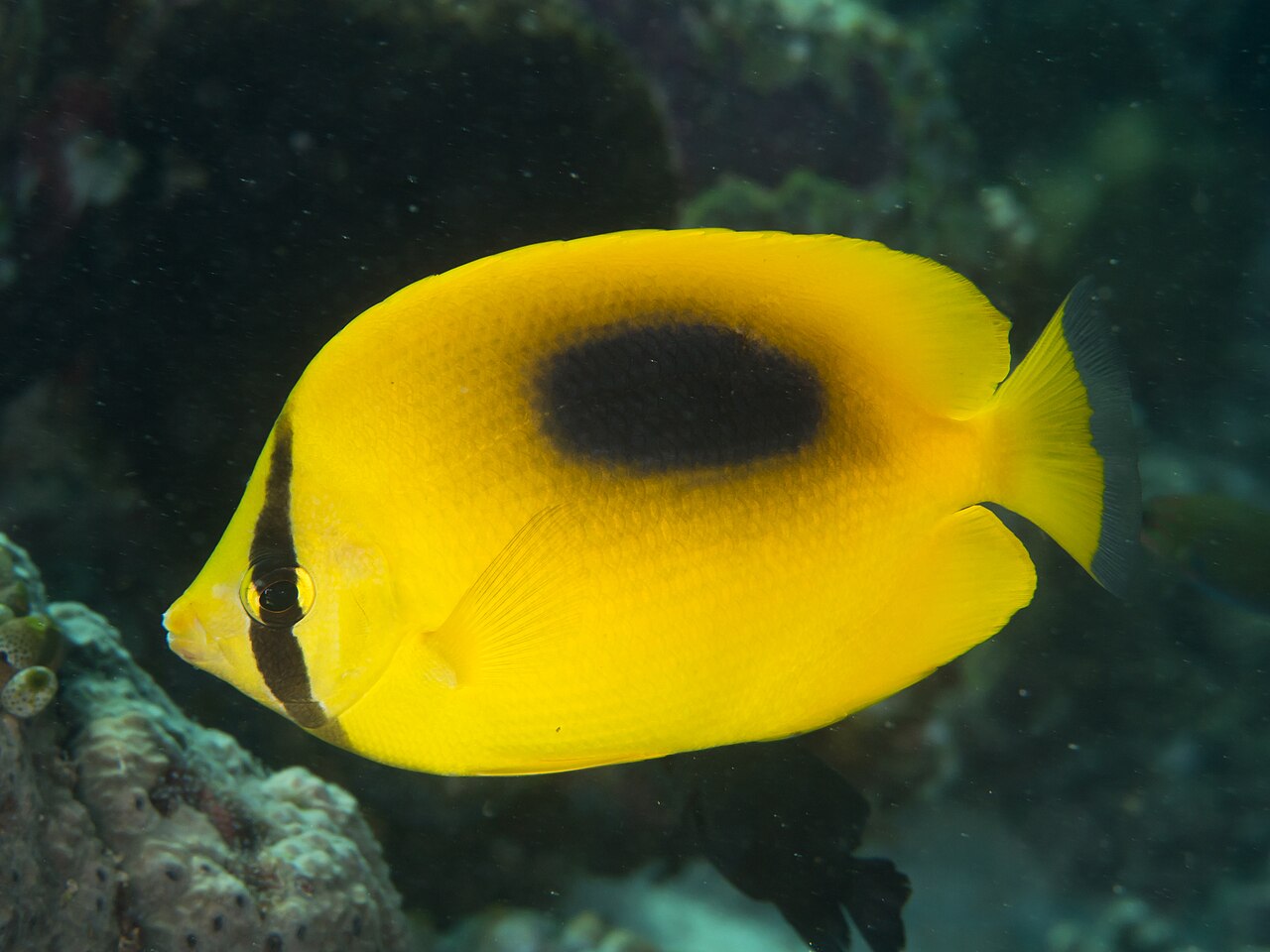
The mirror butterflyfish, also known as the oval-spot butterflyfish (Chaetodon speculum), belongs to the family Chaetodontidae. Its range spans the Indo-Pacific, from Indonesia and Japan south to the Great Barrier Reef and Papua New Guinea, with additional reports from Madagascar, Mauritius, and Réunion. This species reaches a maximum length of 18 cm (7 in). Its dorsal fin contains 14 spines and 17–18 soft rays, while the anal fin has 3 spines and 15–16 soft rays. The body is bright to orange-yellow, marked by a large black blotch beneath the dorsal fin and a vertical black bar crossing the eye. French anatomist Georges Cuvier first formally described it in 1831, citing Jakarta as the type locality. Among butterflyfishes with angular yellow bodies, black eyestripes, and a single differently-colored patch, it is placed in the subgenus Tetrachaetodon (the Blue-lashed Butterflyfish, C. bennetti, is a notable exception). Within this group, it appears most closely related to the Zanzibar butterflyfish (Chaetodon zanzibarensis), which has a smaller black blotch and faint horizontal stripes on its flanks. If the genus Chaetodon were split, Tetrachaetodon would be reassigned to Megaprotodon. The mirror butterflyfish inhabits coral reefs at depths of 3 to 30 m, favoring coastal reef slopes rich in hydroids and sea anemones. Small juveniles hide among coral thickets. Typically solitary and relatively uncommon, it feeds on coral polyps and invertebrates.
Quick Facts
- Genus
- Chaetodon
- Parent
- Chaetodon (Tetrachaetodon)
- Species
- speculum
Facts from the source article.
Lore & Background
The mirror butterflyfish was first formally described in 1831 by the French anatomist Georges Cuvier, with the type locality given as Jakarta. It is found in the Indo-Pacific region from Indonesia to Japan and south to the Great Barrier Reef and Papua New Guinea, and has also been reported from Madagascar, Mauritius and Réunion. The species grows to a maximum of 18 cm in length, with 14 spines and 17-18 soft rays in the dorsal fin and 3 spines and 15-16 soft rays in the anal fin. Its body color is a bright to orange-yellow with a big black blotch below the dorsal fin and a vertical black bar running through the eye.
Like other butterflyfishes with angular yellow bodies, black eyestripes, and a single differently-colored patch (except in the quite basal Blue-lashed Butterflyfish, C. bennetti), it belongs in the subgenus Tetrachaetodon. Among this group it seems to be particularly close to the Zanzibar butterflyfish (Chaetodon zanzibarensis), which has a smaller black blotch and traces of horizontal stripes on the flanks. If Chaetodon is split up, the subgenus Tetrachaetodon would be placed in Megaprotodon.
The mirror butterflyfish is found in coral reefs at depths between 3 and 30 m. It favors coastal reef slopes rich in hydroids and sea anemones. Small juveniles hide in coral thickets. Usually, this species is solitary and relatively uncommon. They feed on coral polyps and invertebrates.
Reader's Guide
The mirror butterflyfish is significant as a representative of the subgenus Tetrachaetodon within the butterflyfish family, illustrating the taxonomic relationships among species with angular yellow bodies and a single differently-colored patch. Its close relation to the Zanzibar butterflyfish (Chaetodon zanzibarensis) is noted, with the latter having a smaller black blotch and traces of horizontal stripes. The species' description by Georges Cuvier in 1831, with type locality Jakarta, provides historical context for its scientific naming. Ecologically, it is found in Indo-Pacific coral reefs at depths of 3 to 30 m, favoring coastal reef slopes rich in hydroids and sea anemones. Its solitary and relatively uncommon nature, along with its diet of coral polyps and invertebrates, contributes to understanding reef community dynamics. The species' reported presence from Indonesia to Japan, the Great Barrier Reef, Papua New Guinea, and also Madagascar, Mauritius and Réunion indicates a broad but patchy distribution. The potential placement of Tetrachaetodon in Megaprotodon if Chaetodon is split up reflects ongoing taxonomic considerations in butterflyfish classification.
Did You Know?
- The mirror butterflyfish grows to a maximum of 18 cm (7 in) in length.
- It was first formally described in 1831 by French anatomist Georges Cuvier.
- It is usually solitary and relatively uncommon.
Taxonomic Framework and Classification
Butterflyfishes belong to a vast lineage of vertebrate animals known as Osteichthyes, a term drawn from Ancient Greek words meaning 'bone' and 'fish.' These bony fishes are defined by endoskeletons built primarily from bone tissue, distinguishing them from cartilaginous fish such as sharks and rays, as well as from extinct groups like placoderms and acanthodians. Within this enormous clade—which encompasses 45 orders, more than 435 families, and roughly 28,000 species—butterflyfishes fall under the gigaclass Actinopterygii, the ray-finned fishes, and more specifically within the class Teleostei. Their family, Chaetodontidae, sits alongside other well-known reef families such as surgeonfishes (Acanthuridae) and the solitary boarfish family (Antigoniidae). The broader context matters: Osteichthyes, in a cladistic sense, actually includes all tetrapods, meaning the bony-fish lineage is the same one that gave rise to mammals, reptiles, and birds. Understanding this deep evolutionary placement helps frame why butterflyfishes share so many structural and developmental features with land vertebrates.
Distribution Along the South African Coast
The waters bordering the Republic of South Africa host a remarkable array of butterflyfish species, each with a documented range mapping onto specific coastal localities. Some species, like the threadfin butterflyfish, extend their tropical Indo-Pacific range as far south as Mossel Bay, while others, such as the pearly butterflyfish, are recorded as far south as Port Elizabeth. The doublesash butterflyfish stands out as an endemic, with its known range stretching from Lamberts Bay to Maputo. Other species show more restricted southern limits: the limespot butterflyfish reaches Port Alfred, the brownburnie is found south to the Bashee River, and several others, including the gorgeous gussie and the vagabond butterflyfish, are recorded as far south as Durban. It is important to note that the ranges listed in regional references may not represent the full global distribution of each species; rather, they capture the extent of confirmed records within South African waters. This geographic mosaic—from the western Indian Ocean to the eastern Pacific—highlights the extraordinary connectivity of Indo-Pacific reef systems.
The Reference List and Taxonomic Standards
The documentation of butterflyfishes in South African waters is governed by a carefully structured reference list serving as a regional catalogue of bony fishes. This list provides locally used common names alongside scientific names complete with author citations and the year of original description. Taxonomic ordering and classification follow, wherever possible, the current usage maintained by the World Register of Marine Species, which means the arrangement may differ from the original cited sources. Those citations are included primarily to support claims about a species' range or the existence of records within the region, rather than to establish taxonomy itself. Sub-taxa within any given taxon are generally arranged alphabetically, and synonyms are listed where they are relevant to identification. The list is specifically a sublist of the broader catalogue of marine bony fishes recorded from the oceans surrounding South Africa, meaning it captures only those species with confirmed presence in these waters. This methodological rigor ensures that researchers, anglers, and conservationists can rely on consistent nomenclature when discussing the region's reef biodiversity.
Diversity Within the Chaetodontidae Family
The Chaetodontidae family, commonly known as butterflyfishes, displays striking diversity in the South African context, with numerous species recorded across the coast. The family includes members of multiple genera: the well-represented Chaetodon, the yellow longnose butterflyfish (Forcipiger flavissimus), and the brushtooth butterflyfish (Hemitaurichthys zoster). Author citations span nearly two centuries, from Linnaeus's 1758 description of the vagabond butterflyfish to Ahl's 1923 identification of the blackedged butterflyfish, reflecting the long history of taxonomic work in this group. Common names add a layer of local identity—species are known as the raccoon butterflyfish, the maypole butterflyfish, the purple butterflyfish, or the yellowhead butterflyfish, among others. Some entries carry multiple synonyms, such as the gorgeous gussie also being called the peppered butterflyfish, or the limespot butterflyfish also known as the teardrop butterflyfish. This richness of nomenclature, combined with the variety of genera and the breadth of recorded ranges, underscores that the Chaetodontidae represent one of the most visually and taxonomically rich families in South African reef ecosystems.
Gallery
Frequently Asked Questions
What is the Mirror butterflyfish?
The Mirror butterflyfish (Chaetodon speculum), sometimes called the oval-spot butterflyfish, is a solitary reef fish in the family Chaetodontidae. It is instantly recognizable by its bright orange-yellow body marked with a large black blotch under the dorsal fin and a vertical black bar through the eye.
Where does the Mirror butterflyfish live?
This species is found across the Indo-Pacific, ranging from Indonesia and Japan down to the Great Barrier Reef and Papua New Guinea, with scattered reports from Madagascar, Mauritius, and Réunion. It typically inhabits coral reef environments between roughly 3 and 30 meters depth.
How big does a Mirror butterflyfish get?
Adults reach a maximum total length of about 18 cm (7 in), making it a mid-sized member of the butterflyfish family. Its body is laterally compressed, typical of the Chaetodontidae.
What are the fin characteristics of the Mirror butterflyfish?
The dorsal fin carries 14 spines followed by 17 to 18 soft rays, while the anal fin has 3 spines and 15 to 16 soft rays. These counts help distinguish it from similar-looking Indo-Pacific butterflyfish species.
Who first described the Mirror butterflyfish and where was the type specimen collected?
French naturalist Georges Cuvier formally described the species in 1831. The type locality is Jakarta, anchoring its original scientific record to the waters of the Indonesian archipelago.
More in Butterflyfish, Part 2 1-24
Spotted an error? Know more?
Reader corrections go straight into our review queue. Suggest an edit · How this site is sourced